

‘The company that got away’
Saab alive and well, boss stresses
Advertisement
Read this article for free:
or
Already have an account? Log in here »
To continue reading, please subscribe:
Monthly Digital Subscription
$0 for the first 4 weeks*
- Enjoy unlimited reading on winnipegfreepress.com
- Read the E-Edition, our digital replica newspaper
- Access News Break, our award-winning app
- Play interactive puzzles
*No charge for 4 weeks then price increases to the regular rate of $19.00 plus GST every four weeks. Offer available to new and qualified returning subscribers only. Cancel any time.
Monthly Digital Subscription
$4.75/week*
- Enjoy unlimited reading on winnipegfreepress.com
- Read the E-Edition, our digital replica newspaper
- Access News Break, our award-winning app
- Play interactive puzzles
*Billed as $19 plus GST every four weeks. Cancel any time.
To continue reading, please subscribe:
Add Free Press access to your Brandon Sun subscription for only an additional
$1 for the first 4 weeks*
*Your next subscription payment will increase by $1.00 and you will be charged $16.99 plus GST for four weeks. After four weeks, your payment will increase to $23.99 plus GST every four weeks.
Read unlimited articles for free today:
or
Already have an account? Log in here »
Hey there, time traveller!
This article was published 18/03/2011 (5387 days ago), so information in it may no longer be current.
DETROIT –Saab boss Victor Muller says his biggest challenge since taking over the company from General Motors is convincing the world this iconic Swedish brand is still alive.
“Saab didn’t die with Saturn, Pontiac and Hummer,” he said at the Detroit auto show. “Rather, we like to think of it as the company that got away.”
Still, it has been an uphill struggle for Muller and his company Spyker Cars, a Netherlands-based firm that builds handcrafted, premium-priced exotic supercars. When the Spyker bid for Saab was accepted in February 2010, there was little more than a brand name exchanged — the factory was empty, the workers were gone and the flow of parts from suppliers had dried up.
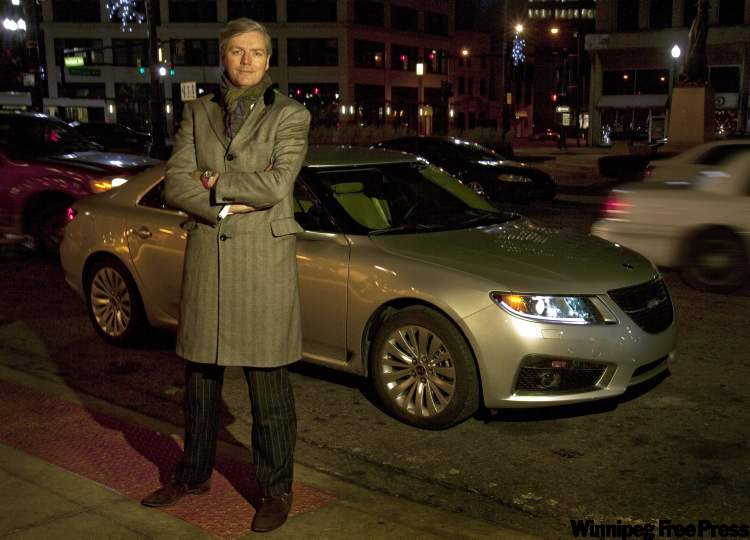
Muller said GM had “emptied the pipeline” before shuttering the Swedish production facility. In North America, there were perhaps a few hundred new cars scattered around the countryside, when 5,000 or 6,000 had been the norm.
Muller says Saab is still fighting a lack of sufficient product in the supply line to its dealers, but production is once again humming. Initially, it was difficult convincing suppliers that Saab’s revival was real, but proving he had a fully funded business plan helped regain their interest.
The turning point was when BMW agreed to supply Saab with engines and other powertrain components, Muller said. Production is on schedule to build about 80,000 cars this year, with a target of 120,000 set for 2012. There’s a full line of all-new products in the Saab lineup — the new 9-5 sedan and the 9-4x crossover, which makes its debut in April.
The climax of the brand’s renaissance will be the introduction in October of 2012 of a completely new 9-3. This model, with front-wheel drive plus a pair of electric motors to drive the rear wheels, will be the first to be designed totally by Muller’s team. The brand’s enthusiasts “will immediately recognize it as a Saab,” Muller said.
Those enthusiasts are the people Saab is targeting. “Saab owners are the most loyal buyers in the world,” Muller said. They were turned off by GM, which didn’t understand the brand or its customers, and they’ve been waiting for someone to restore Saab to its former roots, he said. There’s been a resurgence of sales in Sweden, which Muller said was especially encouraging since media coverage of Saab’s demise had been so intense, Swedes were turned against the brand.
In the United States, Saab sold 11,000 cars in the last quarter of 2010.
Muller said the company is launching a marketing campaign to get out the message “that Saab is alive and kicking,” including a major TV initiative that begins next month.
In Canada, 13 dealers — all former Saab stores under the GM reign — have formed a national network. Parts and service depots were established in August and 2011 models are now starting to roll into Canadian showrooms.
John Anderson, executive director of sales in North America, hopes to grow the dealer network to about 25 stores and sell about 2,500 cars this year.

It’s working on establishing a leasing program — a key element for achieving sales success in the premium segment.
Muller is convinced the addition of an entry-level model — a 9-2 — would sell well. It would get buyers into the brand, much like Audi and BMW are doing with their new entry-level models, he said, and once those buyers are hooked on the brand, they’ll stay loyal to it for life.
The other dream is to build a small two-seater sports car, a fresh iteration of the Sonnett, which Saab built from 1966 to 1974. Both projects, however, would require the development of a new platform. While scalable to suit several other applications, the new Phoenix platform that will form the foundation for the 2012 9-3 is not suitable for such smaller models.
For now, however, those are just dreams. Muller is focused on reality — pumping new life into the iconic Swedish brand.
— Postmedia News