Recession-proof
Dodge sedan popular in 1938 -- and now
Advertisement
Read this article for free:
or
Already have an account? Log in here »
To continue reading, please subscribe:

Digital Subscription
One year of digital access for only $205*
- Enjoy unlimited reading on winnipegfreepress.com
- Read the E-Edition, our digital replica newspaper
- Access News Break, our award-winning app
- Play interactive puzzles
*First annual payment billed as $205.00 + GST for one year. This annual subscription will automatically renew at $233.00 + GST every 52 weeks (10% off the regular annual price of $259.35). Offer available to new and qualified returning subscribers only. Cancel any time.
To continue reading, please subscribe:
Add Free Press access to your Brandon Sun subscription for only an additional
$1 for the first 4 weeks*
- Enjoy unlimited reading on winnipegfreepress.com
- Read the E-Edition, our digital replica newspaper
- Access News Break, our award-winning app
- Play interactive puzzles
*Your next Brandon Sun subscription payment will increase by $1.00 and you will be charged $17.95 plus GST for four weeks. After four weeks, your payment will increase to $24.95 plus GST every four weeks.
Read unlimited articles for free today:
or
Already have an account? Log in here »
Hey there, time traveller!
This article was published 20/01/2012 (5360 days ago), so information in it may no longer be current.
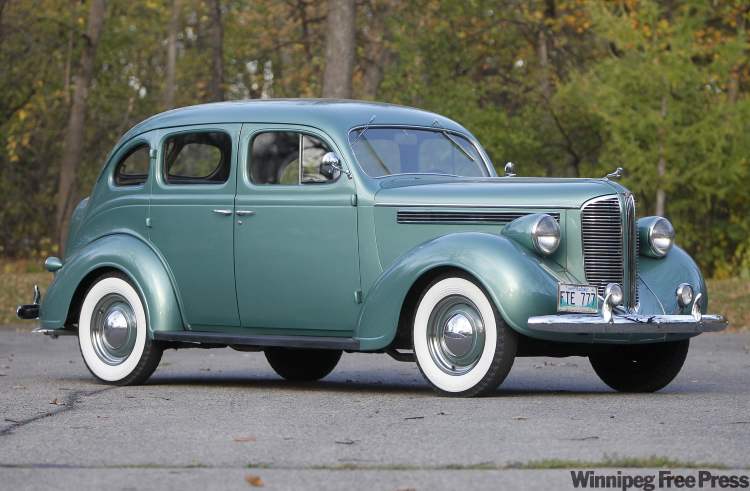
In 1938, the Dodge lineup received just a modest facelift over the 1937 models.
A new, cleaner-looking grille was added, and the headlamps were now mounted on top of the fenders instead of the radiator shell. Other features included all-steel “Silent-Safety” body construction with insulated roof, fenders and cowl, as well as an adjustable front seat with a lever at the driver’s left hand.
In Canada, our Dodge was a bit different and tailored to our market to compete with other vehicles in the lower-priced field. Based on the Plymouth with its 112-inch wheelbase, it was three inches shorter than the American version yet utilized the front sheetmetal of the American Dodge. Built in Windsor, Ont., a favourite for 1938 was the Dodge D10 Deluxe Six Four Door Touring Sedan.

A 1938 Dodge Deluxe touring sedan first caught Winnipeg’s Paul Horch’s eye in the early 1970s. An original Winnipeg car sold new by Breen Motors on Main Street for about $1,100, it went to its first owner in rural Manitoba. Never winter-driven, it didn’t even have a heater, and few miles were put on it. It was later purchased by Abe Allen who kept it until the early 1970s when he sold it to Jim Pearn.
“I told Pearn that if he ever wanted to sell the car I was definitely interested,” Horch said.
The Dodge came factory equipped with an oil filter, six-volt electrical system and front ride stabilizer bar as well as several optional extras, many that we take for granted in vehicles today. These included a passenger-side windshield wiper and rear tail light, fog lamps and dual side-view mirrors.
When Horch finally got the call in September 2010 that the car was available, he wasted no time picking it up and getting started on a restoration. With only 64,500 original miles on the odometer, the Dodge was in exceptional condition for a 72-year-old vehicle.
Powered by a 201.3-cubic-inch L-Head six-cylinder engine it produced 82 horsepower at 3,600 r.p.m. and supplied it to a 4.10:1 ratio rear axle via a “Synchro-Silent” three-speed manual transmission. The Chestnut brown woven wool cloth interior upholstery only required a basic cleaning, and all of the glass was also in excellent condition.

But the brakes needed work, so Horch turned to Norm Dumontier at Mid Canada Suspension to supply new hydraulic components and brake shoes. A new fuel pump and a radiator flush was about all that was needed under the hood, and new u-joints were installed on the driveshaft.
For tires, Horch chose a new set of 6.00-by-16-inch Goodyear wide whitewall radial tires supplied by Jim Benjaminson at Kelsey Tires in Walhalla, N.D. Dressed with the factory centre cap and chrome beauty trim rings, they give the car some real curb appeal.

Horch entrusted Erwin Rempel to completely strip the car to bare metal and prepare it for paint. Imperial Paint matched the original Chillon Green Poly colour, and re-plating the front and rear bumpers was done at North Star/Fairmont Plating. The rest of the chrome and trim on the car is original from 1938.
Buckeye Rubber Parts in Ohio supplied the new 16-gauge steel running boards and rubber covering, while Phil Hoffer at Phil’s Auto Parts came up with dozens of other small and hard-to-find parts. Horch and Rempel painstakingly completed the final assembly after paint, a difficult task to accomplish without scratching anything in the process.
Horch managed to put a few miles on the Dodge after it was completed last September before putting it into winter storage.
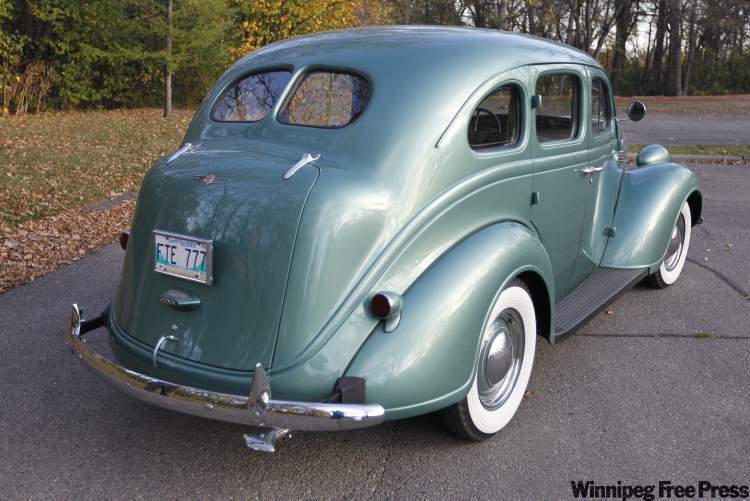
“It’s a real tight car to drive and it runs like a top,” he said, adding that, with a 13.5-Imperial gallon (61-litre) fuel tank, the 3,005-pound Dodge averages about 300 miles to a tank.
Solidly built and with plenty of room, the late-’30s Dodge is a great example of what car-owners looked for in the day. Although 1938 was a recession year, Dodge placed fifth in automobile production and still managed to produce 114,529 vehicles, of which over 10,000 were assembled in Canada.