

2012 CHEVROLET VOLT: Reliable range
Volt cures distance anxiety
Advertisement
Read this article for free:
or
Already have an account? Log in here »
To continue reading, please subscribe:
Monthly Digital Subscription
$1 per week for 24 weeks*
- Enjoy unlimited reading on winnipegfreepress.com
- Read the E-Edition, our digital replica newspaper
- Access News Break, our award-winning app
- Play interactive puzzles
*Billed as $4.00 plus GST every four weeks. After 24 weeks, price increases to the regular rate of $19.95 plus GST every four weeks. Offer available to new and qualified returning subscribers only. Cancel any time.
Monthly Digital Subscription
$4.99/week*
- Enjoy unlimited reading on winnipegfreepress.com
- Read the E-Edition, our digital replica newspaper
- Access News Break, our award-winning app
- Play interactive puzzles
*Billed as $19.95 plus GST every four weeks. Cancel any time.
To continue reading, please subscribe:
Add Free Press access to your Brandon Sun subscription for only an additional
$1 for the first 4 weeks*
*Your next subscription payment will increase by $1.00 and you will be charged $16.99 plus GST for four weeks. After four weeks, your payment will increase to $23.99 plus GST every four weeks.
Read unlimited articles for free today:
or
Already have an account? Log in here »
Hey there, time traveller!
This article was published 09/03/2012 (5155 days ago), so information in it may no longer be current.
Listening to the radio the other day drove home just how little is known about the Chevrolet Volt.
The commentator, in an off-script moment, was lamenting the fact electric vehicles such as the Nissan Leaf and Chevy Volt do not have the driving range demanded by the vast majority of commuters.
While this is true of pure electric cars (most max out at 160 kilometres on a good day), it’s positively wrong when it comes to the Volt. Its advanced powertrain has the ability to motivate it for up to 600 km. How can that give anyone range anxiety?
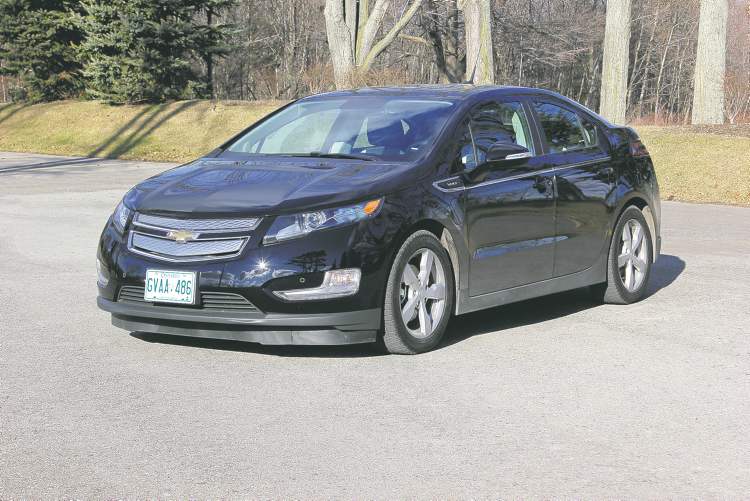
The Volt is the first of what promises to be a slew of extended-range electric cars and, make no mistake, it is an electric vehicle — the electric motor does 100 per cent of the driving.
In simple terms, after charging the main 16-kWh lithium-ion battery, the Volt purrs along using this power source for the first 45 km (Chevrolet says 60-plus km, but the reality is that cold weather takes its toll). From here on, the Volt relies on its 63-horsepower 1.4-litre four-cylinder gas engine. It drives a generator. In principle, it’s much the same as diesel/electric locomotives — there’s no connection whatsoever between the engine and drive wheels.
Furthering the economy/driving range cause is a buffer that’s contained in the main battery. This is used to store the electrical energy captured through regenerative braking and the excess power developed by the generator. It’s this extension that allows the Volt to pull away electrically, and run to 50-plus km/h, even when the instrumentation says there’s zero kilometres of driving range left.
That’s the techy overview, but the manner in which the Volt operates is far simpler. Push the start button and a high-tech sound signals you are ready to go. Get on the accelerator and the Volt pulls off the line surprising crisply. I say surprising because the numbers at play are not exactly standouts — the electric motor produces just 150 horsepower, which is not much for a car that weighs 1,715 kilograms.
The secret lies in the torque — the electric motor twists out 273 pound-feet from Rev One. The combination delivers a 9.8-second run to 100 km/h and an 80-to-120-km/h passing time of 7.4 seconds.
After driving to Detroit and back, a highway-based round trip of 700 km, I had averaged 5.9 L/100 km. At first blush, that’s not overly impressive. However, another 30 km in the city, where the battery and buffer pay the biggest dividend, and the end result was a 1,000-km average of 4.1 L/100 km.
True, this does not take into account the cost of recharging the battery, but it is, nonetheless, the lowest average fuel economy I have ever recorded.
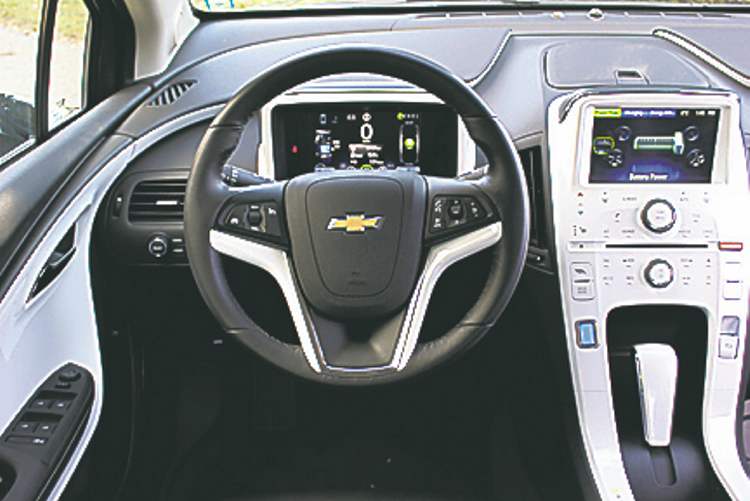
As for the rest of it, the Volt is near-normal — there’s seating for five and 10.6 cubic feet of cargo space beneath the hatchback. Where the Volt differs is that basically all functions are controlled by touch. The white-faced centre stack is iPad-like in that one simply touches an icon to access that feature. The seven-inch screen at the top of the stack functions in the same manner.
The instrumentation is equally out-there — to the left of the speedometer is a ball wrapped in leaves. Balance the ball at the mid-point of the scale and you are attaining the best economy. Accelerate and the ball drops, loses its leaves and changes colour, and it does the opposite during regenerative braking.
In the end, keeping the ball all leafy became like playing Angry Birds — it’s addictive, but it’s a good thing in this instance.
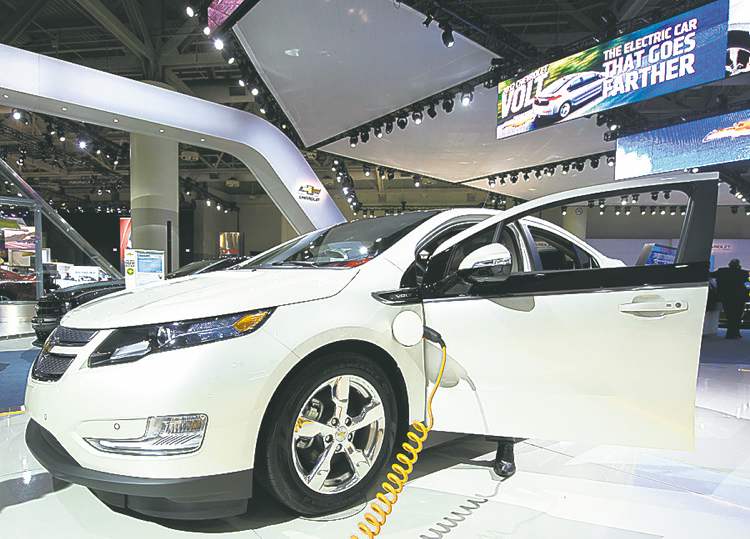
Dynamically, the Volt is equally balanced. The suspension is comfortable without allowing too much body roll, the steering delivers decent feedback and the brake pedal has some semblance of feel — it’s still mushy when compared with a conventional pedal, but given the regenerative side, it proved to be remarkably easy to modulate.
One of the problems with electric cars is the fact they are near-silent in operation, which invariably means sneaking up on an unsuspecting pedestrian. Of course, one could use the horn, risk surprising said pedestrian and being told you are … No. 1. The Volt has a solution — pushing a button on the end of the left-side steering column stalk elicits a discreet three-note “look out” warning.
However, not all is perfect. If you want to maximize the driving range/fuel mileage, you must select the climate-control’s economy setting. As long as the outside temperature is above 10C it works — the strategy relies on the optional heated seats to keep the occupants cosy. Below that temperature, your buns toast, but your toes freeze. This mandates using the less-efficient comfort setting.
Second, the charge time without a 240-volt outlet is long — 12 hours using 110 volts. The other hitch is the rear window. It not only needs a wiper because of its very lazy lie, it splits the rearward view in two. Thankfully, there’s a backup camera — a $795 option!
The Chevrolet Volt is, arguably, the most sophisticated car on the road at the moment — it’s clean, efficient and the manner in which it uses its electric/gas combination to eliminate range anxiety represents the near-term solution to the electrification of the automobile.
The fact the Volt drives like a normal car is its other endearing trait.
— Postmedia News
THE SPECS
— Type of vehicle: Front-wheel-drive mid-sized hatchback
— Drivetrain: Lithium ion battery, electric motor and 1.4L four-cylinder
— Power: 150 hp; 273 lb.-ft. of torque @ 1 r.p.m.

— Brakes: Four-wheel disc with ABS
— Tires: P215/55R17 (optional winters)
— Price: base/as tested: $41,545/$44,135
— Destination charge: $1,495
— Combined electricity/gasoline fuel economy L/100 km: 3.9