

Bye, bye ‘econobox’
Today's subcompacts anything but the spartan puddle-jumpers of yore
Advertisement
Read this article for free:
or
Already have an account? Log in here »
To continue reading, please subscribe:
Digital Subscription
One year of digital access for only $1.44 a week*
- Enjoy unlimited reading on winnipegfreepress.com
- Read the E-Edition, our digital replica newspaper
- Access News Break, our award-winning app
- Play interactive puzzles
*Billed as $5.77 plus GST every four weeks. After 52 weeks, price increases to the regular rate of $19.95 plus GST every four weeks. Offer available to new and qualified returning subscribers only. Cancel any time.
To continue reading, please subscribe:
Add Free Press access to your Brandon Sun subscription for only an additional
$1 for the first 4 weeks*
- Enjoy unlimited reading on winnipegfreepress.com
- Read the E-Edition, our digital replica newspaper
- Access News Break, our award-winning app
- Play interactive puzzles
*Your next Brandon Sun subscription payment will increase by $1.00 and you will be charged $17.95 plus GST for four weeks. After four weeks, your payment will increase to $24.95 plus GST every four weeks.
Read unlimited articles for free today:
or
Already have an account? Log in here »
Hey there, time traveller!
This article was published 13/04/2012 (5165 days ago), so information in it may no longer be current.
Reading car magazines as a teenager, the word most often used to refer to the most affordable cars on the market was “econobox.” And at that time it was an apt term, for most vehicles in the segment were both economical and boxy: Check out a 1987 Honda Civic for proof.
They also resembled penalty boxes for driver and passenger: noisy, underpowered and lacking in amenities.
Today, of course, it’s a little different, and we’ve rounded up three entries in the popular subcompact segment to find out just how much things have changed.
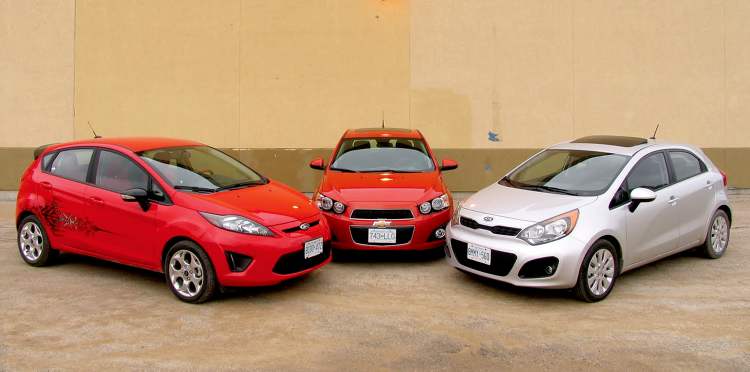
The Ford Fiesta was new last year and brought with it a new level of style and features for the class. 2012 has seen a raft of new entries as well, and we’ve collected a Kia Rio and Chevrolet Sonic to put them to the test.
It just so happens that all three of these were available at the same time, so it only made sense to see how they stack up against each other — and against our perceptions of what a so-called economy car can offer.
For starters, boxy is no longer in the vocabulary of today’s automakers. Nor do all the entries look the same — in our roundup, each of the cars casts a different shadow, at least as different as three four-door hatchbacks can get.
The penalty-box analogy is also far removed from reality. For starters, enhanced safety standards mean each of our entries comes standard with front, side and head curtain airbags as well as anti-lock brakes, traction and stability control.
Common amenities between models are few. You can expect to find tilt steering, split-folding rear seats, stereos and variable intermittent wipers as standard equipment on all of them, but from there, it becomes a game of trying to entice customers with those little extras on the standard-equipment list.
Want power mirrors? Fiesta’s got ’em. Standard Bluetooth? Check out the Sonic. Power windows, four-wheel disc brakes and a CD player? Rio has what you’re looking for.
Of course, despite the small size and low price of entry shared among these competitors, you won’t find such base models populating dealer showrooms.
These companies know that while people value economy and efficiency in entry-level cars, they want creature comforts and convenience features in their daily rides.
To that end, all these cars can be loaded up with enough options to actually double their base prices. The Rio can be had with push-button start, navigation and a heated steering wheel. Sonic fans can stuff a turbocharged engine and six-speed gearbox under the hood if they so desire. And Fiesta buyers can opt for an auto-dimming mirror and heated leather seats.
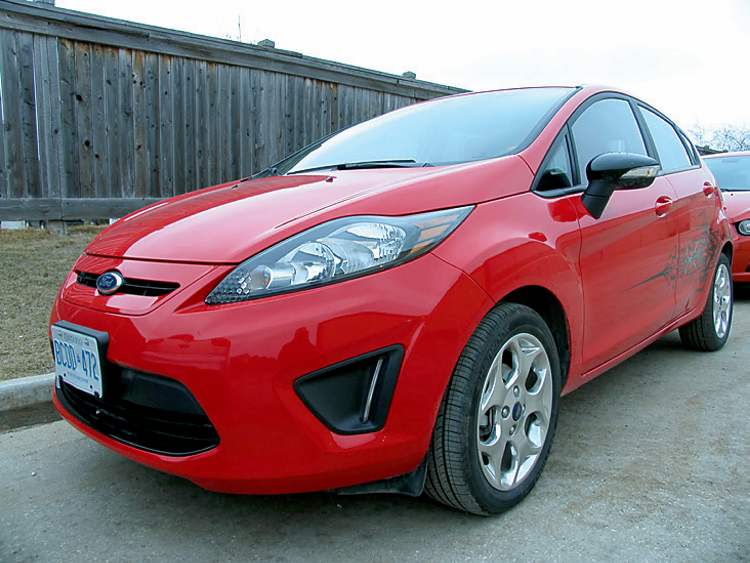
The Fiesta S hatchback starts at $12,499, but ours was a well-equipped $18,999 SES model. That trim includes all kinds of goodies, such as air, cruise, heated seats, premium sound, Ford’s SYNC voice-activated user interface, keyless entry, cruise control and more. Added to our tester was the six-speed dual-clutch automatic, remote start, exterior embellishments, push-button start, “premium” red and black leather interior and a cute $500 tattoo kit.
As tested, our Fiesta rang the till at $25,449, including destination (before taxes). Yup, double.
A base Sonic LS hatch starts life at $15,495, but again we were treated to a higher-trim model. This time, it was an LT that goes for $17,495. The LT gets keyless entry, A/C, cruise, power windows, CD player and more. Add our tester’s six-speed slushbox, exterior appearance package (including 17-inch alloys and a sunroof) and you get a total of $22,040, including destination.
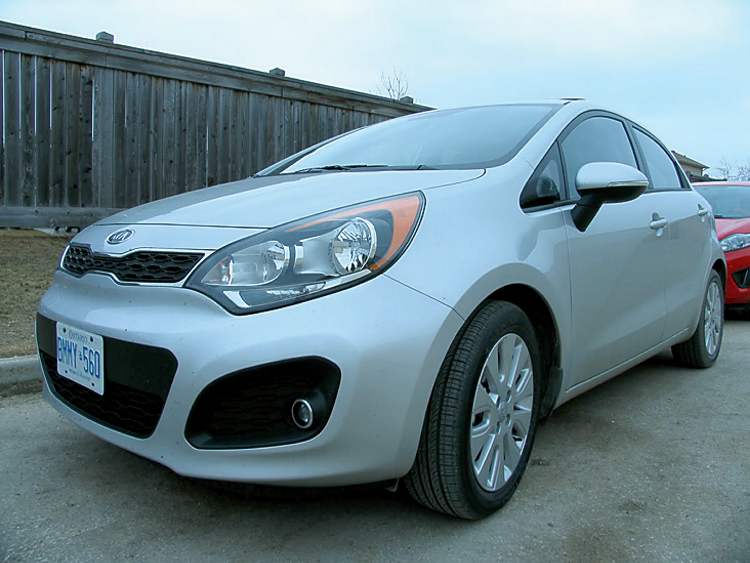
The Kia Rio, the best-equipped option in base form, starts at $14,095. Our tester was the EX, which includes air conditioning, Bluetooth, heated seats, keyless entry, cruise control, 16-inch alloys, upgraded audio, a power sunroof and more. Add our tester’s automatic transmission and the EX UVO user interface, and you get an as-tested price of $20,400, including destination.
That’s right, when optioned with not even all the goodies available, every one of these cars tops 20 grand. So going out of control with the options is no longer the domain of the Porsche Exclusive catalogue.
Perhaps not surprisingly, I’d have to give the value nod to Kia, which manages to offer customers a lot of choice without a skyrocketing price tag. At the other end of that spectrum is the Fiesta, which, in a disturbing trend from Ford, manages to top its class in price, but not in features.
While exterior styling is a highly subjective topic, I do have a favourite looker, and that’s the Sonic. Where the others are a bit too jellybean-shaped for my liking, the Sonic is refreshingly angular and sports a lot of character for an inexpensive car. Its minimal rear overhang and vertical liftgate give it a sporty profile. The hidden rear door handles don’t hurt that goal either.
Think of it as the spiritual successor to the early-’90s Suzuki Swift, or a budget VW GTI, and you won’t be far off.
Our inked and bespoilered Fiesta came close, but its differentiating features have been tacked on rather than styled into the vehicle. And I came to think of the Rio’s styling as the most mature of this group, which is hardly a bad thing. It’s conservative to a fault, but the elegance of the Rio’s duds can be appreciated in certain light as the subtle body creases add some needed visual interest.
Almost as subjective as exterior styling is cabin design, and here the cars differentiate themselves further. Unlike the old days, when an econobox dashboard consisted of two gauges and a radio, car companies go out of their way to portray a vehicle’s character to their customers. In keeping with the Sonic’s sporty bent, its instrument panel is styled after that of a sport bike, with one big analog tachometer and an overlapping digital display that shoots off to the right. In a surprise to myself, I liked it instantly: It’s different and unique, but not at the expense of utility or ergonomics.
And true to the Rio’s conservative outward duds, its interior speaks of upmarket elegance more than the others. It’s more businesslike, mostly black, with just the right amount of chrome brightwork for an understated effect. For sure, it will be a bit boring for some, but that’s the beauty of having such choices on the market — there’s something for everybody.
And then there’s Fiesta. Perhaps it’s unfortunate that our tester was dressed up in its red-and-black interior option, but the red plastic dash panels just didn’t do it for me. It’s not just the colour, either — a coarse texture on a rock-hard surface clearly made the Fiesta feel like the cheapie of the bunch.
And I’ve always said this: Leather seats don’t belong in economy cars. It would be different if it were a high-grade hide, but the reality is in this class, the car companies just can’t spend the money on that and keep the pricing in check at the same time. When there are fabrics available that are as good as those in the Kia and Chevy — forget about the velour upholstery of yore — leather just doesn’t cut it in this class.
Of course, driving each of these cars is really what will tell you whether one is right for you.
During my time with the cars, the Fiesta proved to be the fuel-economy champ, with the Rio close behind. And those real-world impressions are supported by the cars’ official fuel-consumption ratings: While the Fiesta and Rio have city and highway numbers around 7 and 5 litres per 100 kilometres, respectively, the Sonic is closer to 8 and 5.5. While still frugal, the sportiness of the Sonic has to be paid for somewhere.
The Fiesta’s 1.6-litre engine was lightest on power, too, with 120 horsepower on tap and 112 pound-feet of torque way up at 5,000 revolutions per minute. The Rio’s 1.6 delivers 138 hp and 123 lb.-ft. of torque, which proved more useful, as did the Sonic’s 1.8 with its 135 horses and 125 lb.-ft. of torque. Of particular significance in small-displacement four-bangers is the engine speed at which peak torque occurs, and Sonic delivers its peak at a more usable 3,800 r.p.m.
The lesson from all this? If you want more grunt, you use more fuel. The exception to this rule is direct fuel injection, which allows the Kia to generate similar power to the Sonic with fuel consumption approaching that of the Fiesta.
What impressed me about all these cars is how well they maintain their composure on our worn and battered Winnipeg streets. My favourite stretch of road for testing ride quality is on westbound McGillivray Boulevard between Pembina Highway and Waverley Street, where each and every pavement joint signals a small step in the road. Sports cars, heavy-duty trucks and poorly suspended economy cars with short wheelbases hate this stretch. But surprisingly, and particularly in the case of the Sonic, all the cars cruised this road at 80 kilometres an hour without jostling passengers or inducing motion sickness.
The Rio and Fiesta are the more relaxed drivers of the bunch, and that impression is most obvious in their steering response. The Sonic’s steering felt more immediate and responsive, despite it being the only one of the three shod with winter rubber for our test. Now that’s saying something.
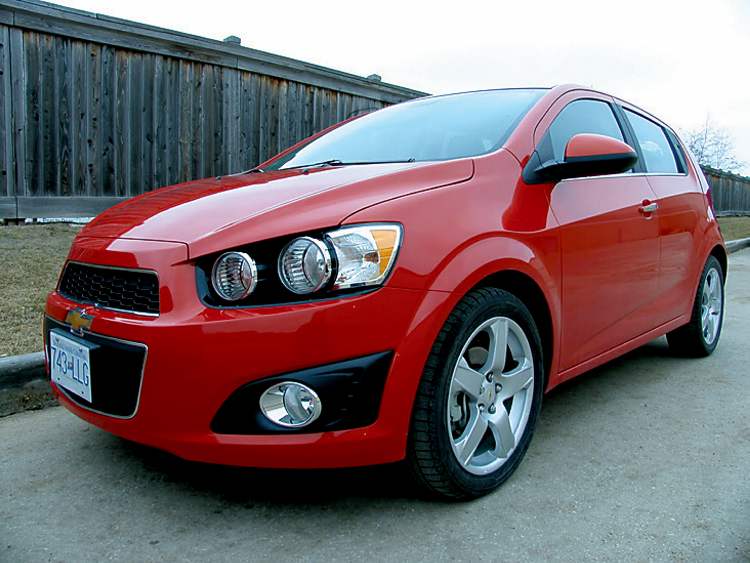
The Sonic’s boxier shape gives it a slight edge in cargo space, with its 539 litres behind the rear bench edging out the Rio’s 425L and Fiesta’s 439L.

The Chevrolet Sonic comes out ahead in this pack, thanks to its edgy styling, sporty drive and high-quality materials, as well as the availability of a more spirited turbocharged engine coupled with a six-speed stick. Rio gets runner-up honours because of its classy interior, good road manners and high-value proposition, plus its class-leading warranty coverage.
And finally, even though the Fiesta made a big splash when it was introduced nearly two years ago, its high as-tested price and low-grade interior ultimately relegated it to third place. The Fiesta is certainly worth a look in this class, though, particularly for those who are attracted to its low starting price and have the discipline to skip most of the options on the order sheet.
So, econoboxes? Hardly.