Cadillac steers toward self-driving vehicles
Advertisement
Read this article for free:
or
Already have an account? Log in here »
To continue reading, please subscribe:

Digital Subscription
One year of digital access for only $205*
- Enjoy unlimited reading on winnipegfreepress.com
- Read the E-Edition, our digital replica newspaper
- Access News Break, our award-winning app
- Play interactive puzzles
*First annual payment billed as $205.00 + GST for one year. This annual subscription will automatically renew at $233.00 + GST every 52 weeks (10% off the regular annual price of $259.35). Offer available to new and qualified returning subscribers only. Cancel any time.
To continue reading, please subscribe:
Add Free Press access to your Brandon Sun subscription for only an additional
$1 for the first 4 weeks*
- Enjoy unlimited reading on winnipegfreepress.com
- Read the E-Edition, our digital replica newspaper
- Access News Break, our award-winning app
- Play interactive puzzles
*Your next Brandon Sun subscription payment will increase by $1.00 and you will be charged $17.95 plus GST for four weeks. After four weeks, your payment will increase to $24.95 plus GST every four weeks.
Read unlimited articles for free today:
or
Already have an account? Log in here »
Hey there, time traveller!
This article was published 20/04/2012 (5238 days ago), so information in it may no longer be current.
MILFORD, Mich. — General Motors will soon be introducing the 2013 Cadillac XTS, which the automaker is claiming will be the most technologically advanced production car the Cadillac brand has ever offered.
The full sized-sedan will be equipped with advanced active safety and driver-assistance systems GM says are “a significant milestone toward the development of self-driving vehicles.”
At GM’s Milford Proving Grounds outside Detroit, I got a chance to experience what it’s like to leave the driving to a soulless machine, courtesy of a semi-autonomous SRX.
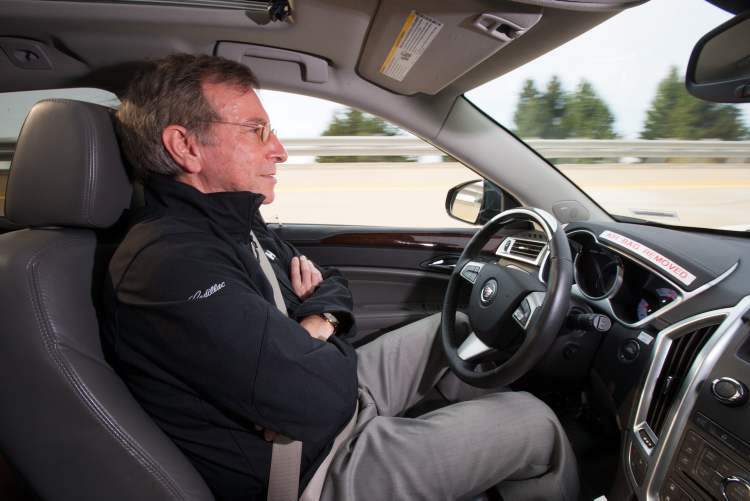
It was part of a day highlighting Cadillac’s safety and crash-avoidance technologies, both near-term and further into the future — or, as summarized by John Capp, GM’s director of global active safety, electronics and innovation, going the next step from just alerting the driver of a dangerous situation to actually intervening if the driver can’t.
Giving driving control over to a car doesn’t come naturally to someone who’s been driving for 40 years, but the SRX’s “SuperCruise” system (as it’s being called internally) proved eerily smooth and effective — at least on the proving ground’s high-banked circuit.
Getting up to 100 kilometres an hour, setting the active cruise control and then activating SuperCruise via a steering-wheel button is simplicity itself. Lights on the steering wheel switch from blue to green to indicate the system is working. Taking one’s hands off the steering wheel is a whole different feeling.
With the forward cameras reading the lane markings, the SRX tracked straight and true, never straying from its intended line. Other buttons on the steering wheel allow the SRX to shift left or right in half-metre increments depending on driver preference.
As part of the demonstration, another car on the track deliberately slowed, activating the brakes as part of the adaptive cruise-control system. Again, the SRX slowed to a safe distance, then accelerated as the car ahead picked up speed. And, again, it stayed exactly in the centre of the lane. A tap of the brakes deactivates SuperCruise, putting the SRX back under the control of the driver.
The system is not nearly perfected, Capp says, but the way the technology is progressing, it’s quite conceivable SuperCruise could be an option on cars within five years — notwithstanding regulatory and legal issues.
One impediment is weather: The cameras need to be able to read the lane markings. Conditions such as snow and even heavy rain could require the driver to take control.
Of greater concern with any such system, says Capp, is keeping the driver engaged in the driving experience and not, in a kind of worst-case scenario, falling asleep behind the wheel.
Cadillac also unveiled its new Safety Alert Seat, which will be offered on the XTS this spring. The luxury sedan will be the first car to use directional tactile sensation — vibrations of the driver’s seat bottom — to warn of crash threats while driving and parking.
The seat generates vibrating pulse patterns on the left and/or right side of the lower bolster to alert the driver of potential dangers, such as drifting from a traffic lane or toward nearby objects while parking. Threats from the front and back trigger pulses on both sides of the seat. The seat works in conjunction with other visual alerts, focusing driver attention toward the direction of potential dangers.
Trying out the seat in a variety of exercises, such as backing out of a parking spot into cross traffic and drifting left and right from the designated driving lane, quickly activated the pulsation, which got my attention faster than it would through other systems’ annoying buzzes, beeps and/or flashing lights.
The Safety Alert Seat is part of the Cadillac Driver Awareness and Driver Assist packages, a combination of active safety systems designed to help drivers avoid crashes. The package includes Forward Collision Alert, lane departure warning, Side Blind Zone Alert and Rear Cross Traffic Alert.
The Driver Assist Package, available this fall, also uses the Safety Alert Seat and features adaptive cruise control, Automatic Collision Preparation and front and rear automatic braking systems.
— Postmedia News