Monster Mercury
1960 Park Lane the ultimate highway cruiser
Advertisement
Read this article for free:
or
Already have an account? Log in here »
To continue reading, please subscribe:

Digital Subscription
One year of digital access for only $205*
- Enjoy unlimited reading on winnipegfreepress.com
- Read the E-Edition, our digital replica newspaper
- Access News Break, our award-winning app
- Play interactive puzzles
*First annual payment billed as $205.00 + GST for one year. This annual subscription will automatically renew at $233.00 + GST every 52 weeks (10% off the regular annual price of $259.35). Offer available to new and qualified returning subscribers only. Cancel any time.
To continue reading, please subscribe:
Add Free Press access to your Brandon Sun subscription for only an additional
$1 for the first 4 weeks*
- Enjoy unlimited reading on winnipegfreepress.com
- Read the E-Edition, our digital replica newspaper
- Access News Break, our award-winning app
- Play interactive puzzles
*Your next Brandon Sun subscription payment will increase by $1.00 and you will be charged $17.95 plus GST for four weeks. After four weeks, your payment will increase to $24.95 plus GST every four weeks.
Read unlimited articles for free today:
or
Already have an account? Log in here »
Hey there, time traveller!
This article was published 10/08/2012 (5085 days ago), so information in it may no longer be current.
Towards the end of the 1950s, full-size cars had become larger and heavier than ever before, and the “longer, lower and wider” sales mantra had pretty much pushed itself to the limit.
At Ford, the post-war marriage of the Lincoln and Mercury divisions had produced many great designs, as well Mercury features that helped distinguish it from the Ford. From 1957 to 1960, Mercury offered an exclusive body that was not based on the Ford or Lincoln, although models could be equipped with optional Lincoln-based engines.
For 1959, the Mercury had grown to more than 218 inches in overall length and weighed well over two tons. Smaller than its Lincoln sibling, it was huge in comparison to the lower-cost Ford.
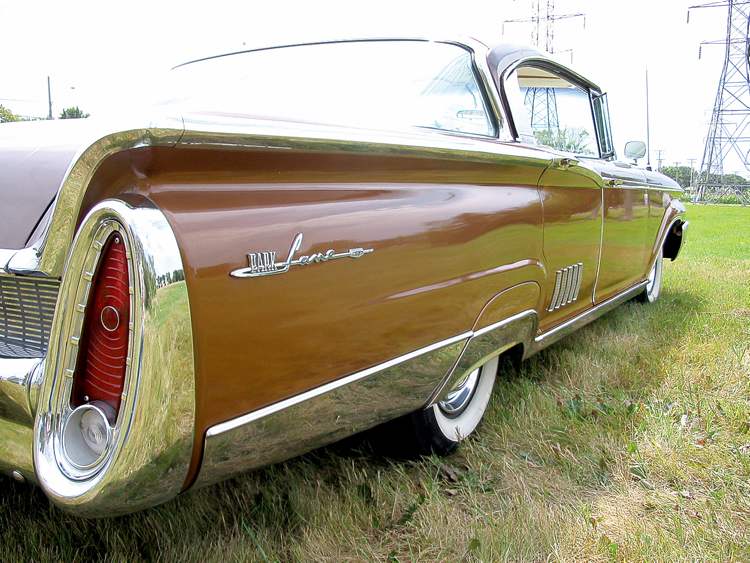
The trend continued for 1960 with the top-line Mercury Park Lane. With a 219.2-inch overall length, the Park Lane rode on a 126-inch wheelbase and weighed in at 4,421-pounds. All two- and four-door hardtop models bore the “Cruiser” designation on the roof’s “C” pillar or rear door frame, and it was difficult to argue that these were not the ultimate machines for highway cruising.
Those highway drives held lasting memories for Tom Dudych and his father’s 1960 Mercury. “It was a black Montclair two-door hardtop,” he said. “When my father wanted to sell the car in 1970, I wanted so much to keep it for when I turned 16 years’ old.”
That didn’t happen, but Dudych tried to find it in the late 1970s, tracing the car through the Motor Vehicle branch to an owner in the Teulon area. With the owner’s name and an old photo of the car he asked around to see if anyone knew the fellow or had seen the car.
“It turned out to be a dead end, so I started to look for another 1960 Mercury and found one in 1989 around St. Andrews,” he said.
The Montclair four-door hardtop had been sitting in a field for several years and was missing a few parts. But Dudych started replacing what was missing and rebuilding the brakes and exhaust system, getting the car in running condition. About this time he came across another 1960 Mercury, this time a top-of-the-line Park Lane model, at a collector-car auction.
The four-door-hardtop had been recently treated to a full restoration, including new two-tone gold and bronze paint along with new light beige cloth and vinyl upholstery, protected by see-through clear vinyl seat covers. But the car went across the block as a no-sale, not meeting its reserve bid.
After talking to the owner out in the parking lot Dudych struck a deal and the Park Lane was his. Now with two 1960 Mercurys, Dudych removed all of the new parts he’d installed on the Montclair and took other available parts as spares for future use.
“After I removed what I could use, I sold the engine and transmission along with the body of the car and recovered the money I had invested in the Montclair,” he said.
The 1960 Park Lane features a wrap-around windshield and rear window along with flared fins and massive vertical tail lamps integrated into the rear bumper. The additional space between the headlamps gave the car an even wider look, while the interior is spacious thanks to a dual-depth dash panel.
The passenger side features a unique stacked push-button AM radio, glove box and electric clock, while the command pod in front of the driver houses the balance of the controls.
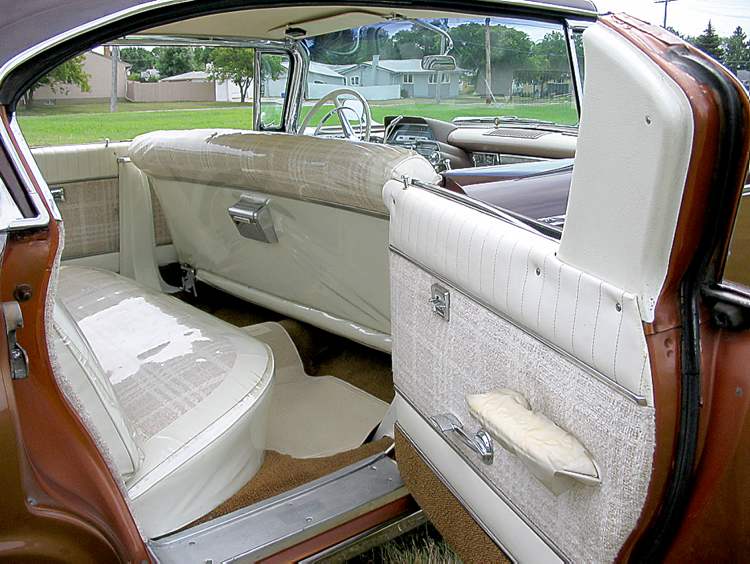
One of 5,788 Park Lane four-door hardtops produced in 1960, the car features full power accessories, including power steering, power brakes, tinted glass, rear-seat radio speaker, day/night mirror, rear fender shields, full wheel covers, wide whitewall tires, power windows and four-way power seats.
Fewer than eight per cent of Mercury production for 1960 featured the optional $78.50 power seats or the $106.20 power windows. While air conditioning was an available option at $472.10, it wasn’t on Dudych’s car and was rarely ordered.
For power the Mercury Park Lane used a massive 430-cubic-inch V8 equipped with 10.0:1 compression pistons and either a Carter or Holley two-barrel carburetor, producing 310 horsepower at 4,100 r.p.m. Backed by a three-speed Multi-Drive automatic transmission leading to a 9-inch rear axle with highway gearing, the Park Lane could cruise effortlessly at 75 mph with its occupants riding in comfort.
Dudych drove the Park Lane as a summer driver for a few years and now treats it to the odd outing on those fair-weather days. Fully maintained, it’s in the same condition as when he brought it home.
Poor fuel economy and the sheer size of these vehicles ultimately led to their demise. The Mercury for 1961 shrank to a 120-inch wheelbase and returned to the use of Ford-based engines. Today, these Mercurys are almost non-existent on the roads and are seldom seen at car shows or cruise nights.
Following Dudych to our photo-shoot location, I couldn’t help noticing the people on the street craning their necks to see the car. A city work crew literally dropped their shovels and stood in the roadway to get a better look at the Park Lane as it passed. That tells me the Mercurys still pack appeal as a collectable car.
The reaction also made Dudych and I wonder how many more of them may be out there. How many readers still have a 1959 or 1960 Mercury? Running or not, email me at larry.dargis@freepress.mb.ca.