AUTO TECH: Nano-technology used to protect car finishes

Advertisement

Advertise with us

Atomic Force Microscopes. Nano-particles. It sounds like science-fiction adventure instead of paint technology, but nano-technology has been utilized in paint clearcoats on several models of Mercedes-Benz cars since 2003.

Read this article for free:


or

Already have an account? Log in here »

To continue reading, please subscribe:

Subscribe and receive a limited-edition Free Press branded hat or tote.

Digital Subscription

One year of digital access for only $205*

  • Enjoy unlimited reading on winnipegfreepress.com
  • Read the E-Edition, our digital replica newspaper
  • Access News Break, our award-winning app
  • Play interactive puzzles

*First annual payment billed as $205.00 + GST for one year. This annual subscription will automatically renew at $233.00 + GST every 52 weeks (10% off the regular annual price of $259.35). Offer available to new and qualified returning subscribers only. Cancel any time.

To continue reading, please subscribe:

Add Free Press access to your Brandon Sun subscription for only an additional

$1 for the first 4 weeks*

  • Enjoy unlimited reading on winnipegfreepress.com
  • Read the E-Edition, our digital replica newspaper
  • Access News Break, our award-winning app
  • Play interactive puzzles
Start now

*Your next Brandon Sun subscription payment will increase by $1.00 and you will be charged $17.95 plus GST for four weeks. After four weeks, your payment will increase to $24.95 plus GST every four weeks.

Hey there, time traveller!
This article was published 07/09/2012 (5108 days ago), so information in it may no longer be current.

Atomic Force Microscopes. Nano-particles. It sounds like science-fiction adventure instead of paint technology, but nano-technology has been utilized in paint clearcoats on several models of Mercedes-Benz cars since 2003.

Other carmakers have tried nano-technology paint as well. Nissan used it to provide scratch-healing clearcoat paint on the 2008 Infiniti EX35. While Nissan’s nano-technology used nano-liquid capsules that flow into minute scratches, Mercedes’ four years of development and testing produced a new chemical- and scratch-resist clearcoat with ceramic particles measuring a millionth of a millimetre each.

Nano-technology was first introduced in 1959 when the renowned U.S. physicist and Nobel Prize winner Richard Phillips Feynman developed the basic idea. But it wasn’t until the mid-1980s that the invention of the Atomic Force Microscope allowed researchers to delve into the actual nano-cosmic world.
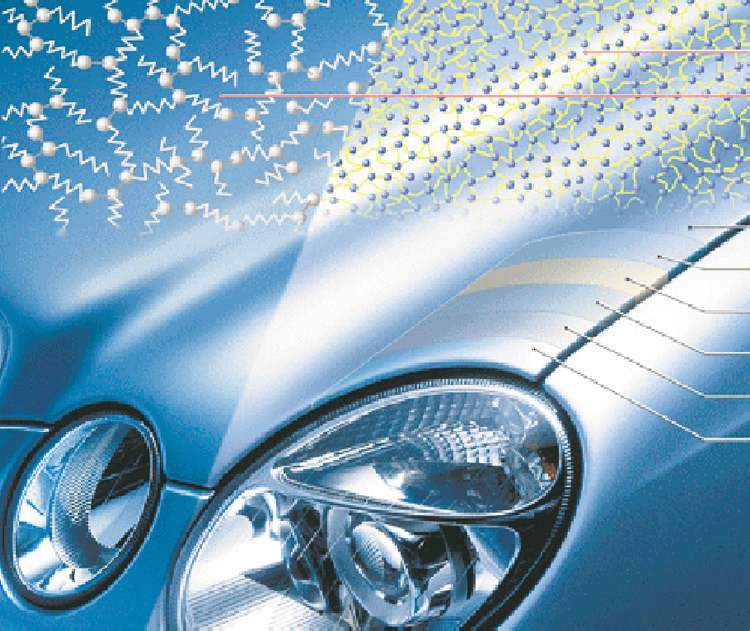
This ad for Mercedes-Benz new nano-particle clearcoat illustrates that the larger particles on the left are more resistent to scratches.

In 1989, researchers managed to move atoms around at will for the first time, and this is now leading to new developments in medicine and mechanical technology. For example, nano-technology has allowed the development of the world’s smallest nozzle, a thousand times thinner than a human hair.

When developing paint clearcoats, the mass and available surface of nano-particles are insignificant in relation to their adhesion, allowing them to stick soundly to any surface. They are perfectly suited as extremely thin coatings for conventional materials, making them less susceptible to breakage and scratches.

During the paint process, the ceramic nano-particles float around freely in the liquid paint. When the car body is baked inside the paint-shop oven at 140C, the ceramic nano-particles cross-link into a dense network instead of the long molecular chains found in conventional paint. This allows the lacquer to provide much more effective scratch protection from normal wear and tear.

Testing of nano-particle clearcoats shows they are three times more resistant to fine scratches than conventional clearcoats, allowing the paint to retain its gloss. Mercedes engineers noted a 40-per-cent improvement in retaining paint gloss compared to conventional clear lacquers.

Mercedes also found that a large proportion of all paintwork scratches are caused by mechanical car-washes. Minute particles of hard materials, such as road dust and sand become lodged in the rotating brushes and etch scratches into the paint surface. These “hair scratches” are particularly noticeable in darker paint shades.

To reduce the amount of scratching, Mercedes offers the following tips for car owners:

To avoid scratches caused by sand, dust or other miniscule particles on the surface of the body, a thorough pre-clean is recommended. Therefore, always spray the paintwork down with the high-pressure washer before driving into the automatic car-wash. I prefer the touchless car washes myself.

After the car has been washed, dry it off with a soft cloth in order to avoid water stains on the paintwork.

Car owners should apply preserver to their vehicle’s paintwork twice a year. You can gauge whether this is necessary by carrying out a simple check: if the water no longer beads on the surface of the car body after it has been washed, then action should be taken.

For older vehicles with dull paint, a high-quality polish is the best option. In the case of newer cars, a gloss preserver should be sufficient. Like polish, this should be applied extremely thinly and in circular movements using cotton wool.

If your car has the nano-particle paint technology and you happen to be involved in a collision, this technology can be duplicated by local bodyshops using Mercedes-Benz approved methods and paint materials. Although it’s been around for years, nano-technology is still in its infancy. The engineers in Stuttgart are already looking at the self-cleaning ability of nano-particle surface structure for automotive wheels. Perhaps, in the future, your car will even be able to clean itself!

Jim Kerr is an experienced mechanic, instructor of automotive technology, freelance journalist and member of the Automobile Journalists’ Association of Canada.

kerr.jim@sasktel.net
Report Error Submit a Tip

More Stories

New businesses start to creep up in former Winnipeg Slurpee shops

Tiago Resko 5 minute read Preview

New businesses start to creep up in former Winnipeg Slurpee shops

Tiago Resko 5 minute read Thursday, Aug. 27, 2026

The remnants of 7-Eleven can still be seen as new businesses move into spaces where Slurpee machines and taquitos once ruled.

As fresh paint dries on several new ventures — such as a pizza place and a convenience store with a name that might make a customer do a double-take — holes across Winnipeg once occupied by the international convenience chain are slowly being filled.

Business at a Domino’s Pizza in Elmwood, formerly a 7-Eleven, has been booming since it opened June 1, the store manager said.

“The issues that 7-Eleven would have had might be different than what we would have. They were dealing with a lot of theft where people can just walk in and out, but Domino’s isn’t set up that way,” said Paul Hemmerling.

Read
Thursday, Aug. 27, 2026

Mayoral rematch between Gillingham, Klein gets ugly on Day 1

Joyanne Pursaga 6 minute read Preview

Mayoral rematch between Gillingham, Klein gets ugly on Day 1

Joyanne Pursaga 6 minute read Updated: Yesterday at 6:25 PM CDT

Former city councillor and provincial cabinet minister Kevin Klein says he will soon enter the race to become Winnipeg’s next mayor — prompting an immediate war of words with incumbent Scott Gillingham.

Gillingham quickly responded to the announcement by calling Klein “toxic” and a “fixer” for Peter Nygard.

Klein said Tuesday he had decided not to enter the mayoral race weeks ago due to an unspecified health scare that required surgery. After recovering, he decided to run.

“The future of the city means a lot to me. I believe that we have so much untapped potential that I felt I should do something about it,” said Klein, noting he felt compelled to run because key city issues, such as perceptions of public safety in the downtown, have grown worse over the past four years.

Read
Updated: Yesterday at 6:25 PM CDT

Winnipeg teacher disciplined for ‘liking’ student’s post

Maggie Macintosh 5 minute read Preview

Winnipeg teacher disciplined for ‘liking’ student’s post

Maggie Macintosh 5 minute read Monday, Aug. 31, 2026

A Winnipeg teacher has been reprimanded for accidentally clicking ‘like’ on a student’s year-old social media post during a late-night scroll.

A recent investigation by Manitoba’s independent teacher commissioner found Jordan Nelson, a hockey coach in the Pembina Trails School Division, engaged in professional misconduct by viewing online profiles of students who were following a team account he was managing on behalf of his school.

“Using information associated with the school’s hockey team account to access and review a student’s social media account, without any legitimate educational or workplace purpose, was inappropriate and inconsistent with the professional boundaries expected of a teacher,” commissioner Noni Classen wrote.

A five-page report, better known as a consent resolution agreement, details agreed-upon facts about an October 2025 incident and subsequent disciplinary action.

Read
Monday, Aug. 31, 2026

Foreign workers at Manitoba hotel are owed $138K in unpaid wages and fees, labour board rules

Abiola Odutola 4 minute read Preview

Foreign workers at Manitoba hotel are owed $138K in unpaid wages and fees, labour board rules

Abiola Odutola 4 minute read Sunday, Aug. 30, 2026

BRANDON — The Manitoba Labour Board has ordered the Western Star All Suites Hotel to pay nearly $138,000 in unpaid wages and administrative fees after it dismissed the appeals involving three foreign workers employed by the company.

In a decision dated Aug. 25, the board ordered 6692452 Manitoba Ltd. (doing business as Western Star All Suites Hotel), 1638185 Alberta Ltd. and company director P.X. to pay a total of $137,915.79 to the Employment Standards Branch for wages owed to foreign workers S.J., J.B. and G.R.

The decision was edited to protect the personal information of the employees, who worked at a hotel, reportedly in Melita, at different times and also lived there during their employment.

The board stated the employees were owed wages after hearing evidence about long working hours, irregular payments, inadequate employment records and working conditions.

Read
Sunday, Aug. 30, 2026

At last, some good news on homelessness

Editorial 4 minute read Preview

At last, some good news on homelessness

Editorial 4 minute read Yesterday at 2:00 AM CDT

There is no shortage of reasons to be frustrated about homelessness in Winnipeg. But the latest numbers provide something that has been increasingly difficult to find — evidence that at least some things are getting better.

Read
Yesterday at 2:00 AM CDT

Letters, Sept. 2

7 minute read Preview

Letters, Sept. 2

7 minute read 3:00 AM CDT

I read Maggie Macintosh’s story with frustration at our city’s continued lack of action on pedestrian safety. I was particularly angered by the fact the “WSD board was unsuccessful last year in making an appeal to city council to permanently reduce speeds around its elementary school buildings.”

Read
3:00 AM CDT