

2012 HONDA FIT SPORT: Fits with the budget
Light on cost, heavy on fun
Advertisement
Read this article for free:
or
Already have an account? Log in here »
To continue reading, please subscribe:
Digital Subscription
One year of digital access for only $1.44 a week*
- Enjoy unlimited reading on winnipegfreepress.com
- Read the E-Edition, our digital replica newspaper
- Access News Break, our award-winning app
- Play interactive puzzles
*Billed as $5.77 plus GST every four weeks. After 52 weeks, price increases to the regular rate of $19.95 plus GST every four weeks. Offer available to new and qualified returning subscribers only. Cancel any time.
To continue reading, please subscribe:
Add Free Press access to your Brandon Sun subscription for only an additional
$1 for the first 4 weeks*
- Enjoy unlimited reading on winnipegfreepress.com
- Read the E-Edition, our digital replica newspaper
- Access News Break, our award-winning app
- Play interactive puzzles
*Your next Brandon Sun subscription payment will increase by $1.00 and you will be charged $17.95 plus GST for four weeks. After four weeks, your payment will increase to $24.95 plus GST every four weeks.
Read unlimited articles for free today:
or
Already have an account? Log in here »
Hey there, time traveller!
This article was published 19/10/2012 (4970 days ago), so information in it may no longer be current.
My wife and I play a game: What’s the best wine we can buy for less than $20? We use the same methodology in looking for a car: What’s the best car for less than $20,000? The 2012 Honda Fit looks like a serious contender.
While marketed as the Jazz worldwide, Honda chose the model name “Fit” for its North American customers when the compact car was brought to our shores in 2006. The Jazz was a worldwide hit, with a number of versions sold in various markets. Most intriguing were the four-wheel-drive units sold in Japan.
The Fit is not your average stripped-out econobox. Mechanically, the vehicle is fitted with a 117-horsepower 1.5-litre four-cylinder i-Vtec engine with an electronic drive-by-wire throttle. While commonplace today, in 2006 that was a significant upgrade over most cars in the marketplace.
A five-speed manual transmission driving the front wheels is the default on all models, while a five-speed automatic is available as an option. All Fit models since the 2009 redesign feature Vehicle Stability Assist with traction control, as well as anti-lock brakes with electronic brake-force distribution.
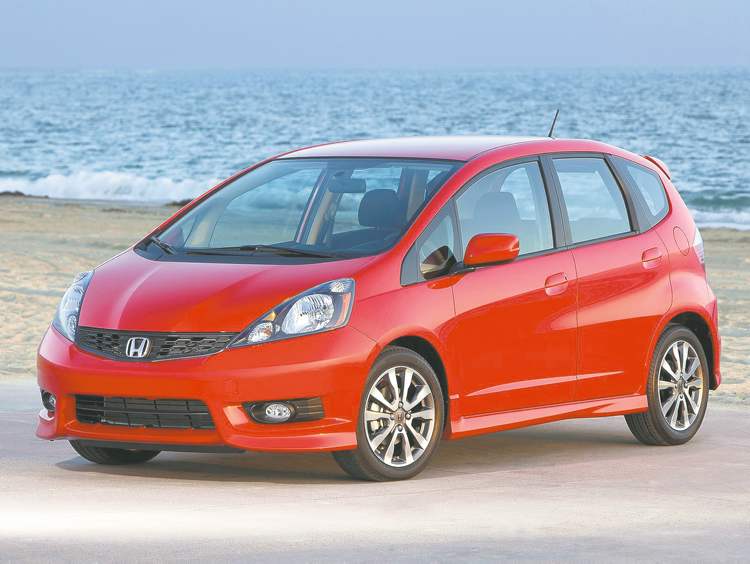
The Fit sheetmetal features a low hoodline that angles upward to the large raked windshield. Behind the large sheet of glass is essentially a tapered rectangular box with doors. The Fit looks more attractive than it sounds.
The clean tapered styling sets it apart from other competitors in the marketplace. It’s a functional design with subtle styling accents incorporated.
While seemingly compact on the outside, the Fit actually has a longer wheelbase and weighs more than the original Honda Accord. Inside, efficiency appears to have been the mantra guiding the layout and design.
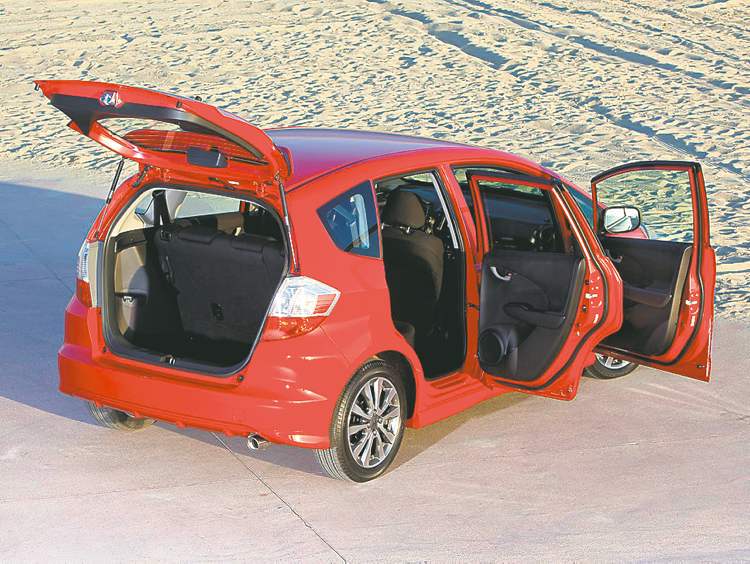
The standard rear Magic Seat configuration allows for creative storage options with its 60/40-split folding seats. The rear seatbacks fold forward, boosting cargo capability from 20.6 cubic feet to 57.28 cu.ft. of flat-floored storage. The front passenger seatback can also fold forward to accommodate a 2.4-metre-long load. The rear seat cushions will flip up to provide full floor-to-ceiling cartage for taller items. Credit this ability to the fuel tank being moved from the rear half of the vehicle to under the driver’s seat, an area less prone to impact.
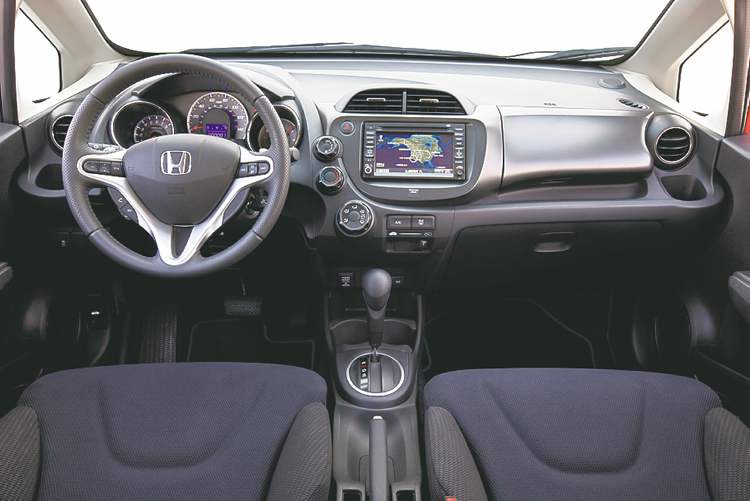
Passenger comfort is another strong point for the Fit. From the driver’s seat, the cabin feels bright and airy. Headroom is astonishingly generous, so six-footers will find centimetres to spare before rubbing the roofliner. The only complaint here was the feeling of how close the door is once seated.
The Fit cabin has been reworked for 2012. The dashboard is now a uniform black colour as opposed to having silver inserts on earlier models. The two cup holders in the lower centre console are now deeper yet easier to get beverages in and out of. There are a total of 10 drink holders throughout the vehicle. Depending on trim level, the cabin furnishing and exterior fittings vary somewhat. The base model DX comes with power windows (auto up/down), power mirrors, 15-inch steel wheels with covers and a 160-watt AM/FM/CD/MP3 audio system with an auxiliary input and two speakers.
An automatic transmission option comes from the factory with air conditioning installed as a separate DX-A model. The LX model adds two more speakers to the the audio system, a driver’s-side armrest, rear spoiler, cruise control, power door locks, Bluetooth hands-free telephone link, heated colour matching mirrors and standard air conditioning. Stepping up to the Sport adds a rear stabilizer bar for crisper handling, two more speakers (six in total), a USB audio interface, premium upholstery, 16-inch alloy wheels and aggressively styled body skirting.
The vehicle tested was a Sport model with automatic transmission.
The Fit is a nimble package around town. Zero to 100 kilometres an hour comes up in 10.5 seconds. It’s not blistering but peppy all the same. The electric rack and pinion steering feel is precise and the car has that fun-to-drive factor that makes motoring less of a chore. While I typically prefer manual gearboxes, the automatic shifted smoothly and downshifted easily when extra zip was needed. The automatic model actually returns slightly better fuel economy — 6.3 litres per 100 kilometres combined — compared with the manual gearbox rate of 6.5 L/100 km.
Road noise has been reduced thanks to extra sound insulation, making the Fit a pleasant highway ride. Stomp on the throttle and the Fit’s engine rewards with a great mechanical rasp, a signature of Honda’s Vtec engines.
Although besting most compact cars and crossovers with more cargo functionality, the sales of the Fit have been dropping over the last few years. Blame increased competition from Honda’s own Civic (the best-selling car in Canada for 14 years) as well as domestic and Korean products.
The tester weighed in at $20,080, a price that many buyers rationalized by cherishing the made-in-Japan label. Interestingly, Fit/Jazz models are also made in the U.K., Brazil, China, India and Indonesia. Following the Japanese tsunami, Canadian-market Fits are now sourced from the assembly plant in Guangzhou, China. Jazz units have been produced at this plant since 2004 and have supplied both the Chinese and European markets.
There have been no visible changes in quality and, if not told about the change, I would not have known. That being said, rumour has it production for all North American Fit models will be transferred to a new Honda plant opening in Mexico in the coming years.
It remains to be seen if consumers will appreciate the Fit’s many attributes with either the Made-in-China or Hecho-en-Mexico labels coded on the dash.
— Postmedia News
THE SPECS
Type of vehicle: Front-wheel-drive compact hatch
Engine: 1.5L in-line four-cylinder
Power: 117 hp @ 6,600 rpm; 106 lb-ft of torque @ 4,800 rpm
Transmission: Five-speed automatic (optional)
Brakes: Front disc/rear drum with ABS
Tires: P185/55 R16
Price: base/as tested: $18,880/$20,080
Destination charge: $1,495
Transport Canada fuel economy (L/100 km): 7.1 city, 5.4 hwy.