Vintage Volvo teaches active-driver lesson
Advertisement
Read this article for free:
or
Already have an account? Log in here »
To continue reading, please subscribe:

Digital Subscription
One year of digital access for only $205*
- Enjoy unlimited reading on winnipegfreepress.com
- Read the E-Edition, our digital replica newspaper
- Access News Break, our award-winning app
- Play interactive puzzles
*First annual payment billed as $205.00 + GST for one year. This annual subscription will automatically renew at $233.00 + GST every 52 weeks (10% off the regular annual price of $259.35). Offer available to new and qualified returning subscribers only. Cancel any time.
To continue reading, please subscribe:
Add Free Press access to your Brandon Sun subscription for only an additional
$1 for the first 4 weeks*
- Enjoy unlimited reading on winnipegfreepress.com
- Read the E-Edition, our digital replica newspaper
- Access News Break, our award-winning app
- Play interactive puzzles
*Your next Brandon Sun subscription payment will increase by $1.00 and you will be charged $17.95 plus GST for four weeks. After four weeks, your payment will increase to $24.95 plus GST every four weeks.
Read unlimited articles for free today:
or
Already have an account? Log in here »
Hey there, time traveller!
This article was published 17/05/2013 (4825 days ago), so information in it may no longer be current.
As winter drew to a close, my instructors and I decided we needed to add a rear-wheel drive car to the stable at Sidorov Advanced Driver Training.
We wanted to be able to provide a real challenge to our repeat customers, and what could be better than a rear-wheel drive car with nearly bald tires, plenty of horsepower and a nice icy section of our airport facility?
Portions of our courses are conducted in the customer’s vehicle, whether it’s a Maserati or a fire truck. It’s best to learn in what you drive regularly, and it prevents the sort of gratuitous thrashing that some people heap on any vehicle which is not their own.
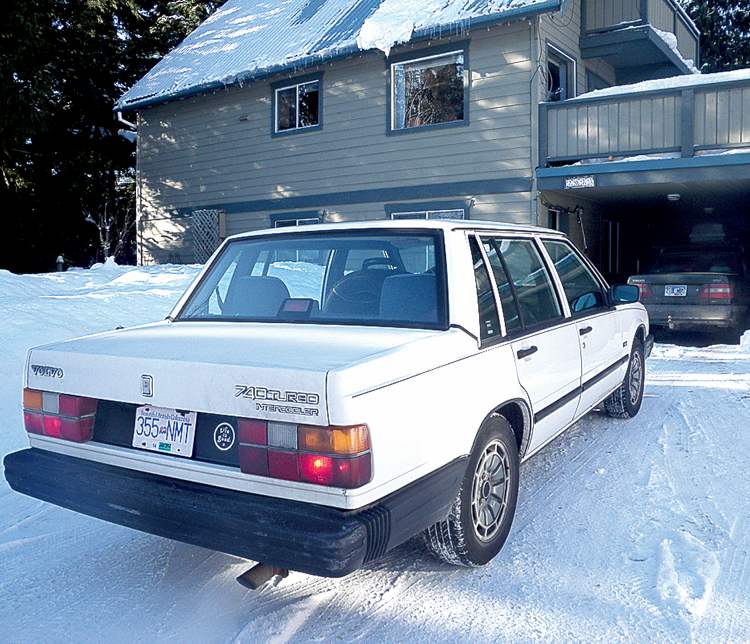
For more advanced skid control, though, we use our own vehicles, set up to be both entertaining and educational.
Certain older vehicles are well-suited to advanced driver training — they have few electronic driver’s aids, are relatively cheap to find parts for, and they usually have some sort of tuner prep available.
We need four seats and four doors. I looked at quite a few ex-police Ford Crown Victorias, but they were universally horrible — best for a taxi in a rough neighbourhood, not our client base. I really wanted a BMW, having worked with that company extensively in the past, and the driving dynamics of an older 3 series are still excellent. But we needed an automatic, and I balked at shopping for a slushbox given the sweetness of the BMW’s manual gearbox.
We ended up with a 1988 Volvo 740 Turbo owned by a student at the University of British Columbia and, prior to that by a mechanic. Stylistically, the Volvo had all the elegance of a refrigerator, but that wasn’t really a concern. It was basically sound, rust-free and solid. What sealed the deal was that the girl who was parting with the car agreed to deliver it to Whistler.
Our square-edged Swedish iron went straight into the shop for a few needed repairs. We installed fresh wiper blades and stronger headlights. Timing belt, serpentine belt, filters, hoses, etc, were changed as a precautionary measure. I was scheduled to attend a conference up north, and decided to give our new vehicle a baptism by ice and snow.
One of the advantages of running an advanced driving school is that our storage unit is filled with tires for all occasions. I dug out the Bridgestone Blizzaks that had been the favourites during our winter tire tests, checked the pressures and slapped them on the 740. A winter survival kit went into the trunk, along with a few spares and three jugs of windshield washer fluid.
While people generally consider Volvos to be heavy cars, they have actually rarely been heftier than their competition. It’s the robust safety structure that gives the impression of mass. The 740 Turbo weighs around 1,400 kg, or a tick over 3,000 pounds — not much more than a current VW Golf 5-door.

I pushed the 740 quite hard on the climb past Pemberton and into the Coast Mountains, trying to carry momentum through the snow-covered hairpin turns. The Volvo felt better than any 25-year-old car should — the big steering wheel and the lack of cup-holders were the most obvious indicators that I was driving something that qualified for collector plates.
Aided by the tenacious grip of the Bridgestones and the inherent balance of a rear-wheel drive chassis, we were soon past Hat Creek and arrowing our way north. Beyond 70 Mile House the road became icy, and it was easy enough to get wheelspin at speed when the turbo spooled up.
In terms of dynamics, the Volvo’s anti-lock brakes still worked well. Traction management and stability control, rather than being subcontracted to a computer, were up to my right foot. On the winter road, driving required genuine involvement — both hands on the wheel, alert to traction changes. Modern vehicles and safety features protect us in many ways, but also allow people to chuff around while paying only minimal attention to the business of driving. They have the dangerous potential of serving as a platform to diminish operator skills. Piloting a car in which the driver has to take an active role was refreshing.
I suspect many of our students will feel the same way.
Alan Sidorov is an experienced automobile racer, product tester and freelance writer. You can reach him at www.spdt.ca