

2013 AUDI Q5 HYBRID: Gas-electric SUV has a lot going on
... but watch out for high sticker price
Advertisement
Read this article for free:
or
Already have an account? Log in here »
To continue reading, please subscribe:
Digital Subscription
One year of digital access for only $1.44 a week*
- Enjoy unlimited reading on winnipegfreepress.com
- Read the E-Edition, our digital replica newspaper
- Access News Break, our award-winning app
- Play interactive puzzles
*Billed as $5.77 plus GST every four weeks. After 52 weeks, price increases to the regular rate of $19.95 plus GST every four weeks. Offer available to new and qualified returning subscribers only. Cancel any time.
To continue reading, please subscribe:
Add Free Press access to your Brandon Sun subscription for only an additional
$1 for the first 4 weeks*
- Enjoy unlimited reading on winnipegfreepress.com
- Read the E-Edition, our digital replica newspaper
- Access News Break, our award-winning app
- Play interactive puzzles
*Your next Brandon Sun subscription payment will increase by $1.00 and you will be charged $17.95 plus GST for four weeks. After four weeks, your payment will increase to $24.95 plus GST every four weeks.
Read unlimited articles for free today:
or
Already have an account? Log in here »
Hey there, time traveller!
This article was published 21/06/2013 (4728 days ago), so information in it may no longer be current.
It might be stating the obvious, but European automakers are more comfortable with diesel powertrains than with gas-electric hybrids, beginning with decades of familiarity with compression-ignition engine technology.
There are other relevant points, yet the upshot is that the Europeans — the big German automakers — are really just getting into the hybrid game reluctantly, and that’s with cars. For Canadians, choice is woefully skimpy for hybrids in the popular crossover and SUV segments, which desperately need to see greater fuel efficiency.
Into these waters wades Audi, not just with a hybrid version of its entertaining and upscale compact Q5 sport-ute, but the “first true performance hybrid SUV,” Audi says.
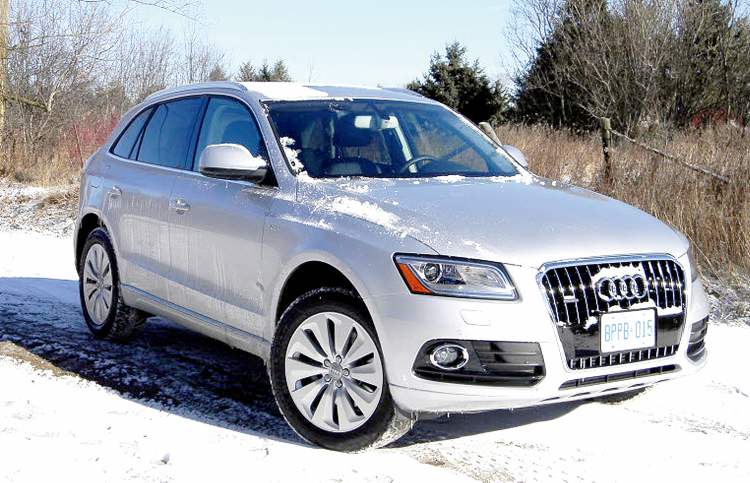
Now, I’m not sure if Audi is defining performance in terms of fuel efficiency or dynamics, but I’m hedging my bets by stating it’s a bit of both. Certainly the Q5 Hybrid displays a big amount of pep when called for, which, considering the gasoline portion of the powertrain is the automaker’s familiar 211-horsepower, 2.0-litre turbocharged TFSI four-cylinder, should not be a surprise.
Add to it an electric motor with a maximum output of 54 hp and 155 pound-feet of torque and, combined, the hybrid system puts out a maximum 245 hp and a rather impressive 354 pound-feet of torque.
Audi says the Quattro-equipped Q5 Hybrid accelerates to 100 kilometres an hour in 7.1 seconds and has a top speed of 209 km/h, which is more or less equal to the non-hybrid Q5 2.0 TFSI. Since it tips the scales at a hefty 2,010 kilograms — an extra 160 kg (mostly the lithium-ion battery pack) compared with the base Q5 — it’s obvious the hybrid setup’s extra oomph more than compensates.
As with all good hybrids, the Q5 can be powered entirely by the 2.0 TFSI engine, by the electric drive (supposedly up to three kilometres when driven at a constant 60 km/h) or in combination. It’s also capable of energy recovery. Where many hybrids use a continuously variable transmission, the Q5 Hybrid sees a modified version of Audi’s smooth eight-speed Tiptronic manumatic. In addition to the regular Drive mode for greatest efficiency or the S mode for sportier motoring, drivers can select EV, which gives priority to electric operation.
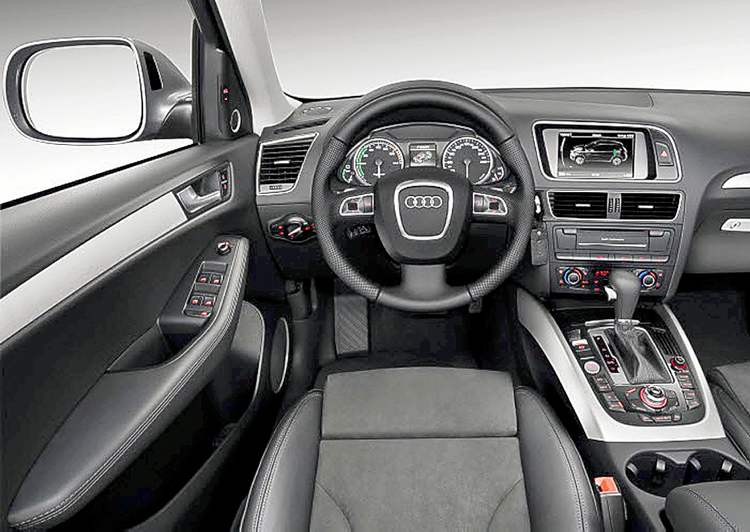
Unlike some other companies, Audi eschews dashboard graphics that grow vines, flowers or other feel-good greenery, instead using matter-of-fact displays that show the various states of the hybrid drive. A power meter replaces the tachometer in the instrument cluster, and its needle indicates total system power on a scale from zero to 100 per cent.
A second scale is subdivided into colour segments — its green and orange segments indicate how the Q5 Hybrid is currently being powered. An auxiliary gauge shows the charge state of the battery. There’s also a colour display in the driver information system that depicts power flows and operating states of the hybrid system. The monitor also shows detailed fuel-economy and energy-recovery statistics.
Eco geeks will love it, but I ignored most of it after a while. Still, I couldn’t ignore the Q5 Hybrid’s fuel economy during my week with the tester, which coincided with a rather nasty cold snap. While 11.4 litres per 100 kilometres during mixed use isn’t horrible for a hybrid sport-ute (and certainly more frugal in comparison with similar-sized non-hybrid SUVs), I expected better. The fact the turbo four requires premium unleaded doesn’t help the cause either.
There are a few subtle variations to the hybrid that separate it from the regular Q5s, starting with slightly different height and track-width dimensions. Of a more obvious nature are the fully painted bumpers, hybrid badges and 19-inch wheels in a rather attractive turbine design.
Certainly, as hybrids go, the Q5 demonstrates a rather sporty demeanour. Only the brakes aren’t up to typical Audi standards — the hybrid’s regenerative setup can make them a bit touchy, but they’re still pretty good. Steering feel from the electro-mechanical rack is excellent and the firm suspension handles tighter turns with little body movement.
The Q5’s long wheelbase creates a roomy cabin for four six-foot-plus people. The seats are comfortable, the dash layout is attractive and the fit and finish of the materials and trim appear first-rate. It’s worth noting that the lithium-ion battery pack is located under the cargo floor and does not reduce cargo capacity.
Audi has priced the hybrid as the topline Q5 — at $56,600 it’s almost $17,000 more than the base model and just slightly less than the Lexus RX 450h luxury hybrid, its nearest SUV competitor. So in addition to all the hybrid technology, it’s fully loaded. That’s not to say it provides the same hedonistic experience as would be found in the RX 450h. Audi’s approach is typically Teutonic, which is better defined as logically luxurious.
As much as it’s good to see another hybrid added to the sport-ute segment, the simple fact is that pricing the Q5 Hybrid as a premium model isn’t going to help the vehicle gain any sort of following. In other markets, Audi has turbodiesel engines that provide a simpler and less expensive solution to achieving greater fuel efficiency.
When the Q5 was first introduced for the 2009 model year, the company’s official answer to the question regarding any possibility of a diesel option for North America was: “Provided there is satisfactory demand from the consumer and that adequate supply and financial obligations are met on our side…”
Better late than never, that time has nearly arrived. Audi Canada says there will be a turbodiesel available for the Q5 later this year. I think I would wait for it.
— Postmedia News