

2013 Nissan Pathfinder vs 2013 Mazda CX-9: Van-ternatives
A tough choice between a pair of jumbo SUVS
Advertisement
Read this article for free:
or
Already have an account? Log in here »
To continue reading, please subscribe:
Digital Subscription
One year of digital access for only $1.44 a week*
- Enjoy unlimited reading on winnipegfreepress.com
- Read the E-Edition, our digital replica newspaper
- Access News Break, our award-winning app
- Play interactive puzzles
*Billed as $5.77 plus GST every four weeks. After 52 weeks, price increases to the regular rate of $19.95 plus GST every four weeks. Offer available to new and qualified returning subscribers only. Cancel any time.
To continue reading, please subscribe:
Add Free Press access to your Brandon Sun subscription for only an additional
$1 for the first 4 weeks*
- Enjoy unlimited reading on winnipegfreepress.com
- Read the E-Edition, our digital replica newspaper
- Access News Break, our award-winning app
- Play interactive puzzles
*Your next Brandon Sun subscription payment will increase by $1.00 and you will be charged $17.95 plus GST for four weeks. After four weeks, your payment will increase to $24.95 plus GST every four weeks.
Read unlimited articles for free today:
or
Already have an account? Log in here »
Hey there, time traveller!
This article was published 08/11/2013 (4595 days ago), so information in it may no longer be current.
This past summer, I found myself behind the wheel of two full-size crossovers on back-to-back weeks and, while this was not an organized comparison test, they were just begging for a head-to-head battle.
First up was the all-new Pathfinder. With this fourth-gen redesign, Nissan has taken a drastic change in direction moving from a truck-based body-on-frame design to a more van-like unibody layout. So the Pathfinder has chosen the path more travelled: highways, byways, and yes, soccer practice. A vannabe, to be sure.
The incumbent in this heads-up match is Mazda’s CX-9. It’s familiar, having been on the scene since 2007, and on the whole it hasn’t changed much during its tenure. Of likely most importance to consumers is whether Mazda has been able to keep the CX-9 current, both in terms of looks and features.
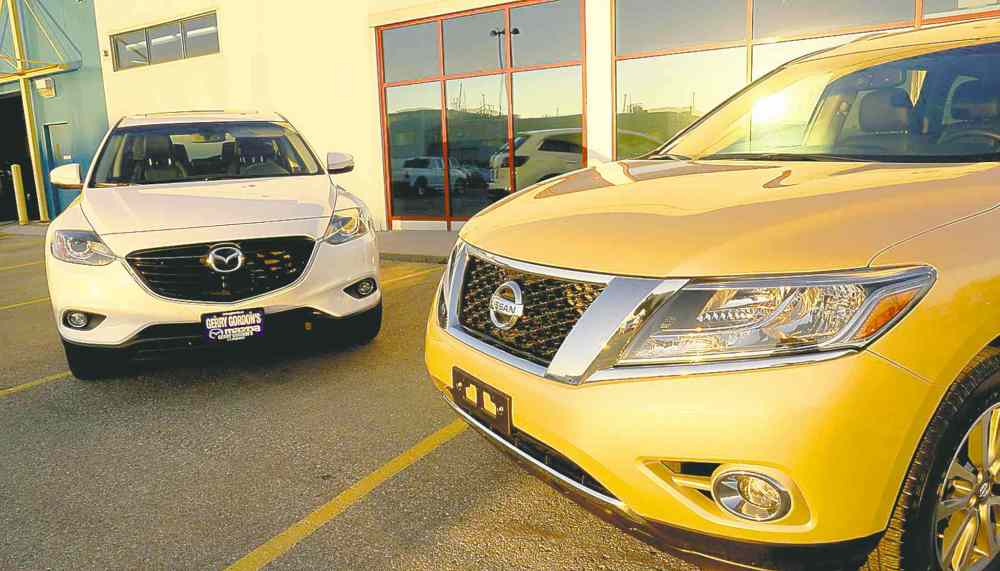
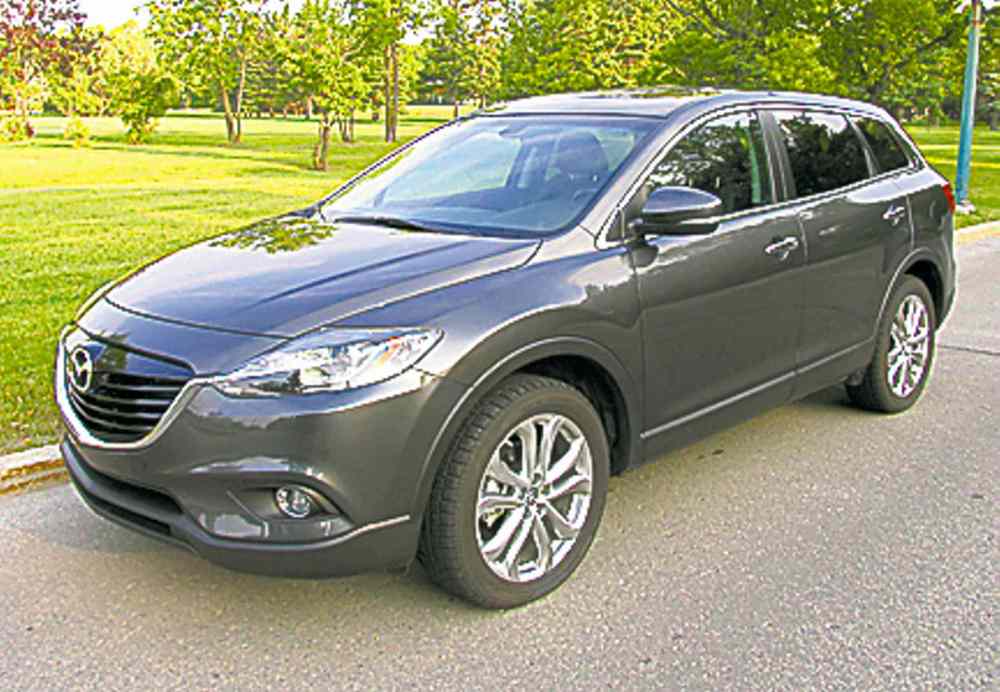
2013 has seen a facelift to keep the big ute’s looks consistent with Mazda’s current “Kodo” design language used on the 3, 6, and CX-5, all models that are at most two years old. On the inside, a new 5.8-inch display acts as a user interface for the CX-9’s new tech features.
The two test vehicles were not direct competitors in terms of equipment level or price tags. Starting price for the Pathfinder is an attention-grabbing (and van-like) $29,998. Lest the low price of entry conjure images of crank-down windows and 14-inch wheels, the base Pathfinder S comes well-equipped indeed. Things such as 18-inch alloys, three-zone climate control, power heated mirrors and push-button ignition are all standard kit. Conspicuous by its absence is Bluetooth connectivity, available only if you select the $35,428 SV or higher model.
Our Pathfinder was the SL, which starts at $35,698 in 2WD form. Add our tester’s 4WD and you can add $2,000 to its price tag. The SL nets remote start, a rear-view camera, leather upholstery, a seven-inch display, rear proximity sensors, heated front and rear seats, wood-grain trim, a power liftgate and a bunch of other goodies over the S. (The mid-level SV model has some of those features.)
So, with the Nissan we’re at $37,698 plus destination, fees and taxes.
The CX-9 has more upmarket aspirations. Starting price for Mazda’s flagship crossover is $33,995 in front-drive GS form. Standard equipment also includes 18-inch alloys, three-zone climate control, power-heated mirrors and the aforementioned touch screen, but not push-button ignition.
The Mazda also includes rain-sensing wipers, automatic headlights, a rear-view camera, and yes, Bluetooth connectivity. All-wheel drive is available on the GS for an additional $3,000.
Our tester was a GT with navigation package, adding such niceties as leather seats, xenon headlights, 20-inch alloys, keyless ignition, blind-spot monitoring system, a power moonroof and premium audio. Also included in this top trim are some items that make the Pathfinder somewhat of a bargain: parking sensors and a power liftgate are only available on this range-topping $47,250 model — items that are included in the Pathfinder that enjoys a $10,000 price advantage.
At $36,995, a CX-9 GS with all-wheel drive would have been a better matchup for this comparison, but with differences only in trim and not in powertrain or fundamental practicality, the disparate equipment levels were easy to overlook in this shootout.
So will the incumbent’s good looks and spirited drive be enough to fend off the newcomer’s overachieving aspirations?
Nissan Pathfinder
I wanted to like the Pathfinder, but there are a couple of things that had it trying to catch up from behind. First, there’s its styling. We’re a long way from the rugged Pathfinder of yore, the rounded edges and more practical shape making it look more like a scaled-up wagon than an SUV.
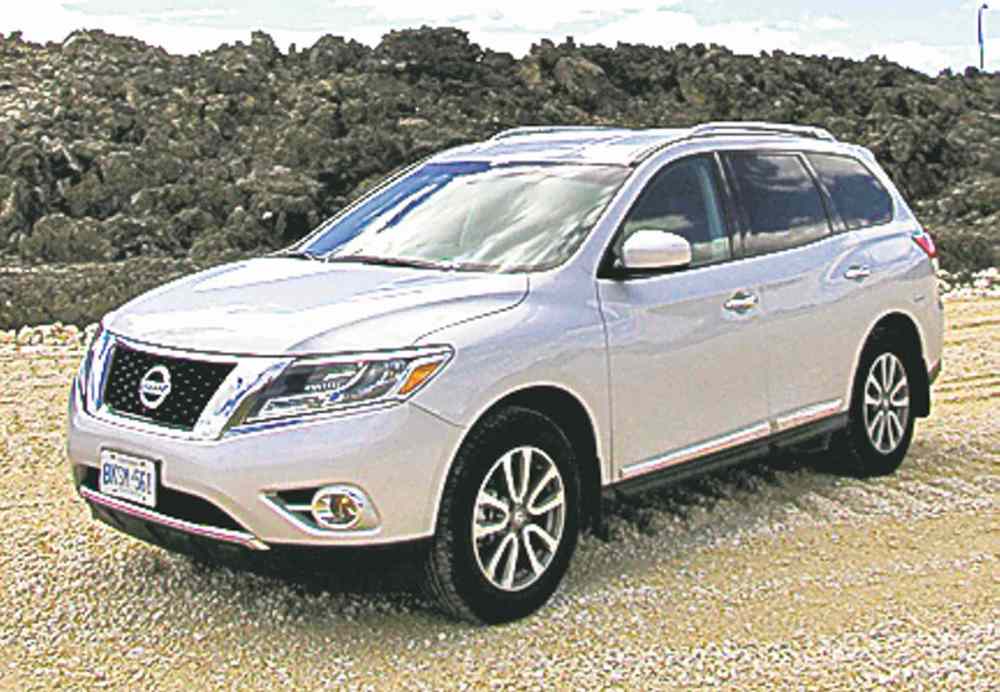
And then, there’s the CVT. Ah, the dreaded continuously variable transmission. Lots of people like it, particularly Nissan, where it has found its way into almost every car and crossover the company makes. Its benefits are well-documented: lower fuel consumption and more consistent power delivery when compared to a transmission with fixed gear ratios, whether it be automatic or manual.
But the drawbacks of CVTs are no secret either, and Nissan’s are not entirely immune despite being among the best on the market. In fact, with this powerful V6 and Nissan’s ability to nearly eliminate droning, or sustained high engine revs under acceleration, from the CVT’s vocabulary, there should be no downsides to the unit. And there weren’t, most of the time.
But occasionally — I would estimate four or five times during my week with the Pathfinder — at low speeds and under light acceleration, the Pathfinder would shudder ever so slightly for a few seconds. It appears I’m not alone in this observation — a quick Internet search revealed this is a known condition and Nissan has issued a service bulletin on the matter. Whether the related fix has exorcised the shudder demons is not clear at this point.
However, the V6-CVT combo makes for quite a thrifty fuel-sipper, considering the girth of this people-mover. Rated at 10.9 litres per 100 kilometres in the city and 7.8 on the highway for all-wheel drive versions (front-drivers do slightly better), I managed low 9s on my 200-km highway trip and about 13 in the city. Not far off of what I would have expected from a mid-sized sedan just a few years ago.
As far as fulfilling its mission as a practical people-mover, the Pathy’s got this covered. Big doors and second-row seats that tilt and slide forward with the pull of a lever make third-row access straightforward. Once back there, there’s enough room for children or the occasional adult you have a secret desire to punish, but the seat bottom is quite low and short, meaning grown-ups won’t be comfortable there for long.
The Nissan’s display screen is not of the touch variety, so it loses points in my book. And the graphics are strangely reminiscent of the first Nissan Murano I drove 10 years ago.
The Pathfinder is truly a jumbo crossover that entices new-car shoppers with good value, a practical size and pretty amazing fuel consumption. But there are many things it should be doing better.
Mazda CX-9
The CX-9 is big on first impressions: Sleek and sporty styling, a gutsy and satisfying V6 paired with a six-speed automatic transmission, and a level of driver engagement that nothing this size should possess.
But this comparison is about how well these vehicles serve their intended function, and driving enjoyment isn’t really near the top of the list of core values that a vehicle in this segment should have. A nice-to-have, to be sure, but typically not a deal-maker or breaker.
So, to be honest, I had a difficult time choosing a winner in this comparison. The CX-9’s richer price range and significantly higher fuel consumption will seal the deal right away for lots of folks, who will surely flock to the Pathfinder. Plus, I thought its sleeker shape would render it less commodious than the Pathfinder, but the numbers and third-row comfort tell a different story.
Even though the Mazda’s cargo-volume number is bigger, the Pathfinder’s larger liftgate opening and boxier shape do give it the edge in cargo versatility. In a side-to-side comparison, though, the Mazda’s third row seat offers a higher and longer seat bottom to take some load off the cheeks, though both third rows are quite easy to access.
In the real world, the CX-9 gives up at least two litres per 100 km in both city and highway conditions to the Pathfinder, a significant enough difference to affect the purchasing decision. Officially, the CX-9 is rated at 12.8 and 9.0 L/100 km in city and highway cycles respectively.
The V6 is gutsy and sounds good, while the six-speed slushbox is adept at making the right decisions in various situations. But you can forget about shifting this beast manually (not that most people would) — there is no rev-matching on downshifts here. So, with this type of consumption and a leave-me-alone transmission, you can rest assured that Skyactiv technology has not made its way up to Mazda’s flagship people-mover.
But the CX earned points with me because of its sharper steering response (despite the presence of winter tires) and a firmer ride. Perhaps a bit too firm, but that’s for individual shoppers to decide.
In the end, shoppers who are looking at these two options in the seven-seat crossover market will have to consider whether the CX-9’s character and dynamic advantages are enough to overcome the strikes against it in the form of a loftier price tag and thirsty fuel use.
If neither of these is to your liking, there’s no shortage of alternatives in this class. Other seven-seat models to consider are the Dodge Durango, Ford Explorer, GMC Acadia, Chevrolet Traverse, Hyundai Santa Fe XL, Kia Sorento, Honda Pilot and Toyota Highlander.