2015 PORSCHE 918 SPYDER
There are not enough exclamation points in the world to describe how incredible Porsche's hyper hybrid is. It's quite simply the biggest, baddest supercar we've ever driven
Advertisement
Read this article for free:
or
Already have an account? Log in here »
To continue reading, please subscribe:

Digital Subscription
One year of digital access for only $205*
- Enjoy unlimited reading on winnipegfreepress.com
- Read the E-Edition, our digital replica newspaper
- Access News Break, our award-winning app
- Play interactive puzzles
*First annual payment billed as $205.00 + GST for one year. This annual subscription will automatically renew at $233.00 + GST every 52 weeks (10% off the regular annual price of $259.35). Offer available to new and qualified returning subscribers only. Cancel any time.
To continue reading, please subscribe:
Add Free Press access to your Brandon Sun subscription for only an additional
$1 for the first 4 weeks*
- Enjoy unlimited reading on winnipegfreepress.com
- Read the E-Edition, our digital replica newspaper
- Access News Break, our award-winning app
- Play interactive puzzles
*Your next Brandon Sun subscription payment will increase by $1.00 and you will be charged $17.95 plus GST for four weeks. After four weeks, your payment will increase to $24.95 plus GST every four weeks.
Read unlimited articles for free today:
or
Already have an account? Log in here »
Hey there, time traveller!
This article was published 31/01/2014 (4572 days ago), so information in it may no longer be current.
VALENCIA, SPAIN — It’s no great surprise that the new 918 Spyder is oh-my-God fast.
That might be the most polite descriptor anyone matting the throttle of Porsche’s super-hybrid might choose to blurt out. Those of us less politically correct might start our descriptors with an equally religious “Holy …” but the next word out of our mouth would not be quite as decorous.
In either case, however, they would be rejoined by the same exclamation point. How could it not be so? The friggin’ thing costs about a million bucks, has Porsche writ large all over its sexy silhouette and boasts no fewer than three motors — one of them a fossil-fuelled engine with legitimate racing lineage.
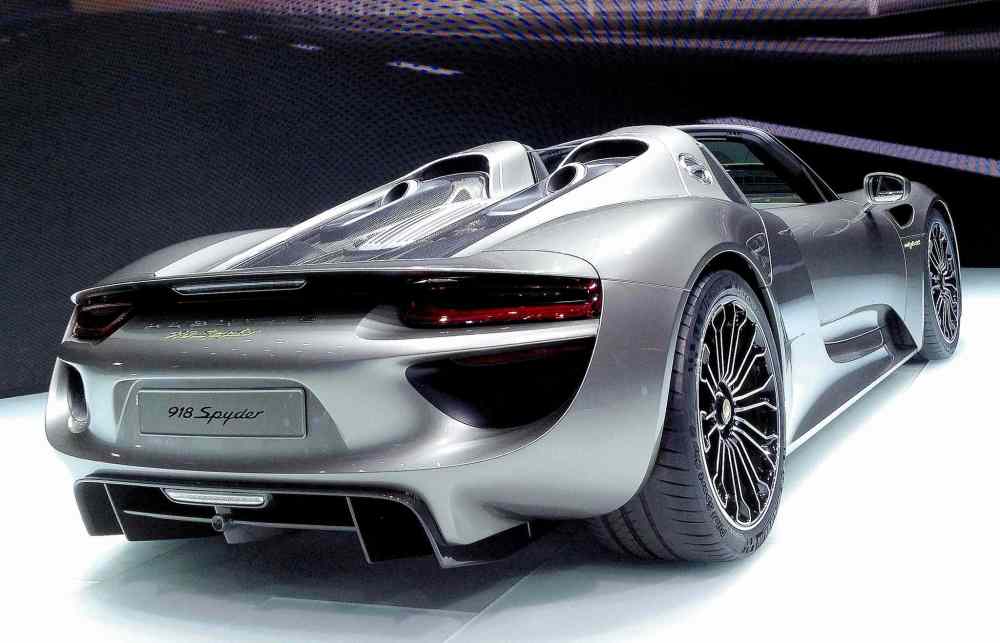
Of course, it’s fast!
Here’s the thing, though: There are varying degrees to its exclamation-point silliness. Like some kind of transformer-esque road rocket, the 918 has a performance range for everyone.
For instance, the timid and/or environmentally conscious could rotate the little steering wheel-mounted controller to the 918’s Electric mode. This would have the 129-horsepower and 156-hp electric motors on its front and rear axles (respectively) accelerating the 1,634-kilogram supercar to 100 kilometres an hour in 6.2 seconds.
That makes the electrified Porsche faster than the average sports sedan before its raucous 4.6-litre racing-inspired V8 has even started internally combusting.
One more notch up is the Hybrid mode. In this mode, the 4.6L lights off and, depending on the speed and throttle application, the gas engine may or may not add to the proceedings. Floor the throttle, for instance, and it will fire the big V8 and accelerate with more than enough urge to keep up with the 911 Turbo S that’s serving as our pace car around Valencia’s famed Ricardo Tormo Formula One race track.
On the gas, the 4.6L is a constant companion; cruise at a steady speed, however, and the gas engine will flutter (sometimes annoyingly) in and out of consciousness.
Toggle it up to Sport and things start getting really dramatic, the high-revving (9,150 — another exclamation point — rpm) V8’s bark now a constant reminder of the evil that lurks within. What was as quick as a sports sedan running on electricity alone now hauls down that seriously fast Turbo S up ahead with relative ease. It’s now seriously quick, though not quite worthy of those aforementioned exclamations points — yet.
That comes soon enough with one more toggle twist to the Race setting, which, through the miracle of combining lithium-ion, permanent magnets and high-compression pistons in just the right measure, now threatens to play bumper cars with our 911 Turbo S pace car every time the track straightens for more than a hundred metres.
This is when all that oh-my-God-ing starts in earnest. One second, you’re 100 metres back and the next, that 560-horsepower Turbo S risks becoming a hood ornament on the 918’s carbon-fibred bonnet.
What’s really scary, what renders the 918 transcendent, however, is that there is still one more to go. It’s called Hot Lap and, for this, one depresses the little rocket-launcher-like red button in the middle of the mode toggle.
In about the time it takes to circumnavigate Ricardo Toromo’s four kilometres at speed, the 918 dumps every bit of its 6.8 kilowatt-hours of lithium-ion as fast as those two electric motors can deplete them. No holding a few electrons back in reserve, no worrying about range anxiety, no wondering where the next plug-in station may be: The big battery just dumps every bit of electricity at its disposal to the wheels in one glorious burst of excess horsepower.
It might be true that, if one placed any credibility in the blogosphere, Ferrari’s 949-hp hybrid, the LaFerrari, will prove slightly quicker, but one has to wonder how much more adrenalin-charged one has to get than absolutely scared to death before the ridiculous really does become the sublime.
Thankfully, for we the moderately talented, the rest of the Porsche is up to the task. The chassis, basically two huge pieces of carbon fibre bolted together with six 12-millimetre high-strength steel bolts, offers the rigidity of pre-Cambrian Shield granite. Coupled with multi-adjustable Bilsteins and double-wishbones, it means there’s so little roll that one starts asking whether Porsche has sprung active suspension on us.
The crowning glory, though, is that the 918 also steers its rear wheels as well as its fronts. According to Michael Holscher, the 918’s technical project manager, the three degrees that the rear wheels can also turn is worth up to five seconds a lap around the Nxrburgring.
In other words, that measly three degrees of rotation is the difference between the 918’s much-vaunted sub-seven minute lap (6:57 to be exact) around the Green Hell and just another — ho-hum — seven-and-something circulation.
As impressive as the 918’s cut-and-thrust ability may be, however, it pales compared to its ability to scrub off speed. Like all hybrids, the 918 uses regenerative braking to recharge its battery. According to some reports, this regenerative braking resulted in some vagueness to the brake pedal, the reverse polarity of the electric motors not generating the feedback that a good old hydraulic system might.
I found no such tendency — at least at the racetrack. The feedback through the pedal was excellent. I was consistently out-braking Matthias Hoffsuemmer, Porsche’s former endurance racing tester, in the 911 Turbo, and it had far less to do with talent than with carbon ceramic brakes, a low centre of gravity and the huge (365/35ZR20 front and 325/30ZR21 rear) Michelin Cup Sport 2’s limpet-like grip.
The icing on the cake is that the 918 is also a relative piece of cake to drive fast, the all-wheel-drive system pulling as well as pushing, the electronic stability nanny ensuring that the front and rear wheels stay in line, and the electric power steering offering all of the precision of the hydraulic variety. Where Porsche’s previous attempt at supercar superiority, the Carrera GT, was the most difficult supercar I have ever driven, the 918 is one of the more user-friendly.
A few imperfections do arise, however, when you take the 918 out of its preferred racetrack milieu and try to do something normal with it like, say, commuting. In Electric mode, those aforementioned vague brakes do rear their ugly heads. Not so much spongy as springy, it feels like Porsche tried to imbue some “feedback” into its electronic braking but, instead of emulating a hydraulic system, they feel like artificial springs are pushing back on your foot. The sensation disappears the faster you drive and the more aggressive the driving mode selected but, at creeping speeds, they are just plain weird.
Then there’s the question of how truly frugal the 918 can be in everyday driving. On the one hand, it’s a hybrid, with all the expectations of frugality that those added electrons bring. On the other, it’s a freakin’ 887-horsepower supercar. Which of those diametrically opposed extremes holds sway?
It depends on the situation. We did, for instance, see 7.0 litres per 100 kilometres on one highway outing in Hybrid mode. In the city, though, 18.0 L/100 km was more the norm, unless we had sufficient juice to run completely electric which, if our experience is anything like everyday reality, the 918 can do about for 20 or 25 kilometres.

That’s a long way from those claims of 3.0 L/100 km, but nonetheless impressive considering the alternative. After all, how many US$845,000, 887-horsepower supercars capable of almost 350 km/h do you know that can manage seven litres on the highway?
One last idiosyncrasy is that while Porsche does make a quick-charging option with a 25-minute recharge — it takes four hours on a normal 110-volt circuit) — but for some reason it’s not compatible with North American charging ports.
Flies in the ointment, to be sure, but for now the 918 is the biggest, baddest supercar I’ve tested. And worthy of every exclamation point you can muster.
— Postmedia Network Inc. 2013