COMPARO: Infiniti Q50 AWD Hybrid VS Lexus IS 350 AWD F-Sport: Infinitely superior
The new Q50 wins this sports sedan comparison by a mile
Advertisement
Read this article for free:
or
Already have an account? Log in here »
To continue reading, please subscribe:
Digital Subscription
One year of digital access for only $75*
- Enjoy unlimited reading on winnipegfreepress.com
- Read the E-Edition, our digital replica newspaper
- Access News Break, our award-winning app
- Play interactive puzzles
*Billed as $5.77 plus GST every four weeks. After 52 weeks, price increases to the regular rate of $19.95 plus GST every four weeks. Offer available to new and qualified returning subscribers only. Cancel any time.
Monthly Digital Subscription
$4.99/week*
- Enjoy unlimited reading on winnipegfreepress.com
- Read the E-Edition, our digital replica newspaper
- Access News Break, our award-winning app
- Play interactive puzzles
*Billed as $19.95 plus GST every four weeks. Cancel any time.
To continue reading, please subscribe:
Add Free Press access to your Brandon Sun subscription for only an additional
$1 for the first 4 weeks*
- Enjoy unlimited reading on winnipegfreepress.com
- Read the E-Edition, our digital replica newspaper
- Access News Break, our award-winning app
- Play interactive puzzles
*Your next Brandon Sun subscription payment will increase by $1.00 and you will be charged $17.95 plus GST for four weeks. After four weeks, your payment will increase to $24.95 plus GST every four weeks.
Read unlimited articles for free today:
or
Already have an account? Log in here »
Hey there, time traveller!
This article was published 31/01/2014 (4493 days ago), so information in it may no longer be current.
Picking the winner of a sports sedan shootout is not something done by mining the spec sheets. Nor do the spoils of victory go to the car with the most features or highest price. Instead, the superior car can often be determined simply by which vehicle gets chosen most often when given the option to drive either one.
That choice was presented to us recently when Lexus provided a 2014 Lexus IS 350 AWD F-Sport, and Infiniti delivered its new Q50 AWD Hybrid S for a comparison of four-door performance sedans. Yes, the Hybrid presented a kink in the equality of the two models, but by most other measures these two stars of the middleweight class are equals — both AWD and V6 engines, both dressed in sports trim, both darned sexy in their own right.
So, after driving both cars through a range of conditions, and with both at my disposal over several days, one car kept luring me back to drive it again and again, while the other was only slightly more enticing than oatmeal for breakfast.
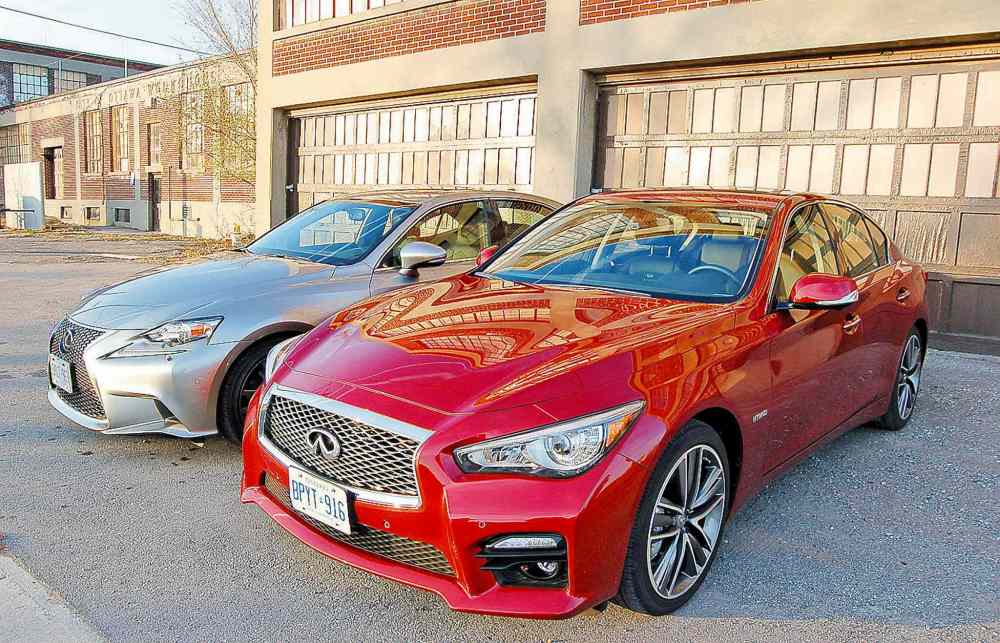
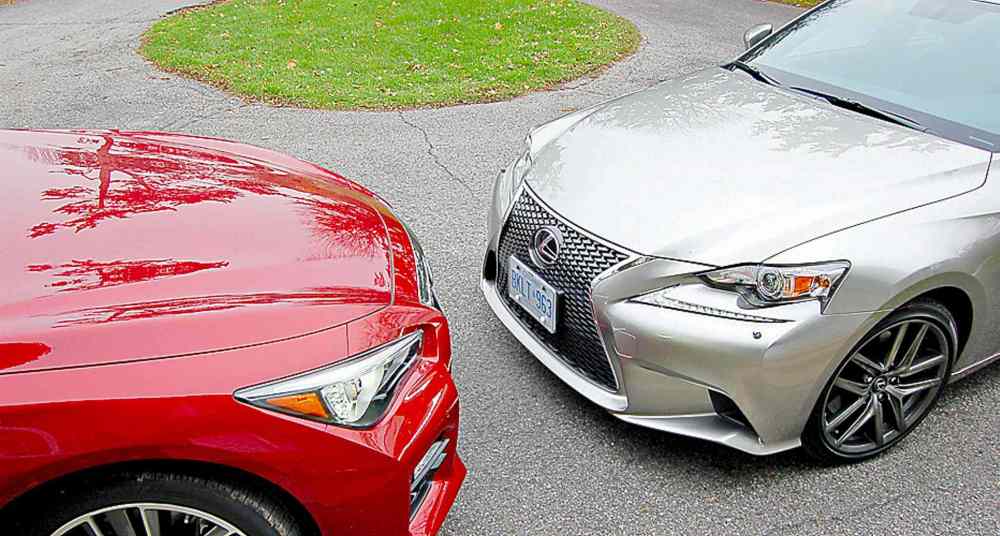
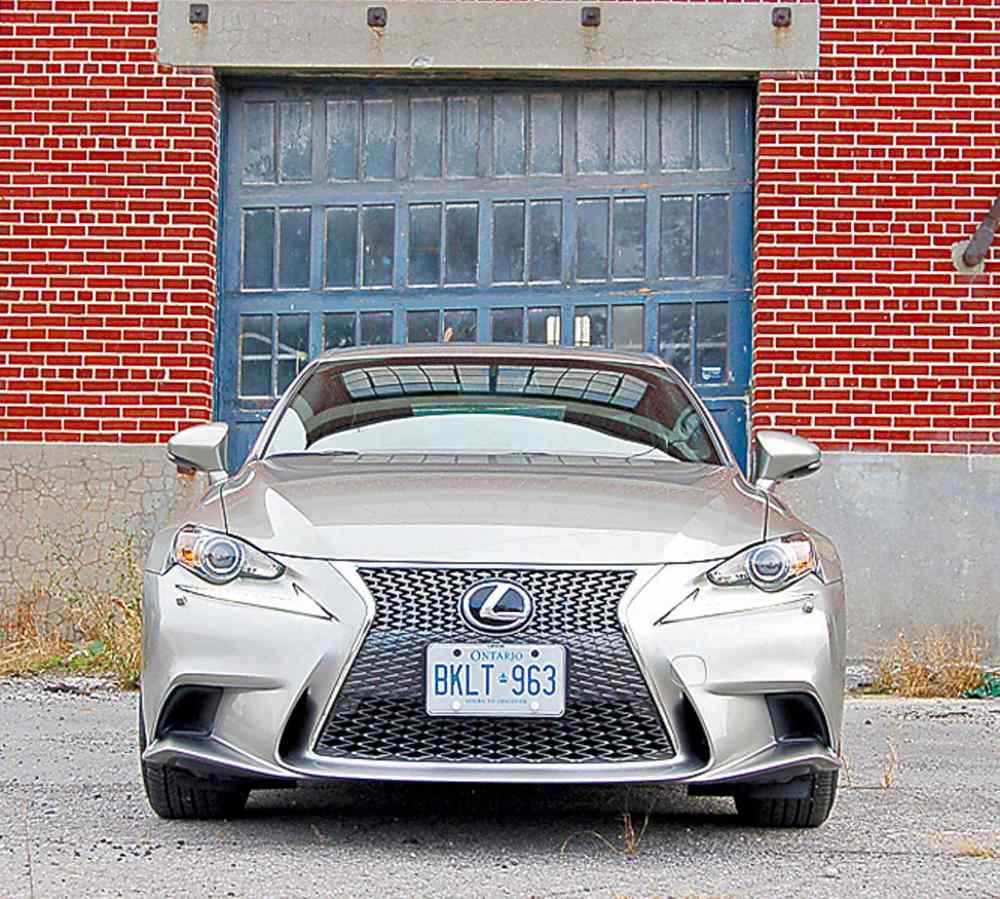
That’s not to say the runner-up is a yawner of a car. It’s just that winner was clearly more engaging and much more rewarding in so many ways. The first car to arrive was the Lexus. While the 18-inch wheels on the F-Sport looked a little small, the dark grey rims bestowed upon the car a hardened look. The snout, with its large grille flanked by a swooshy valance and bulbous HID headlamps, complemented by LED “ice picks” below the lamps, is as aggressive as it is unique. The design treatment carries into the rear flanks, though less successfully than the front.
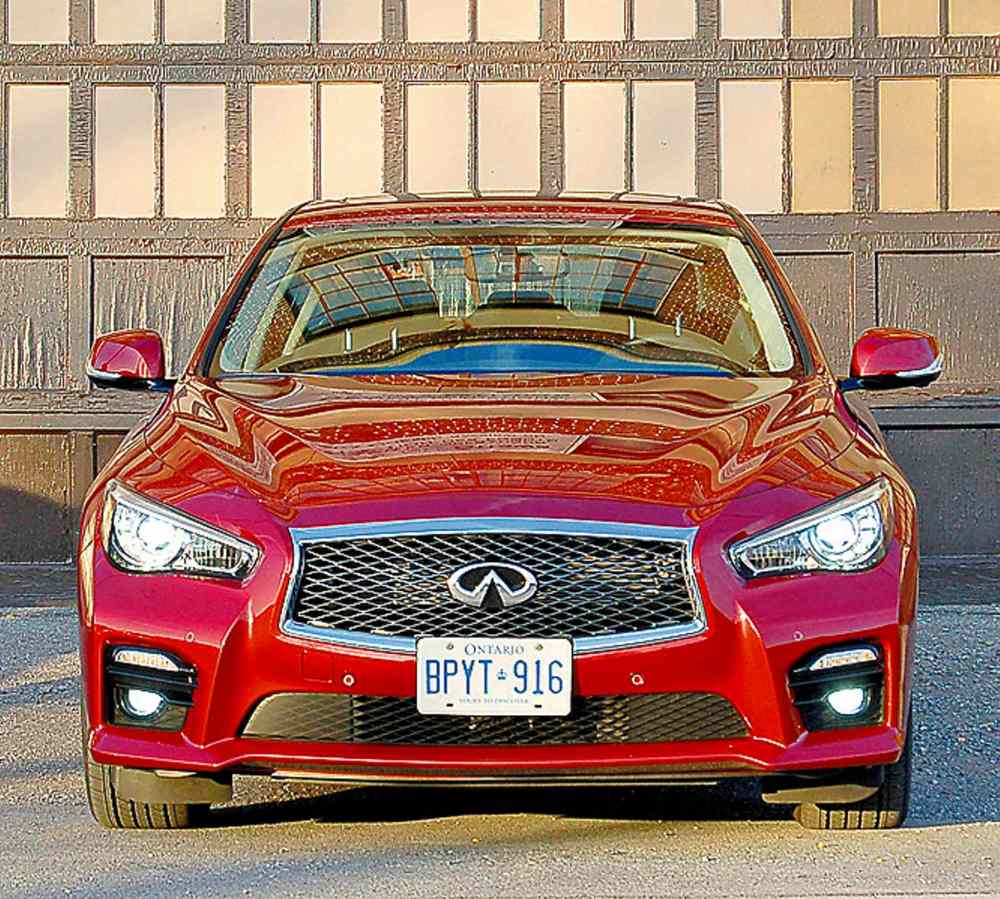
The F Sport brings aluminum pedals and other nice trim pieces, extra bolstering on the front seats, and an adaptive, variable suspension. The Q50, by comparison, has an equally attractive front, but benefits from a better overall design coherency, its 19-inch wheels and sharp crease along the beltline bonding the aggressive front and rear design elements that much better.
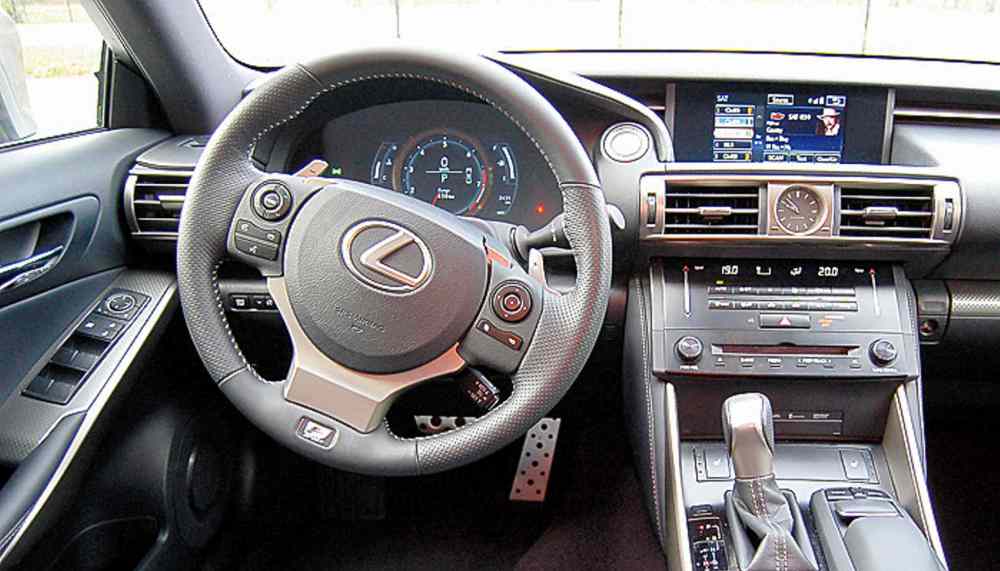
Inside is where the Lexus lags significantly behind the Infiniti. The IS interior feels akin to a 1990 stereo amplifier and turntable set, with multi-layers to the dash, a mouse in lieu of a touchscreen for climate and radio functions, and graphics that look as dated as Pac-Man. Still, the IS’s main instrument cluster, dominated by a large tach, is one of the best graphic displays I’ve seen on any car, though I’m not quite ready to give up on real gauges with real needles.
The IS also felt overly snug, and dark, with an all-black headliner and all-black interior. Rear-seat leg room was tight.
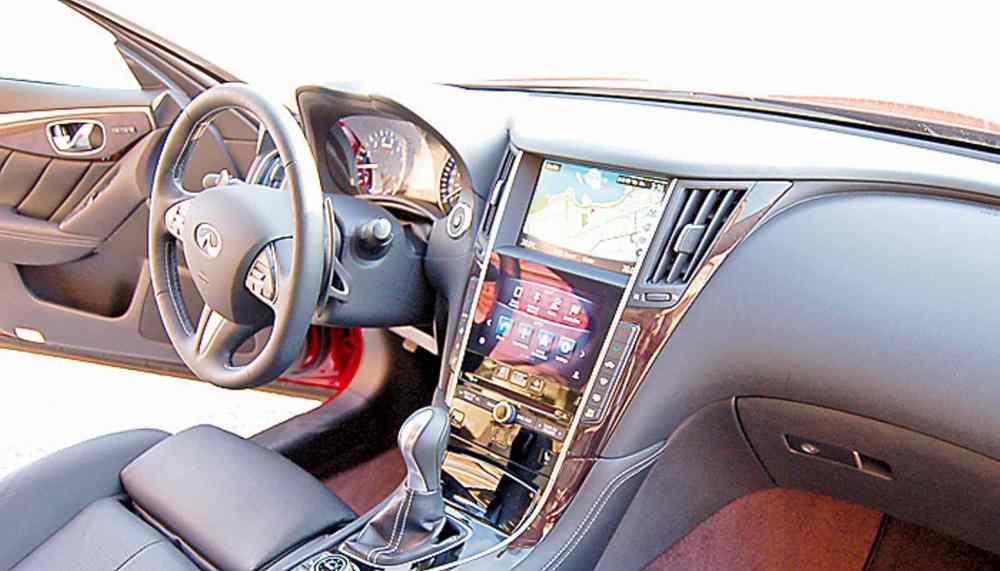
The Q50, however, was the picture of modernity, with outstanding graphic displays on a seven-inch, high-res touch screen that responded quickly to my finger’s commands. Another eight-inch touch screen handles navigation and other duties, and conventional buttons stand by as backups.
The Q50’s attractive instrument cluster is cloistered with yet another five-inch LCD display. With 22 more cubic feet of interior space, the Q50 felt much more spacious, too, and the quality leather sport seats were especially comfortable (as were those in the Lexus).
In short, the Q50 interior feels like the most recent iPad air, the Lexus like an aging Dell. The technological superiority of the Q50 is such that functions such as steering, ride quality and a plethora of driver nannies can be set individually and for different drivers. The Lexus did not even include memory seats.
A true sports car, however, ought to feel a little snug and not be overburdened with fancy controls, keeping to the basics so the driver can focus on the task at hand — driving — whether it’s snaking through those twisty bits of the Lanark Highlands or keeping the pace on a four-lane highway. Here, the Lexus gains on the Q50, mostly through its tight steering, which feels natural, progressive and reassuring no matter what road is being consumed. Overall handling in the Lexus is excellent. It might be the car’s best trait.
The Q50’s steering, on the other hand, is hyper sensitive thanks to its direct adaptive steering, otherwise known as steer-by-wire, where your inputs are relayed to a computer and it returns some feedback.
The system can be tailored to sensitivity — both effort and response can be adjusted. Standard mode brought the best mix, but “quick mode” was almost too twitchy and felt plain weird sometimes. I suspect the adaptive steering might be beneficial on a race track, but it does take some getting used to, since it reacts instantly. It certainly feels more artificial than the electric power steering in the Lexus.
The blue ribbon for acceleration, though, handily went to the Q50, in part because of the Hybrid’s boost in horsepower. Where the standard issue Q50 gets 328 horsepower from a 3.7-litre V6, the Hybrid jumps to 360 combined horsepower from the lithium-ion battery and 50-kilowatt electric motor. While the electrons can allow the hybrid to idle without using fuel, of course, and travel to about 50 km/h in electric mode before needing help from the gas, the more important number is the torque, which comes in at 403 pound-feet, 126 more than the Lexus. Not only does the Q-ship feel fast, zero to 100 km/h requires 5.4 seconds. The Lexus, equipped with a six-speed automatic (the rear-wheel drive can be had with an eight-speed auto) and 3.5-litre V6 with 306 horsepower, requires 5.7 seconds, Lexus says.
The Q50 Hybrid, perhaps because it weighs 80 kilograms more, didn’t feel as agile as the Lexus, though in sport mode the Q50 felt confident, and quicker on the off-ramps.
Despite one car being a hybrid, average fuel economy in city driving was nearly a tie at 12.4 L/100 km for the Q50 and 12.8 for the Lexus. The transition between full-electric and gas-electric in the Q50 is noticeably robust, though not bothersome. The brakes on the Q50 are especially sensitive, however, requiring your best modulating foot to stop with smoothness, unlike the Lexus, which stops with steady and consistent force.
The cars were equally good at controlling noise and vibration, though the Lexus sounded louder at idle. The Lexus also has a built-in sound enhancer to better detect engine sounds under acceleration.
So, there are the numbers, and on paper the Infiniti is the better car. In real life, too, the Q50 is the car I wanted to drive every day, even when I could have driven the Lexus.
No question, the IS 350 is a fine sports sedan some might find more “pure.” But in this back-to-back comparison, the IS simply lacked the attraction and sophistication of the Q50 — which wins this duel through performance, technology and simple driver satisfaction.
— Postmedia Network Inc. 2014