2013 FERRARI F12 BERLINETTA: The limit
The F12 is fast, seriously fast, heart-in-your-throat, pinned-in-your-seat fast
Advertisement
Read this article for free:
or
Already have an account? Log in here »
To continue reading, please subscribe:

Digital Subscription
One year of digital access for only $205*
- Enjoy unlimited reading on winnipegfreepress.com
- Read the E-Edition, our digital replica newspaper
- Access News Break, our award-winning app
- Play interactive puzzles
*First annual payment billed as $205.00 + GST for one year. This annual subscription will automatically renew at $233.00 + GST every 52 weeks (10% off the regular annual price of $259.35). Offer available to new and qualified returning subscribers only. Cancel any time.
To continue reading, please subscribe:
Add Free Press access to your Brandon Sun subscription for only an additional
$1 for the first 4 weeks*
- Enjoy unlimited reading on winnipegfreepress.com
- Read the E-Edition, our digital replica newspaper
- Access News Break, our award-winning app
- Play interactive puzzles
*Your next Brandon Sun subscription payment will increase by $1.00 and you will be charged $17.95 plus GST for four weeks. After four weeks, your payment will increase to $24.95 plus GST every four weeks.
Read unlimited articles for free today:
or
Already have an account? Log in here »
Hey there, time traveller!
This article was published 31/01/2014 (4551 days ago), so information in it may no longer be current.
On the Maricopa Highway, deep in Nowheresville, California– I suppose, somewhere deep down, I always knew this day would come.
Not that I didn’t do my best to repress it or, as is the custom with all males, delve into the kind of denial that let O.J. Simpson claim, nay believe, that he was innocent. We of the XY chromosome are nothing if not industrious in denying our limitations.
Nonetheless, I must admit that I think I have found the limit. At the very least, I have found my limits. Indeed, I will now officially renounce the automotive gearhead’s official credo, that which is central to all things sports car aficionados do and believe, the inspiration that gets us up in the morning, the addiction that keeps us out in the garage to all hours and the reason we pore over hot-rod magazines in the quest of ever more go-faster parts.
I have seen too much horsepower and found it — and Lord, this pains me to admit — more than enough. Nay, I will debase myself even further: It’s more than I can handle.
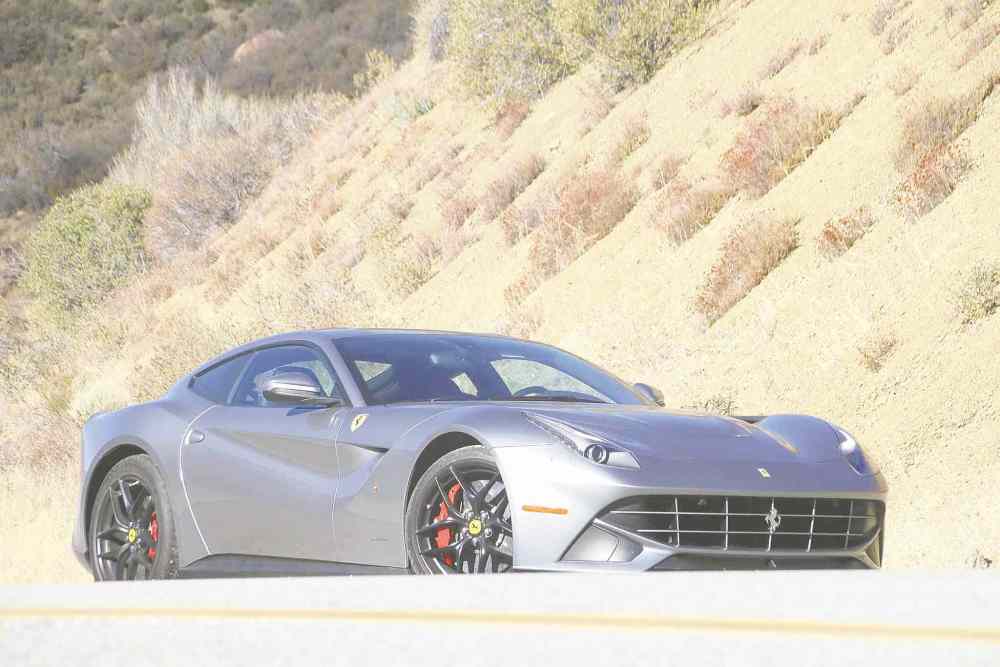
I must, before completely embarrassing myself further, offer a few caveats that I might retain some semblance of my masculinity. Considering the outrageous supercars that have gone before, the 2013 Ferrari F12 Berlinetta is, incredibly, the most powerful Ferrari road car ever sold to the public. It also sends its power only to the rear wheels, unlike the (recently tested) Porsche 918, which boasted even sillier levels of brute force.
Perhaps if Ferrari had chosen to have the F12’s monstrous 6.2-litre V12 power all four wheels, as is all the rage among supercars these days, I might not be writing this Dr. Phil confessional.
Nevertheless, I have to say that hooning about on California’s Maricopa Highway — as sinewy a piece of tarmac as you’ll find in the Sunshine state — the F12’s 725 horsepower is more than I need. Way more.
Even the longest straights — and they are few — are gobbled up short-shifting the big V12 at 6,000 rpm. Even so restricted, the F12 rushes into corners at such warp speed that the big Brembo carbon-ceramic discs are rendered a necessity rather than dilettantish fashion accessory.
Trying to use more of the big engine’s oomph ends up being counterproductive, my aging synapses not able to process the speed nearly fast enough to set up for the next corner. In my defence, the Ferrari’s power is so prodigious that even lollygagging in its mid-range, it leaves a Porsche 911 Turbo gasping in its wake.
A quick calculation — later, after a soothing camomile tea calms jangled nerves — reveals that the F12 makes more power short-shifting at 6,000 rpm than the turbo Porsche does at full chat. Perhaps you’ll now understand the ignominy of my situation; this Ferrari, supposedly a grand touring car, took everything I had to offer and still had another 200 horsepower and 2,500 rpm in reserve.
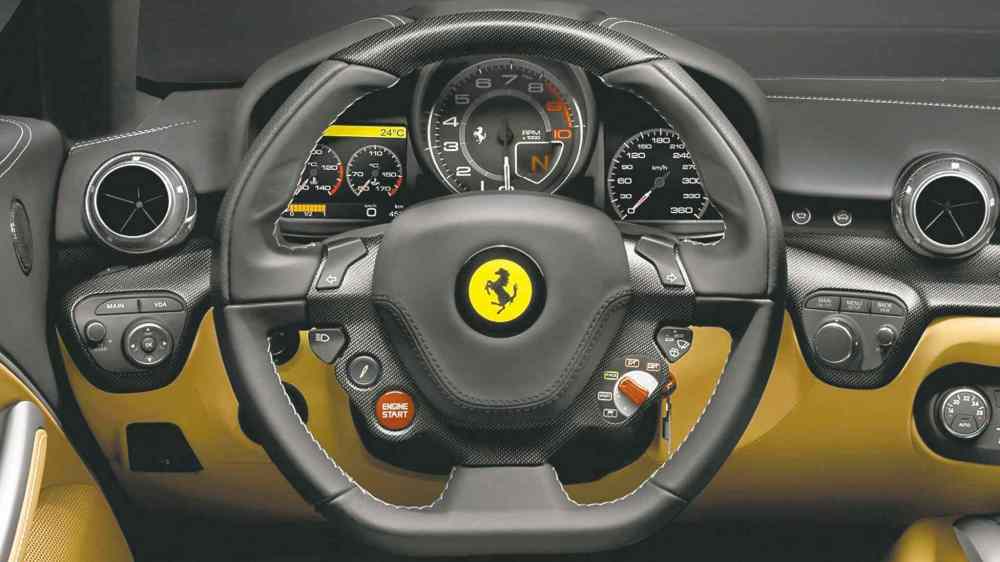
The F12’s Formula One steering wheel has five little shift-point LEDs, each demarcating a different power level — 5,500, 6,200, 7,000, 7,750 and finally, for those truly brave of heart, 8,450 rpm — along the F12’s path to warp speed. Roiling as fast as I can along the Maricopa, I manage to light but the first — and that only rarely — with the row of unlit LEDs constantly mocking my lack of cojones.
So the F12 is fast. Seriously fast. Heart-in-your-throat, pinned-in-your-seat fast. Exactly how fast, though, is open to some interpretation. Ferrari itself says the F12 will accelerate to 100 kilometres an hour in 3.1 seconds and to 200 in just 8.5 (on its way to 340 km/h). But real-world testing has seen figures vary from a rather mediocre (as if accelerating to 100 km/h in under four seconds could ever be considered mediocre) 3.6-second sprint to another test that proclaimed the big Ferrari the quickest rear-wheel-drive production car ever, with a recorded Veyron-challenging time of 2.9 seconds.
The one thing agreed upon by all is that the F12’s rapidity is not limited by power (those screaming 725 horses are fortified by 509 pound-feet of torque) but by the frailty of the rubber-tarmac interface. The F12’s (optional) Michelin Pilot Super Sports may be 315 millimetres wide and have the consistency of well chewed Wrigley’s Doublemint, but there are only two of ’em, and they haven’t a prayer of containing the V12’s fury.
Thank the Lord, then, for traction control that monitors such things as yaw, steering angle and engine speed, cutting power when any number of combinations (such as too much yaw, or oversteer, combined with a sudden spike in rpms) indicate the poor shmo behind the wheel is in way over his head.
The F12’s steering wheel-mounted Manettino offers a number of options with ever-increasing degrees of rear-wheel-steering latitude — Wet, Sport, Race, CT Off and ESC off — this last disabling all of the Ferrari’s electronic stability control aids and best reserved for people named Michael or Mario. I never got the little red knob past Race, survival instinct trumping any fleeting notion of testing the F12’s limits.
Such outrageous speed literally mandates the F12’s huge carbon-ceramic discs and six-piston Brembos. Like the throttle, the brake pedal is incredibly sensitive, the merest brush with a heavy right foot enough to simulate running into the proverbial brick wall. It’s hard to imagine the big Brembos ever fading, despite the F12’s rather portly 1,746 kilograms.
That rather hefty curb weight (the company’s 458 boy-racer is at least 360 kilos lighter) is all but completely disguised behind the wheel, the F12 offering Ferrari’s classic hair-trigger steering that makes the Berlinetta feel more 600-cc superbike than two-ton grand touring automobile. It dives for apexes like a car a thousand pounds lighter and a foot shorter. At the limits of traction, one suspects that the F12 might be tougher to corral back into line than the mid-engined 458, but it’s nonetheless impressive that something so large is so willing.
It certainly plays against type. The F12 is, after all, a classic front-engine, rear-wheel-drive sports car (as opposed to the modern mid-rear-engine layout characterized by the 458). And even if Ferrari’s radical rearward placement of the big V12 in the front engine bay does result in a fairly balanced 46/54 weight distribution, virtually all classic front-engine cars have been relegated to grand touring status, that somewhat-condescending pejorative reserved for something lesser than a pure sports car.
Aston Martins and Jaguars have adapted to this characterization, their high-powered sportsters typically softer and more comfortable than their Lamborghini and McLaren competitors. And certainly some of its forbears — the 550 Marenello comes to mind — were not nearly this heart-attack serious.
But not only is the F12 more powerful than anything except the recent spate of hyper-hybrids about to hit the market (mid-engined all, by the way), but its suspension offers little of the spongy softness typical of gentlemen’s expresses. Oh, there’s a soft-ish suspension setting available, but rather than labelled “Soft” or “Comfort” or some other squishy sobriquet for compliant, it’s called “bumpy roads,” Ferrari seemingly unwilling to admit there’s anything even remotely soft about the F12.
So, if you’re in the market for an F12 — those of you who have the requisite $350,000+ burning a hole in your pocket — understand that the F12 is not for the faint of heart. It’s not an upgrade from your Mercedes SL550 or Jaguar XK. It may indeed share their classic front-engine, rear-drive layout, but Ferrari has infused it with enough blunt force and suspension trickery to keep up with all the mid-engined nancy boys. It’s as singularly focused as a rear-wheel-drive sports car will ever be.
Most certainly, it is capable of more speed than your humble scribe can muster. The car is willing, but the driver is weak.
All this talk of the F12’s incredible turn of speed should not be confused with a lack of sophistication. The big V12, for instance, which revs so freely to 8,700 rpm redline is completely tractable at 1,500. Indeed, in auto mode, the double-clutch manumatic shifts from sixth to its overdrive seventh gear at just 60 km/h, the F12 purring along as if it were a come-to-meeting Camry.

The F12 is also surprisingly roomy, perfectly capable of all-day comfort should the Learjet be temporarily grounded. Even the cargo hold is surprisingly commodious, able to swallow a full-sized golf bag, as long as it is custom-designed by Ferrari.
And while labelling your cruise-control system “Pit Speed” may be a pretension beyond the pale, what it lacks in subtlety, it more than makes up for in excellent ergonomics. Its simple one-button activation lets you set a desired speed easier than any other system I’ve encountered. The steering wheel-mounted turn signals may take some getting used to, but there should be no doubting they are superior to the archaic stalks everyone else uses.
The F12 will also activate the parking brake automatically, “hill hold” when starting off on inclines and, with the punch of a little button, raise its front end majestically in the air to prevent the crunching of expensive carbon fibre over curbs.
None of this is even remotely helpful in containing those aforementioned 725 horses, but it’s ever so appreciated when you’re not trying to set lap records.
— Postmedia Network Inc. 2013