Bird of summer
For local Winnipeg couple, classic Thunderbird is a lifestyle choice
Advertisement
Read this article for free:
or
Already have an account? Log in here »
To continue reading, please subscribe:

Digital Subscription
One year of digital access for only $205*
- Enjoy unlimited reading on winnipegfreepress.com
- Read the E-Edition, our digital replica newspaper
- Access News Break, our award-winning app
- Play interactive puzzles
*First annual payment billed as $205.00 + GST for one year. This annual subscription will automatically renew at $233.00 + GST every 52 weeks (10% off the regular annual price of $259.35). Offer available to new and qualified returning subscribers only. Cancel any time.
To continue reading, please subscribe:
Add Free Press access to your Brandon Sun subscription for only an additional
$1 for the first 4 weeks*
- Enjoy unlimited reading on winnipegfreepress.com
- Read the E-Edition, our digital replica newspaper
- Access News Break, our award-winning app
- Play interactive puzzles
*Your next Brandon Sun subscription payment will increase by $1.00 and you will be charged $17.95 plus GST for four weeks. After four weeks, your payment will increase to $24.95 plus GST every four weeks.
Read unlimited articles for free today:
or
Already have an account? Log in here »
Hey there, time traveller!
This article was published 08/05/2014 (4481 days ago), so information in it may no longer be current.
By 1965, Ford’s Thunderbird had reached it’s 10th year of production. What began in 1955 as a two-seat personal car, conceived as an upscale alternative to the Chevrolet Corvette, was now much more.
Buyer demographics had changed, and the Thunderbird was now seen as the personal-luxury leader in the field. A true four-passenger coupe or convertible since 1958, the Thunderbird offered buyers something competitors couldn’t — a heritage and a following that carried it from the showroom to the street.
Available with all of the optional amenities, the Thunderbird was a unique vehicle that carried you in style, with a quiet and smooth ride that said you’d arrived.
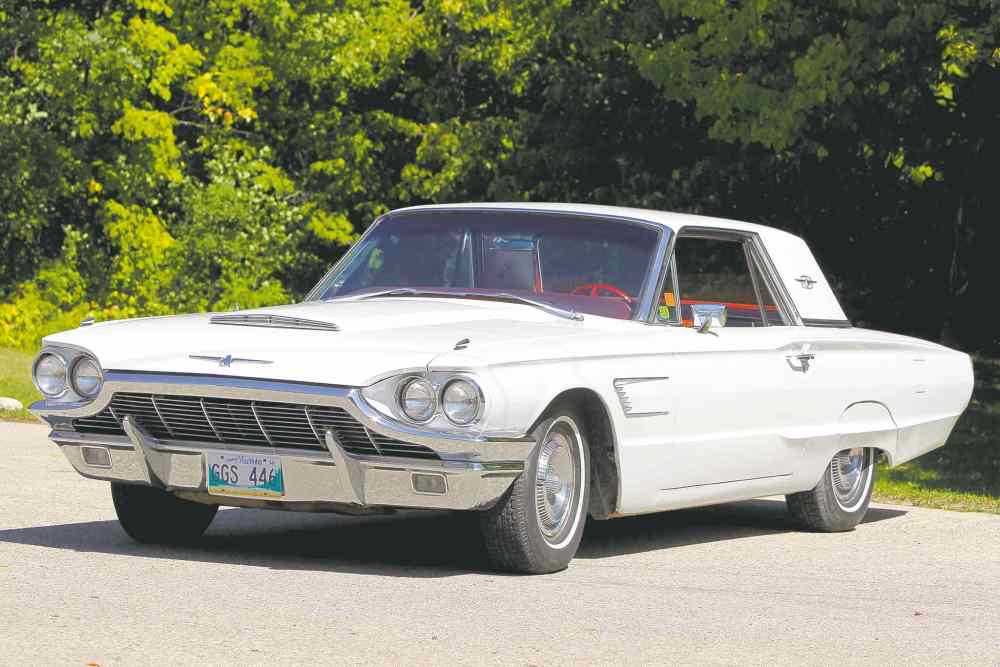
The ’65 Thunderbird, riding on a 113.2-inch wheelbase, was in the second year of a three-year styling phase and so received only mild visual enhancements over the ’64 model. Simulated chrome-trimmed air scoops could be found in the front fender along with a new crest replacing the Thunderbird script on the leading edge of the hood. Fender-mounted turn indicators and sequential rear turn signals were now standard equipment.
The Swing-Away steering column, introduced as an extra-cost option in 1961 and made a standard feature in 1963, continued for ’65. With the gear selector in the “Park” position, the steering column could be moved 10 inches to the right, making access and egress to the passenger compartment easier for the driver.
The interior also continued to feature unique, aircraft-inspired toggle switches and levers for controls, and there was a ribbon-style speedometer that ran the length of the gauge cluster.
Power for the Thunderbird remained the 300-horsepower, 390-cubic-inch Thunderbird V8. Equipped with four-barrel carburetor and dual exhausts, it produced 427 lb-ft of torque and was powerful enough to move the nearly two-ton T-Bird smartly down the freeway.
For John and Suzanne Courcelles of Winnipeg, the mid-60s Thunderbird is a lifestyle choice. Already owners of a classic two-seat 1957 Thunderbird, the ’65 was a good fit in their classic-car family.
“In 2012, I wanted to find a car from the year I was born and, after checking out a ’65 Chevrolet Impala, I heard about a Thunderbird that was for sale,” Courcelles recalled.

The 1965 Thunderbird hardtop, finished in Wimbledon White with red leather interior upholstery, is one of 42,652 produced that year. Equipped with features like power steering, power assisted front disc brakes, Swing-Away wheel, AM radio, front bucket seats, centre console, tinted glass, power seat, whitewall radial tires with fender skirts and full wheelcovers, It’s a classy package and ready for the road.
The car was originally sold in Thompson, Manitoba and was a daily driver until 1968 when it was traded in. The second owner had a different idea and kept the Thunderbird as a summer-only vehicle, storing it during the harsh winter months.
For the Courcelles family, the Thunderbird makes an exceptional summer driver. With its ample trunk and smooth ride, it’s easy to pack up and get away to the lake for weekends and regular trips to the golf course.

“The car offers great comfort on trips and is a joy to drive,” Courcelles said.
The Thunderbird would continue with very close styling for 1966, but sales declined by as much as 20 per cent due to competition from other brands in the personal luxury field. Additional pressure from the sporty new Ford Mustang and, in 1967, the arrival of the Mercury Cougar.
While the marque soldiered on for the next 30 years, the Thunderbird would disappear in 1997. A reintroduction in 2001 saw the Thunderbird return as a two-seat roadster, but slow sales forced Ford to cease production in 2005.
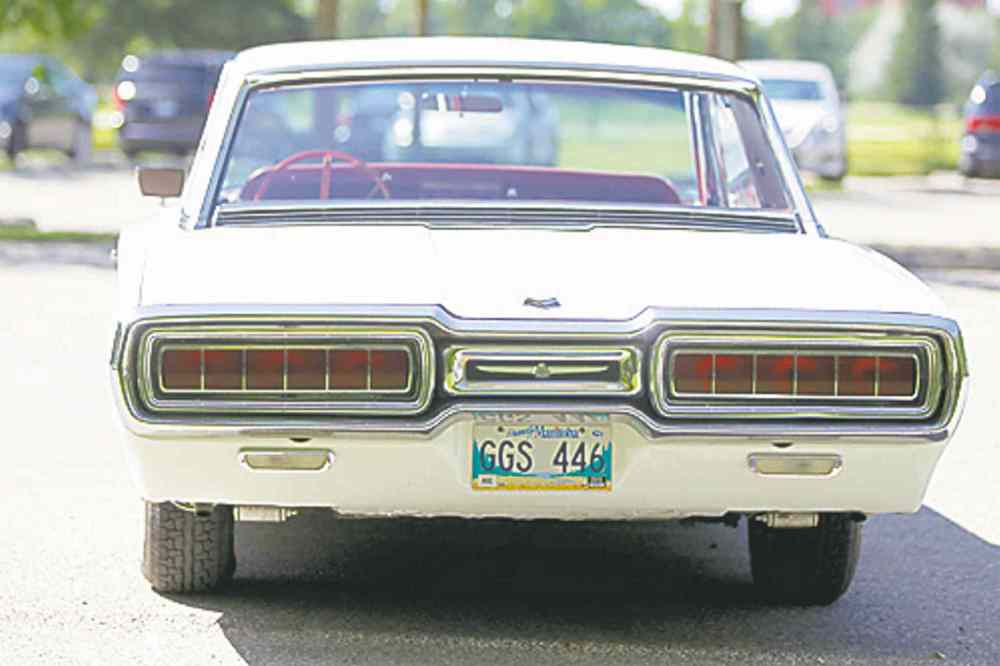
Today, the classic Thunderbird has a steadfast collector-car following that breaks down into segments that include the original 1955-to-1957 two-seat roadsters, the 1958-to-1960 square-birds, the 1961-to-1963 aero-birds and the fourth-generation 1964-to-66 models.
But whatever your preference, the Thunderbird is and always will be a winner among the personal-luxury set.