Too big for the BBC
In the case of Jeremy Clarkson versus Top Gear, the talent clearly overshadowed the concept
Advertisement
Read this article for free:
or
Already have an account? Log in here »
To continue reading, please subscribe:

Digital Subscription
One year of digital access for only $205*
- Enjoy unlimited reading on winnipegfreepress.com
- Read the E-Edition, our digital replica newspaper
- Access News Break, our award-winning app
- Play interactive puzzles
*First annual payment billed as $205.00 + GST for one year. This annual subscription will automatically renew at $233.00 + GST every 52 weeks (10% off the regular annual price of $259.35). Offer available to new and qualified returning subscribers only. Cancel any time.
To continue reading, please subscribe:
Add Free Press access to your Brandon Sun subscription for only an additional
$1 for the first 4 weeks*
- Enjoy unlimited reading on winnipegfreepress.com
- Read the E-Edition, our digital replica newspaper
- Access News Break, our award-winning app
- Play interactive puzzles
*Your next Brandon Sun subscription payment will increase by $1.00 and you will be charged $17.95 plus GST for four weeks. After four weeks, your payment will increase to $24.95 plus GST every four weeks.
Read unlimited articles for free today:
or
Already have an account? Log in here »
Hey there, time traveller!
This article was published 02/04/2015 (4132 days ago), so information in it may no longer be current.
I suspect that to most Canadians, indeed virtually everyone on this side of the North Atlantic, the British Broadcasting Corporation’s firing of Jeremy Clarkson must seem like much hullabaloo about nothing.
After all, Top Gear, the program he hosts, is but a car show, something normally relegated to the deepest, darkest recesses of cable television here in North America, and then only at the most ungodly of hours. The concept that someone, let alone 350 million someones, should care enough to protest his dismissal for taking a swing at Oisin Tymon, the show’s producer, is unfathomable to those who couldn’t give a fig about a lowly car show.
Of course, that’s mostly because those who haven’t seen the show don’t realize that, just like Survivor isn’t about camping skills and the popularity of Hell’s Kitchen has nothing to do with cooking, Top Gear isn’t really about cars. It is a character play, plain and simple. The cars, no matter how super they might be, are mere props in the BBC’s automotive commedia dell’arte. There are hundreds of car shows produced around the world and even more car-crazed YouTube snippets, and many have access to the same phantasmagoric sleds as Clarkson, Hammond and May. Yet Top Gear remains a worldwide cultural phenomenon in a genre normally known for its obscurity.
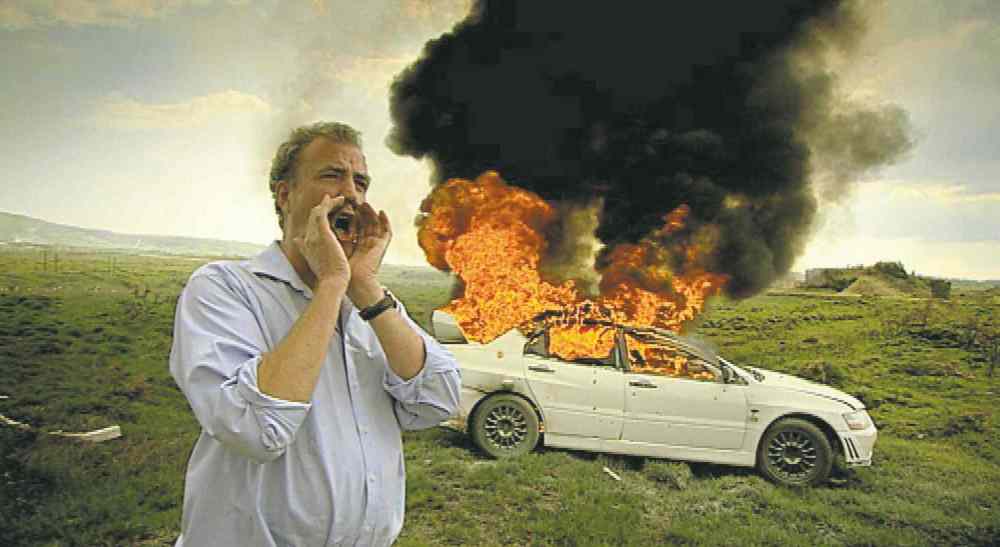
One could cite Top Gear’s incredible production values — rumours run rampant that the BBC spends as much as $1-million per episode for its weekly reviews — for its success. But then many TV shows have fallen by the wayside, despite huge budgets. And, yes, its skit-like montages are hilarious, but the show has no monopoly on humour.
The BBC, looking to salvage the show with a new host, will tell you that Top Gear was always an ensemble piece, Richard Hammond and James May equally responsible for the show’s success. But that would be forgetting the lessons of Honey Boo Boo, Richard Hatch and the even more controversial Charlie Sheen. Television likes its characters writ large and Clarkson is, even to his detractors, the largest of them all.
Oh, Hammond’s chirpy little squirrel-with-his-head-chopped-off routine is endearing and May’s impression of a sleepy-eyed Charlie Watts wondering what all the fuss is about adds humorous counterpoint, but Clarkson’s riff on the classic outspoken (if you’re a fan; racist and misogynist if you’re not) old curmudgeon is picture perfect.
The reason 350 million people — far beyond the number that would normally watch a car show, no matter how edifying — tune in every week is simple; they want to see what the H-E-double-hockey-sticks Clarkson is going to say next.
And, of course, he delivers. His affronts are legendary — his last run-in with the BBC’s regulators was when he offended the entire country of Argentina with just a licence plate. He has insulted politicians (not so controversial) and foreigners (very controversial), feigned a Nazi salute (unforgivable) and glamorized drunk driving (I’ll leave you to search for a suitable derogatory descriptor). Even Hammond and May, two friends he clearly adores, are not spared, clearly the only voice he trusts being his own. It is a narrowness of opinion that, unfortunately for the BBC in this fracas, 350 million viewers agree with.
And that’s what has fans around the world so baffled. The one question heard over and over in this great debate is how could the BBC risk losing someone with so many loyal followers. Top Gear is, after all, the most popular show the BBC produces — indeed, Guinness World Records cites it as the most widely watched factual TV program in the world — and the petition calling for Clarkson’s reinstatement quickly passed one million signatories.
I, ever the cynic, would posit that it is precisely because of his incredible popularity that Clarkson was let go. Indeed, lost in all this brouhaha is that the BBC was going to cancel Top Gear in 2002 until Clarkson weighed in to save it. Now it is, to paraphrase Wall Street, the show too big to fail.
Legion are the managers who rebel at the notion that the talent is bigger than the concept and I suspect that there was more than a hint of jealousy and caste-system hierarchy behind the decision not to re-sign Clarkson’s contract.
As with so many such dismissals, the Yorkshire punch-up may not have been the reason for his dismissal, only the excuse. Because there was recourse in this oh-so-public scrum. In fact, fairly simple recourse.
Clarkson, like so many troubled TV personalities, is reputed to have a bit of a love/hate relationship with alcohol. Indeed, on the day of the dust-up in question, his partners in crime were reportedly three sheets to the wind, May so soused that he claims no recollection of the events, saying he was “blind drunk.” The chances Clarkson would have planted one on Tymon — along with, it is reported, a long torrent of verbal abuse — without libation being involved are relatively remote.
Not that this is any excuse for such heinous bullying, but it would have allowed BBC, had it really wanted to salvage Clarkson’s career (and Top Gear’s popularity), to do what producers have always done with their poorly behaved celebrities: package him off to whatever the British equivalent of the Betty Ford Clinic is. Thirty days later, Clarkson could emerge to pronounce a few poignantly contrite mea culpas from a carefully staged pulpit and then continue on with his quest to offend the entire world.
Instead, Clarkson is fired; Top Gear’s future is in doubt and the train wreck that seemingly the entire world loves to watch is off the public airwaves.

Clarkson is a boor. Of that there can be no question. But he’s a boor that 350 million people in 212 countries and territories tune in to watch with religious fervour. And they watch him precisely because he is a boor.
That may not be politically correct, but let’s be perfectly honest here: nobody is watching Top Gear for the cars.
–Postmedia Network Inc. 2015