The EV that isn’t, but will soon be
2024 Hyundai Kona looks every bit electric, but it’s just gas for now

Advertisement
Read this article for free:
or
Already have an account? Log in here »
To continue reading, please subscribe:

Digital Subscription
One year of digital access for only $205*
- Enjoy unlimited reading on winnipegfreepress.com
- Read the E-Edition, our digital replica newspaper
- Access News Break, our award-winning app
- Play interactive puzzles
*First annual payment billed as $205.00 + GST for one year. This annual subscription will automatically renew at $233.00 + GST every 52 weeks (10% off the regular annual price of $259.35). Offer available to new and qualified returning subscribers only. Cancel any time.
To continue reading, please subscribe:
Add Free Press access to your Brandon Sun subscription for only an additional
$1 for the first 4 weeks*
- Enjoy unlimited reading on winnipegfreepress.com
- Read the E-Edition, our digital replica newspaper
- Access News Break, our award-winning app
- Play interactive puzzles
*Your next Brandon Sun subscription payment will increase by $1.00 and you will be charged $17.95 plus GST for four weeks. After four weeks, your payment will increase to $24.95 plus GST every four weeks.
Read unlimited articles for free today:
or
Already have an account? Log in here »
Hey there, time traveller!
This article was published 21/09/2023 (1096 days ago), so information in it may no longer be current.
AYER’S CLIFF, Que. — You could be forgiven for thinking the 2024 Hyundai Kona is an electric vehicle.
It’s not. Yet.
“The design started as an EV, so there’s no compromise on EV design,” said Steve Flamand, executive director of product planning for Hyundai Auto Canada.
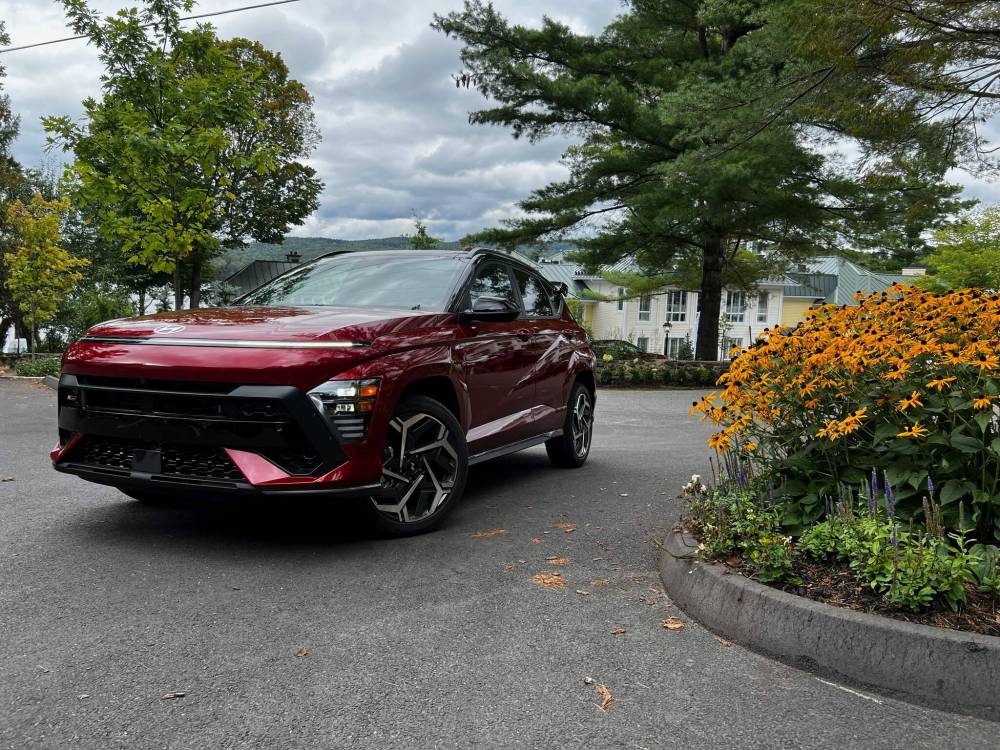
Kelly Taylor / Winnipeg Free Press
The 2024 Hyundai Kona N-line model will soon be followed by entry-level models and, next year, an EV version.
The Kona comes, for now, with a 1.6-litre turbo gas motor, soon to be followed by a 2.0-litre naturally aspirated four-cylinder. Early next year, however, the reason for its design origin becomes clear: an EV version will hit the market.
Built into the gas versions are some subtle design features that hint at its electric future: louvres cover the front grille opening, set to open when engine temperatures demand extra airflow for cooling. The net effect is that when the EV, which requires far less airflow, arrives, the visual differences won’t be as stark as between today’s Kona and Kona EV.
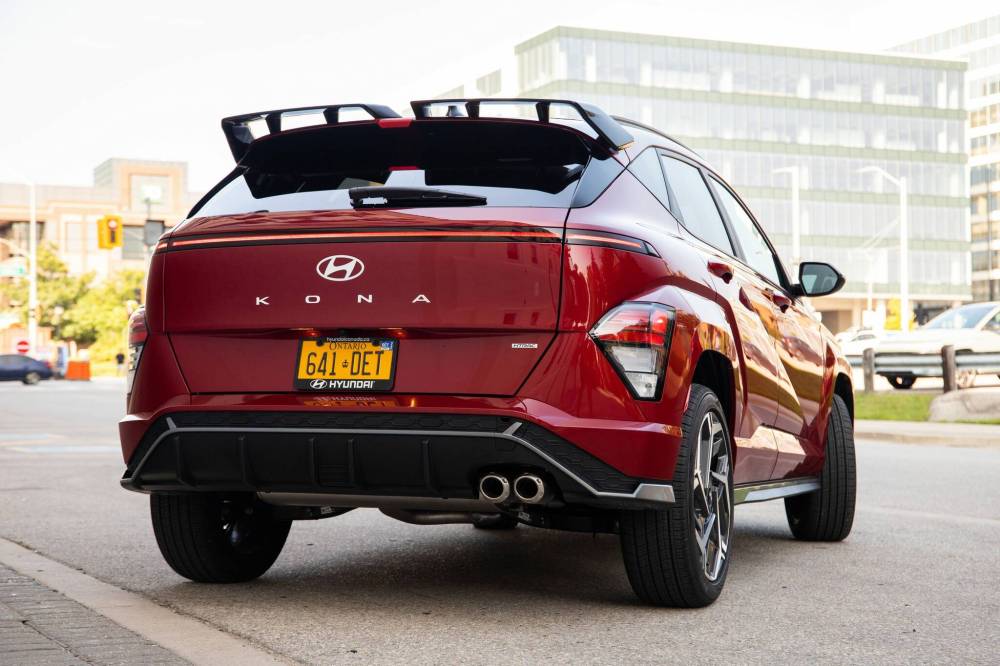
The continuous strip of LED lights just forward of the hood opening, and across the rear tailgate, also suggest EV. In the actual EV, however, those strips will be composed of little square dots, or pixels, as a visual clue to the powertrain within and a nod to the pixels composing the taillights of the IONIQ 5 EV.
The big news about Kona is its size, however. It’s grown to be similar in size to the last generation Tucson, which in its current generation is also bigger than it used to be.
“Some of the feedback we got from customers was it’s a really good car but interior room and cargo space is a little tight,” Flamand said at a gathering of automotive journalists here in Quebec’s eastern townships to drive the new Kona.
The size difference is noticeable, both in the extra 77mm of rear set legroom and in the extra 179 litres of space (now 723 litres) in the cargo bay.
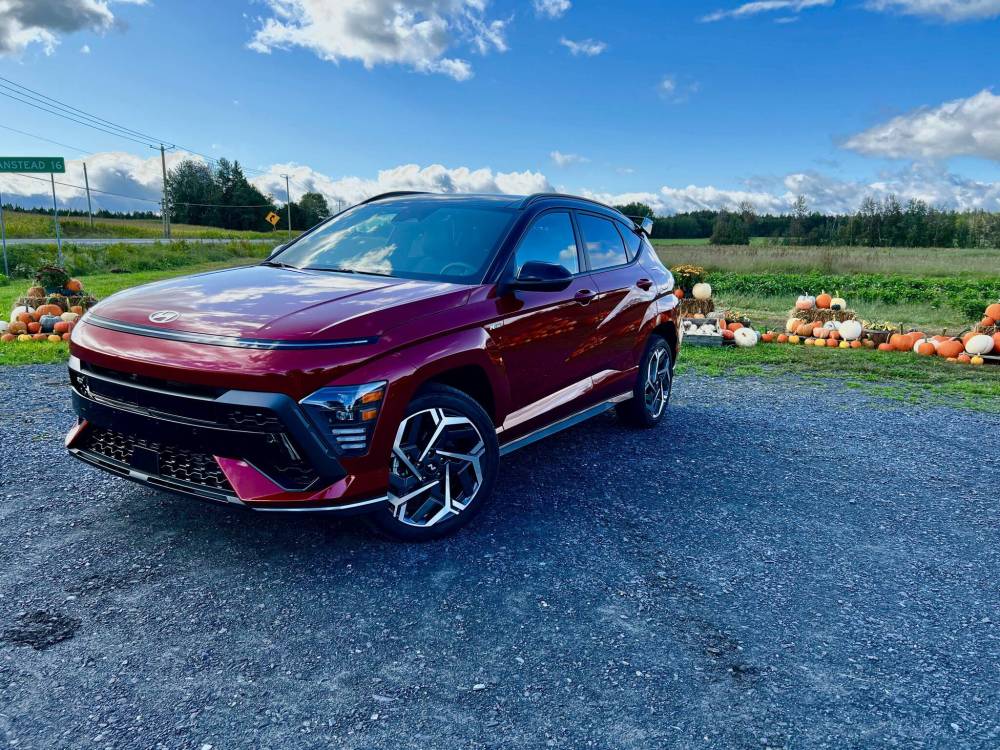
The Kona arrived to Canada in 2018 and quickly became a sales leader for the Korean company. It comprises nearly one-quarter of Hyundai sales, driven, Hyundai officials think, by demand for a compact vehicle with a high seating position for greater visibility.
For 2024, Hyundai is starting with the N-line versions, with the upmarket motor, the 1.6-litre turbo, with all-wheel drive standard. Essence and Preferred models, with the base 2.0-litre motor and AWD optional, will follow in about four weeks. Flamand said the timing is dictated by when production starts on each powertrain version.
The 1.6-litre turbo is mated to an eight-speed automatic transmission, instead of the dual-clutch automated manual transmission on previous Kona N-line models. Ricardo Chan, director of product planning, said customers indicated they would prefer a smoother shifting experience than a DCT can provide. The 2.0-litre motors will arrive with a continuously variable transmission, which Hyundai calls an IVT (intelligent variable transmission).
Another clue to the coming electric version is the transmission shifter: it’s moved to the steering column, and at first glance appears as if you raise it to select reverse and drop it to select drive. However, the tip of the stick twists: clockwise for drive and counter-clockwise for reverse. A button on the end selects park.
Moving the shifter to the steering column opens up considerable space in the centre console, allowing for a generous storage bay with flip out cupholders, a Qi wireless charging pad for smartphones, and handy placement of the drive mode select knob, and controls for the heated seats and heated steering wheel.
Because the 2.0-litre hasn’t yet started production, we had only the N-line to drive, and the upmarket engine certainly gives the little ute some scoot. Its 190 horsepower and 195 pound-feet of torque get the Kona cooking quickly. Selecting sport mode or using the wheel-mounted shift paddles adds some urgency, holding shifts longer and letting the little engine rev.
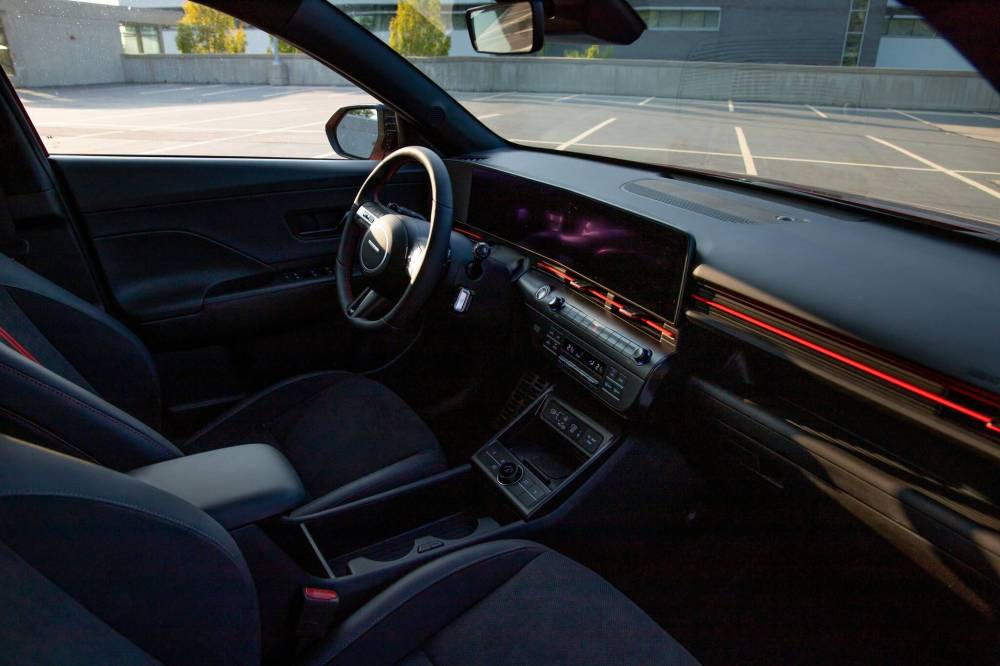
Supplied
There are several cues that the Kona was designed to be an EV from the start, from the closed grille to the column-mounted transmission selector.
Sport mode is also a good way to overcome the transmission’s occasional tendency to hunt, which is only apparent when in slow and go traffic and you’re transitioning from deceleration to acceleration.
The base engine, with 147 horses and 132 pound-feet, will be more sedate, but should still make for a decent little city ute.
The added wheelbase also contributes to improved ride and handling.

Missing, perhaps, from the list of options is a power tailgate, almost a necessity even in this segment. Hyundai says customer data suggests Kona customers aren’t interested in what the company says would be a $1,000 option. It may not have a power tailgate, but the hood also doesn’t require a prop rod: cylinders that hold the hood up are a nice touch.
Hyundai states as its primary competitors to Kona the Honda HR-V, Toyota Corolla Cross, Subaru Crosstrek, Nissan Kicks, Chevrolet Trailblazer and Kia Seltos, and boasts it has the most powerful upmarket engine among them. Only the Crosstrek, Trailblazer and Seltos offer more than one engine, none as powerful as the Kona’s 1.6 turbo.
Left off the competitor’s list, which allows Hyundai to ignore its optional 250-hp 2.5-litre turbo, is the Mazda CX-30. Flamand said Hyundai’s analysis of the intentions of Kona buyers suggests those looking at Kona do not cross shop to the CX-30.
Supplied
The Kona arrived to Canada in 2018 and quickly became a sales leader for the Korean company.
In any event, Hyundai can expect to sell boatloads of the now less diminutive Kona, which strikes a better balance between compactness and utility than its predecessor.
kelly.taylor@freepress.mb.ca
Kelly Taylor
Copy Editor, Autos Reporter
Kelly Taylor is a copy editor and award-winning automotive journalist, and he writes the Free Press‘s Business Weekly newsletter. Kelly got his start in journalism in 1988 at the Winnipeg Sun, straight out of the creative communications program at RRC Polytech (then Red River Community College). A detour to the Brandon Sun for eight months led to the Winnipeg Free Press in 1989. Read more about Kelly.
Every piece of reporting Kelly produces is reviewed by an editing team before it is posted online or published in print — part of the Free Press‘s tradition, since 1872, of producing reliable independent journalism. Read more about Free Press’s history and mandate, and learn how our newsroom operates.
Our newsroom depends on a growing audience of readers to power our journalism. If you are not a paid reader, please consider becoming a subscriber.
Our newsroom depends on its audience of readers to power our journalism. Thank you for your support.
The specs
Engine: 1.6-litre turbo four-cylinder; 2.0-litre four-cylinder
Power: 190 @ 6,000 r.p.m. (1.6t); 147 hp @ 6,200 r.p.m. (2.0)
Torque: 195 lb-ft. @ 1,700-4,500 r.p.m. (1.6t); 132 lb-ft. @ 4,500 r.p.m. (2.0)
Layout: front-engine, all-wheel drive (1.6t); front-engine, front-drive (2.0 (AWD optional)
Transmission: eight-speed automatic (1.6t); continuously variable (2.0)
Steering: power-assist rack-and-pinion
Suspension: MacPherson strut (front); coupled torsion beam axle (rear, FWD); multi-link (rear, AWD)
Brakes: four-wheel discs
Fuel economy (l/100km, city/highway/combined): 8.1/6.8/7.5 (2.0 FWD Essential); 8.4/6.7/7.6 (2.0 FWD Preferred) 8.8/8.1/8.5 (2.0 AWD Essential); 9.0/8.1/8.6 (2.0 AWD Preferred); 9.7/8.4/9.1 (1.6t, all models)
Price: $25,999 – $38,499
Kelly Taylor
Copy Editor, Autos Reporter
Kelly Taylor is a copy editor and award-winning automotive journalist, and he writes the Free Press‘s Business Weekly newsletter. Kelly got his start in journalism in 1988 at the Winnipeg Sun, straight out of the creative communications program at RRC Polytech (then Red River Community College). A detour to the Brandon Sun for eight months led to the Winnipeg Free Press in 1989. Read more about Kelly.
Every piece of reporting Kelly produces is reviewed by an editing team before it is posted online or published in print — part of the Free Press‘s tradition, since 1872, of producing reliable independent journalism. Read more about Free Press’s history and mandate, and learn how our newsroom operates.
Our newsroom depends on a growing audience of readers to power our journalism. If you are not a paid reader, please consider becoming a subscriber.
Our newsroom depends on its audience of readers to power our journalism. Thank you for your support.
Advertisement Advertise With Us
Advertisement Advertise With Us