Bad boss? Oh, you don’t slay…
Horrible as the one who signs your paycheques may seem, history has, occasionally, offered us worse
Advertisement
Read this article for free:
or
Already have an account? Log in here »
To continue reading, please subscribe:

Digital Subscription
One year of digital access for only $205*
- Enjoy unlimited reading on winnipegfreepress.com
- Read the E-Edition, our digital replica newspaper
- Access News Break, our award-winning app
- Play interactive puzzles
*First annual payment billed as $205.00 + GST for one year. This annual subscription will automatically renew at $233.00 + GST every 52 weeks (10% off the regular annual price of $259.35). Offer available to new and qualified returning subscribers only. Cancel any time.
To continue reading, please subscribe:
Add Free Press access to your Brandon Sun subscription for only an additional
$1 for the first 4 weeks*
- Enjoy unlimited reading on winnipegfreepress.com
- Read the E-Edition, our digital replica newspaper
- Access News Break, our award-winning app
- Play interactive puzzles
*Your next Brandon Sun subscription payment will increase by $1.00 and you will be charged $17.95 plus GST for four weeks. After four weeks, your payment will increase to $24.95 plus GST every four weeks.
Read unlimited articles for free today:
or
Already have an account? Log in here »
Hey there, time traveller!
This article was published 10/03/2018 (3047 days ago), so information in it may no longer be current.
Here is one of the things I have learned in my years as a big-shot newspaper columnist — some news stories are so alarming, they leave you totally alarmed.
For instance, I began to sweat profusely and wring my hands when I read a story in this newspaper that appeared under the following alarming headline: “Some bosses so awful, workers consider killing them.”
Here’s how the story began: “About 12 per cent of workers have fantasized about killing their bosses, according to a recent survey conducted in the United Kingdom by consulting company Expert Market.

“Rates varied by industry. Construction workers were at the top, with 22 per cent admitting that, at some point, they’d had bloodthirsty thoughts about supervisors.”
I am not a psychologist, but I know what you are thinking. You are thinking: “Only 12 per cent? Wow! I would have thought it would have been much higher.”
Before you jump to any potentially lethal conclusions, allow me to point out that, as far as I can recall, I have never seriously considered killing any of my bosses. I am not a legal expert, but I suspect murdering a supervisor is forbidden under the terms of most labour agreements.
On the other hand, I cannot swear that my bosses have never considered doing away with me.
That would explain several hazard-prone assignments, such as the time they sent me, a person who had never been on a horse in his life, to attempt barrel racing, a horse-intensive activity, at the Manitoba Stampede in Morris.
It would also explain my editor’s brilliant idea that I should see whether I would be able to jump out of a perfectly fine airplane while strapped to the back of a member of the Canadian Forces’ Skyhawk skydiving team.
That fell through because, technically, I am way too heavy to be strapped to the back of another skydiver, so instead, they sent me to try my hand at bull riding, wherein I was forced to sit on top of a 2,000-pound angry bull named Free Ride.
You likely think I am crazy for impugning my bosses’ motives, but I am not the only one with such dark fantasies. According to a story I have just read in Britain’s Daily Express newspaper, four in 10 British workers regularly have nightmares about work “with some (four per cent) even dreaming that their boss is trying to murder them.”
What does it mean if you fantasize about sending your boss to the Big Workplace in the Sky, or dream about your boss planting you six feet under?
Ha ha ha! How the (bad word) would I know? I am just a middle-aged, overweight newspaper columnist, but I suspect it might be a good idea for you and your boss to meet in a neutral location in a public place and sit down to clear the air over a cup of tea, which you should probably ensure is brewed at your table, because, well, you never know, right?
In terms of having a wonderful, non-lethal relationship with their superiors, not everyone is as fortunate as you and I, in the sense that, based on several minutes of scouring the internet, it is clear that history is rife with examples of Devil Bosses From Hell.
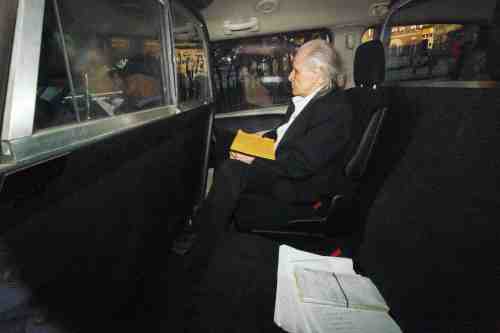
For starters, you may recall the infamous Leona Helmsley, the New York hotelier and real estate developer dubbed “The Queen of Mean” for her legendary cruelty towards employees and absolute disdain for “little people.”
Hotel employees throughout the Helmsley empire were so aware of her hair-trigger temper they devised a warning system to alert one another when she left her apartment on the way to one of the hotels.
In 1989, at her trial for tax evasion, wherein she was forced to serve 18 months behind bars, she became famous for this pithy motto: “We don’t pay taxes. Only the little people pay taxes.”
When she dropped dead in 2007, she lived up to her most unpleasant nickname by turning her back on most of her relatives and giving them the cold shoulder in her will, famously leaving the bulk of her estate, a reported US$12 million, to her pet dog, a little white Maltese named Trouble, who became the richest (and least popular) lapdog in the world when her mean mistress passed away.
Say what you will about Helmsley, at least she never sent one of her employees to prison for daring to offer their resignation.
It turns out that is exactly what happened to Johann Sebastian Bach, who, despite currently being dead, is widely regarded as one of the greatest classical music composers of all time. For all you young people out there, classical music is the stuff they play in 7-Eleven parking lots to prevent teenagers from hanging around.
I had no idea Bach’s boss had shipped this musical genius off to prison until the other day when, while driving to the office, I accidentally tuned in to a classical station wherein the host was relating historical tidbits about the legendary composer.
From what I understand, in 1708, Bach took a job as a chamber musician in the court of the Duke of Sachsen-Weimar and had his sights set on being the capellmeister, or music director. When the capellmeister croaked, the job went to his son, who, by all accounts, was an idiot.

Ticked off at being bypassed, Bach accepted an invitation from Prince Leopold to join the rival court of Anhalt-Cothen and become their capellmeister. In 1717, when Bach asked the Duke of Weimar to release him from his employment, the Duke retaliated by having the composer imprisoned for 30 days for “too stubbornly forcing the issue of his dismissal.”
While behind bars, he kept busy by writing chorale preludes for organ, later published as part of his first organ masterwork, which is apparently a big deal in classical music. When he got out, he was dismissed “without honour” and allowed to go work for the prince.
So, yes, that guy whose music is played regularly by the Winnipeg Symphony Orchestra became a (bad word) jailbird because his royal boss was a huge jerk.
The point is, as far as anyone knows, Bach never once considered killing his boss, although he did make him listen to hours of classical music, so you might say it came out even in the end.
doug.speirs@freepress.mb.ca