Trimming transformed
Nasty conditions, repetitive stress injuries and ducking authorities are no longer part of the job description for hands-on work in the evolving, soon-to-be-legal cannabis industry
Advertisement
Read this article for free:
or
Already have an account? Log in here »
To continue reading, please subscribe:

Digital Subscription
One year of digital access for only $205*
- Enjoy unlimited reading on winnipegfreepress.com
- Read the E-Edition, our digital replica newspaper
- Access News Break, our award-winning app
- Play interactive puzzles
*First annual payment billed as $205.00 + GST for one year. This annual subscription will automatically renew at $233.00 + GST every 52 weeks (10% off the regular annual price of $259.35). Offer available to new and qualified returning subscribers only. Cancel any time.
To continue reading, please subscribe:
Add Free Press access to your Brandon Sun subscription for only an additional
$1 for the first 4 weeks*
- Enjoy unlimited reading on winnipegfreepress.com
- Read the E-Edition, our digital replica newspaper
- Access News Break, our award-winning app
- Play interactive puzzles
*Your next Brandon Sun subscription payment will increase by $1.00 and you will be charged $17.95 plus GST for four weeks. After four weeks, your payment will increase to $24.95 plus GST every four weeks.
Read unlimited articles for free today:
or
Already have an account? Log in here »
Hey there, time traveller!
This article was published 30/04/2018 (3011 days ago), so information in it may no longer be current.
Hilary Black still remembers the old days, when trimming cannabis in British Columbia meant diving under trees to hide from police helicopters and working long, hard days under less-than-ideal conditions.
“I remember sitting on a milk crate in a barn for days, trimming,” says Black, who founded Canada’s first medical cannabis dispensary, the B.C. Compassion Club Society, in 1997.
“Terribly uncomfortable; maybe I would get a cushion over my milk crate.”
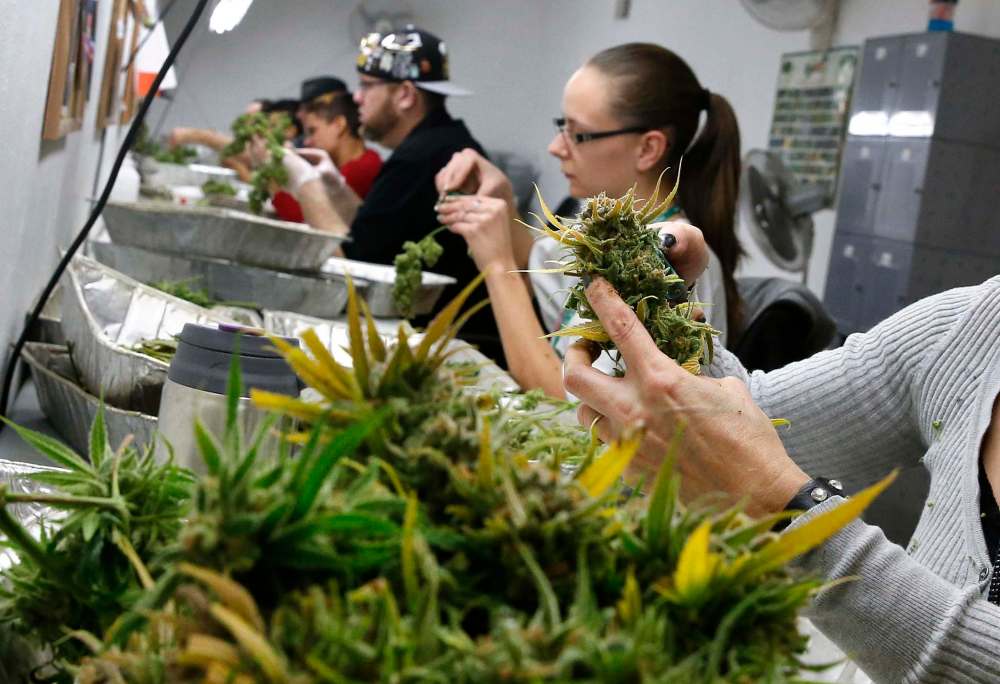
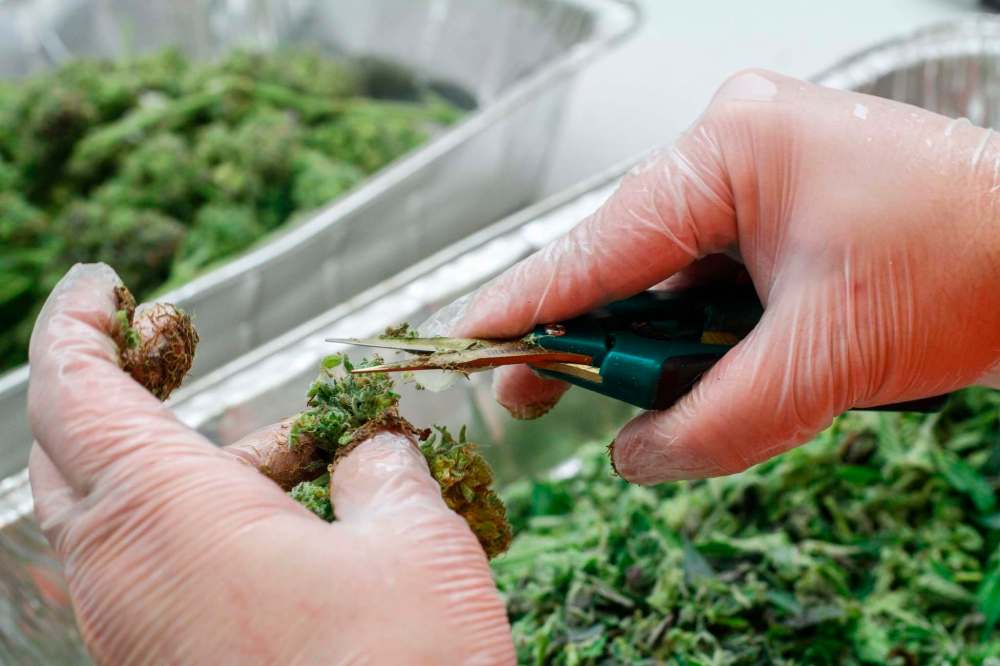
Cannabis buds don’t just fall off the plant, ready to use. Before going to market, those flower clusters have to be carefully removed from the plant’s stalk, along with any excess stems and leaves. Even with the advent of automated cannabis trimming machines, much of the work is still done the old-fashioned way — manually, carefully, bud by bud.
“You don’t want to be digging your scissors in and taking out a chunk of the flower that’s a valuable part of what the final product is,” Black explains. “You don’t want to trim too close.”
Black now works in the world of legal cannabis as the director of patient education and advocacy for Canopy Growth Corp. It’s a far cry from the days she used to spend sitting at tables, trimming the cannabis needed to supply her dispensary.
“You can injure yourself through so much repetitive motion,” she says. “I definitely remember, some days, waking up after long stretches of trimming and my hand would feel like a claw because the muscles had all spazzed up. And that’s not how it is anymore in the regulated world.”
As the cannabis industry moves above ground, the kinds of workplace health and safety challenges faced by trimmers have finally come to light.
In the U.S., the Centers for Disease Control has even sent its inspectors to observe workers at a legal cannabis farm in Washington state. The resulting report found workers “were concerned about repetitive hand motions when trimming cannabis,” and made a series of occupational safety recommendations, including rotating tasks among workers to minimize repetitive stress, ensuring frequent breaks and a regular cleaning schedule, and properly maintaining tools.
Those kinds of safety measures are par for the course at Canopy Growth, Black says.
“They pay attention to the ergonomics — what’s the chair that you’re in, what’s the table that you’re in, how is it all fitting together in a way that’s the best possible physical outcome for the employee.”–Hilary Black
“People have benefits and vacation, that was never a part of our unregulated world,” she says.
“And they pay attention to the ergonomics — what’s the chair that you’re in, what’s the table that you’re in, how is it all fitting together in a way that’s the best possible physical outcome for the employee.”
In short, says Black, government regulations and labour codes mean “no more sitting on a milk crate in a cold barn for a couple of days.”
Even in a regulated industry, though, cannabis-trimming work isn’t always steady or predictable.
Sandi Meekings loved her job as a trimmer with MedReleaf, an Ontario-based licensed producer.
“It was a really chill job, the people there were fantastic,” she says. “I loved doing the trim work, it was great.”
Meekings got her job through a temporary staffing agency in January, and worked at MedReleaf for about five weeks.
“You’re trimming cannabis and listening to music, what better job can you have in the world?”–Sandi Meekings
“The only problem that I had was, the first week I was there for 33 hours, the second week I was there for 16, the third week I was there for 16,” she says.
In the end, Meekings had to take a full-time job offer elsewhere.
“It was difficult for me to say goodbye to it because it was such a great job, and I enjoyed every minute that I was there, but it was just all over the place,” she says. “A lot of times I had to wait until five in the afternoon to find out if I was working the next day.”
MedReleaf employs both full time and temporary trimmers, says Darren Karasiuk, the company’s vice-president of strategy. As MedReleaf brings more and more growing space online, he expects “greater predictability” in terms of its need for trimming staff.
Trimmers “ensure that the final, dried bud product is visually appealing,” says Karasiuk. “They maintain quality standards, and to that end they play an important role.”
Meekings says she would have liked to continue as a trimmer with MedReleaf.
“You’re trimming cannabis and listening to music, what better job can you have in the world?”
“Traditionally, if you look through the history of agriculture, when it comes to high-labour, intensive harvesting of agriculture products, often you would have groups of women sitting around doing it.”–Hilary Black
Hilary Black is also nostalgic for her old days as a trimmer.
“There was always a real sense of camaraderie, because you’re stuck in a room with a group of people for days and days, and sometimes weeks if you’re working on a really big harvest,” she says.
Black described her trimming days as a kind of sisterhood.
“I definitely have spent a lot of time harvesting cannabis with women,” she says. “Traditionally, if you look through the history of agriculture, when it comes to high-labour, intensive harvesting of agriculture products, often you would have groups of women sitting around doing it.”
“And we would catch up, and talk about life, and talk about our health. (It’s) a real bonding time, actually — I kind of miss it, in fact.”
Still, Black says today’s trimmers are better off with eight-hour shifts and regular breaks, instead of the “marathon trim sessions that we used to do.”
“I think that it physically would be less taxing than in the old days, for sure,” she says.
“And, no helicopters.”
solomon.israel@theleafnews.com
@sol_israel
History
Updated on Tuesday, May 1, 2018 11:32 AM CDT: Corrects spelling of "Sandi Meekings."