Kosher Kush cannabis shouldn’t be called ‘kosher,’ rabbis say

According to cannabis legend, potent weed cultivar was blessed by a rabbi

Advertisement

Advertise with us

It's a celebrated variety of cannabis with a distinctly Hebraic backstory, but rabbis from two Canadian kosher certification agencies say the name "Kosher Kush" could be disappointing or misleading for people who observe Judaism's ancient dietary laws.

Read this article for free:


or

Already have an account? Log in here »

To continue reading, please subscribe:

Subscribe and receive a limited-edition Free Press branded hat or tote.

Digital Subscription

One year of digital access for only $205*

  • Enjoy unlimited reading on winnipegfreepress.com
  • Read the E-Edition, our digital replica newspaper
  • Access News Break, our award-winning app
  • Play interactive puzzles

*First annual payment billed as $205.00 + GST for one year. This annual subscription will automatically renew at $233.00 + GST every 52 weeks (10% off the regular annual price of $259.35). Offer available to new and qualified returning subscribers only. Cancel any time.

To continue reading, please subscribe:

Add Free Press access to your Brandon Sun subscription for only an additional

$1 for the first 4 weeks*

  • Enjoy unlimited reading on winnipegfreepress.com
  • Read the E-Edition, our digital replica newspaper
  • Access News Break, our award-winning app
  • Play interactive puzzles
Start now

*Your next Brandon Sun subscription payment will increase by $1.00 and you will be charged $17.95 plus GST for four weeks. After four weeks, your payment will increase to $24.95 plus GST every four weeks.

Hey there, time traveller!
This article was published 08/07/2019 (2603 days ago), so information in it may no longer be current.

It’s a celebrated variety of cannabis with a distinctly Hebraic backstory, but rabbis from two Canadian kosher certification agencies say the name “Kosher Kush” could be disappointing or misleading for people who observe Judaism’s ancient dietary laws.

Kosher Kush is a type of dried cannabis bud, sold by Canopy Growth Corporation in Canada’s recreational cannabis market. The cultivar was developed by DNA Genetics, a renowned seed breeder whose website describes Kosher Kush as “a stinky over-the-top strain with an average yield, making all who smoke it feel ‘blessed.'”

“The word ‘kosher,’ it shouldn’t be a marketing word,” said Rabbi Tsvi Heber, director of community kosher with the Toronto-based Kashruth Council of Canada, which describes itself as Canada’s largest kosher-certifying body.
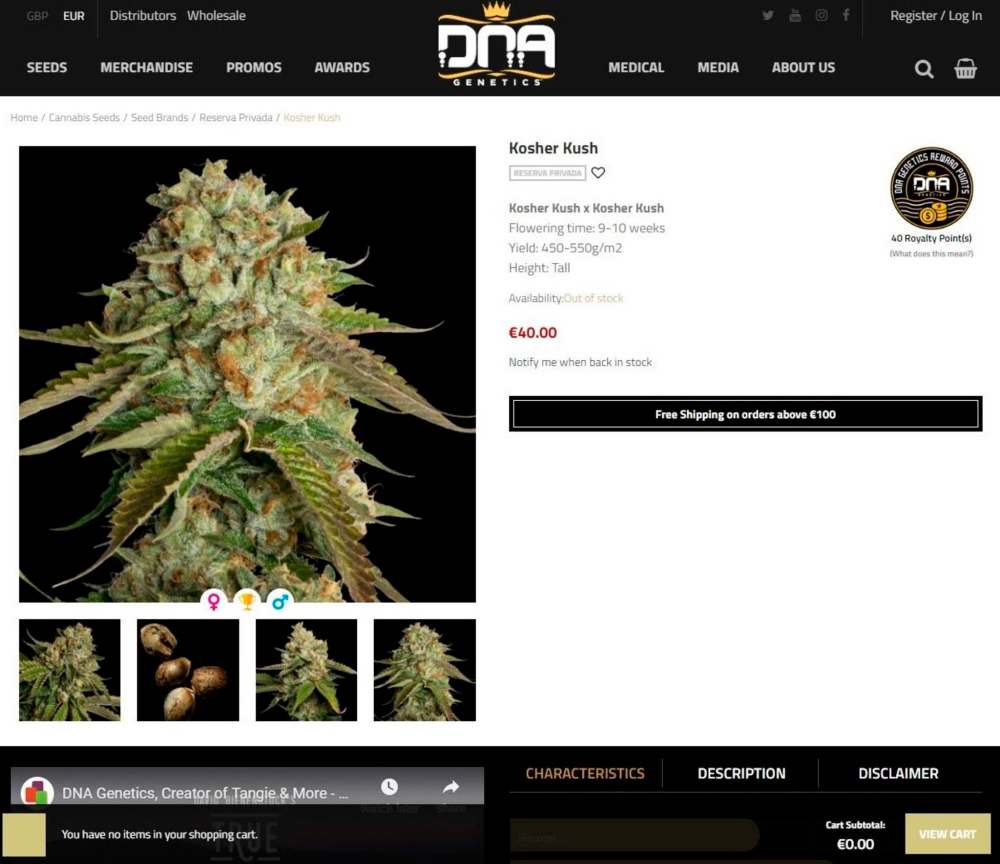
Kosher Kush, as seen on the website of cannabis breeder DNA Genetics. The cannabis cultivar is known for its potency. (DNA Genetics)

Instead, Heber said “kosher” should only be applied to food products that have been deemed compliant with the dietary edicts of Jewish religious law.

“I’m speaking as a rabbi, but also as a kosher consumer. A kosher consumer doesn’t want to see the word ‘kosher’ associated with something that’s basically some marketing upshot… Just to use that name to try to promote a product is disappointing.”

Rabbi Mendy Feigelstock, director of kashrut and operations with Vancouver-based kosher-certifier Kosher Check, has heard complaints from his local community about a Vancouver cannabis dispensary called Kosher Leaf Society. Feigelstock said he’s heard about Kosher Kush before, and considers the name “misleading for the consumer.”

“It would be, I guess, a lot worse if it was a food product that wasn’t kosher. That would be extremely misleading, but I think it’s still misleading to claim a product is kosher if it’s not kosher-certified. I don’t think they have any basis to do that.”

The company behind the product says it meant no offence.

“This is really just an example of a quirky story that turned into a quirky strain name,” said Adam Greenblatt, a business development lead with Canopy Growth Corp. “We’re certainly not trying to mislead people about whether or not it is a kosher product.

“I see it as an acceptable colloquial use of the term.”

The tale behind Kosher Kush, as told to Greenblatt by DNA Genetics founders Don Morris and Aaron Yarkoni, goes something like this: sometime in the 2000s, Morris was hosting a house party. He’d picked up a tray of cannabis seedlings earlier in the day, and during the party he left the plants under a light in his bathroom. Later on, a freshly minted rabbi showed up.

“And she was also very much into cannabis, she loved cannabis. And being that she was newly ordained, she saw these cannabis plants and she was excited to bless them,” said Greenblatt.

Those supposedly sanctified seedlings were later used to make seeds, which DNA called Kosher Kush. (“Kush” is a common cannabis descriptor, and refers to the Hindu Kush mountain range in Asia where cannabis grows wild.)

“It’s not really a promotional tactic in my mind,” Greenblatt said. “(DNA Genetics) didn’t just do market research and determine that if they call it Kosher Kush it’s going to take off.”
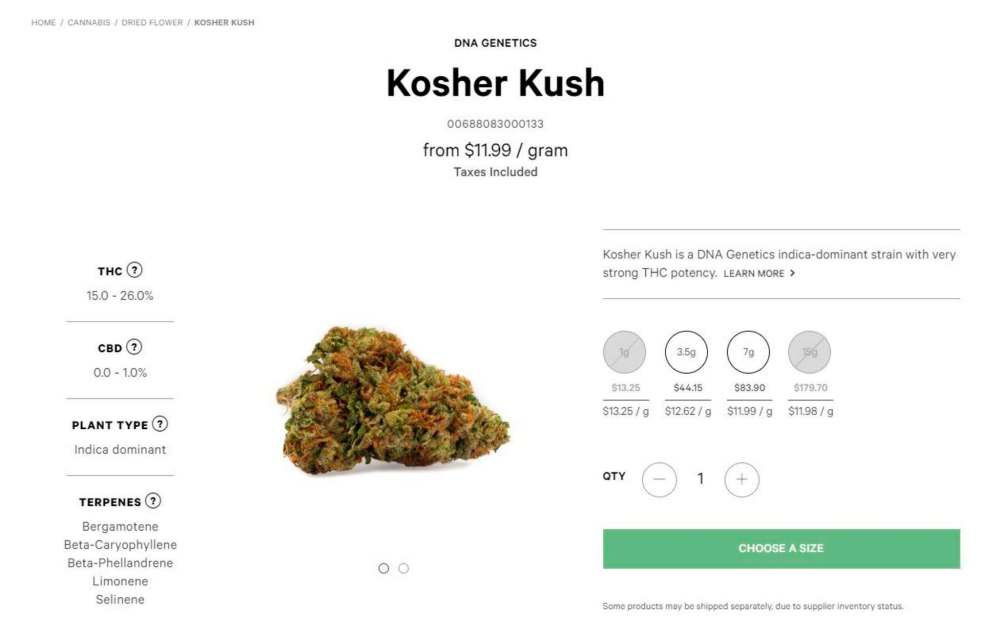
Canopy Growth's Kosher Kush cannabis, which is sold under the DNA Genetics brand, for sale on the Ontario Cannabis Store website. (Ontario Cannabis Store)

Some cannabis products have been certified kosher in Canada before: in 2017, Quebec-based cannabis producer Hydropothecary (now called Hexo) received media attention when its medical cannabis products were certified kosher by certification agency Ottawa Vaad HaKashrut.

The issue of kosher cannabis products could come back to the fore with the pending legalization of commercially manufactured cannabis edibles at the end of 2019.

Feigelstock said his agency would consider kosher certification for edible cannabis products meant for medical purposes, but not for recreational use. On the other hand, the Kashruth Council of Canada has already declined to certify medical cannabis products as kosher, partly out of concern such an endorsement could validate the recreational use of cannabis and partly because the group doesn’t think medications need to be kosher-certified. 

(Heber believes the recreational use of inhaled cannabis smoke or vapour wouldn’t violate Jewish dietary laws, but it could go against other aspects of Jewish religious jurisprudence.)

Meanwhile, Greenblatt said Canopy Growth has no plans to change the product’s name, and noted a few other licensed Canadian cannabis producers have also sold Kosher Kush. (Whistler Medical Marijuana Corp.’s website claims the cultivar “originates from Californian orthodox Jewish growers.”) 

“I’m a politically correct person, I was raised Jewish, my summer camp was very strictly kosher,” Greenblatt said. “And so I always knew that at some point someone was going to ask about Kosher Kush as a strain name.”

solomon.israel@theleafnews.com   

Twitter: @sol_israel

Report Error Submit a Tip

More Stories

ER wait times have hit all-time highs in Winnipeg and are impacting nearly all aspects of hospital operations

Tom Brodbeck 17 minute read Preview

ER wait times have hit all-time highs in Winnipeg and are impacting nearly all aspects of hospital operations

Tom Brodbeck 17 minute read Friday, Aug. 21, 2026

On most days at Health Sciences Centre’s adult emergency department, all 58 treatment beds are filled with sick patients. Another dozen or so brought in by ambulance line the hallways on stretchers, with only one nurse to look after them.

Out in the waiting room, about 30 or 40 people — sometimes more — are slouched in chairs in pain or discomfort, waiting hours to see a doctor. Most have been assessed by a triage nurse, but many will have to wait 10 to 20 hours to be examined by a physician because there’s no room for them in the treatment area.

Some patients leave because they can no longer tolerate the excruciating wait, only to return days later, sicker than they were before.

Welcome to the emergency department at Manitoba’s largest hospital, where some of the highest-acuity patients seek medical care but now face delays that were unimaginable a few years ago.

Read
Friday, Aug. 21, 2026

Plenty of alternatives to U.S. wines on the shelves

Ben Sigurdson 5 minute read Preview

Plenty of alternatives to U.S. wines on the shelves

Ben Sigurdson 5 minute read Yesterday at 6:00 AM CDT

In February 2025, Manitoba (and most other provinces) pulled American liquor from store shelves as part of the ongoing trade dispute with the United States.

Then in December, the province followed a similar course to others and put American booze that was already on hand back on shelves, selling off inventory that had been wasting away in warehouses for months, and directing proceeds from those sales to charities.

Lineups sprung up at numerous stores as consumers snapped up bestselling American products — think Maker’s Mark, Jack Daniel’s, Apothic Red and the like. After that initial rush, what was left has been languishing on shelves ever since, with many products eventually being drastically discounted for a quick sale, lest they become too long in the tooth.

I decided early on not to write about/review U.S. products in this space until things were well and truly sorted. But a few months back, I found myself in the mood for a big, oaky red wine and — in a moment of weakness, or nostalgia, or maybe just curiosity — I picked up a $30-ish California Cabernet Sauvignon.

Read
Yesterday at 6:00 AM CDT

Puzzles Palace

1 minute read Monday, Jul. 27, 2026

To solve our puzzles, please subscribe with this special offer: |

Kosher Kush cannabis shouldn’t be called ‘kosher,’ rabbis say

Solomon Israel 5 minute read Preview

Kosher Kush cannabis shouldn’t be called ‘kosher,’ rabbis say

Solomon Israel 5 minute read Monday, Jul. 8, 2019

It's a celebrated variety of cannabis with a distinctly Hebraic backstory, but rabbis from two Canadian kosher certification agencies say the name "Kosher Kush" could be disappointing or misleading for people who observe Judaism's ancient dietary laws.

Kosher Kush is a type of dried cannabis bud, sold by Canopy Growth Corporation in Canada's recreational cannabis market. The cultivar was developed by DNA Genetics, a renowned seed breeder whose website describes Kosher Kush as "a stinky over-the-top strain with an average yield, making all who smoke it feel 'blessed.'"

"The word 'kosher,' it shouldn't be a marketing word," said Rabbi Tsvi Heber, director of community kosher with the Toronto-based Kashruth Council of Canada, which describes itself as Canada's largest kosher-certifying body.

Instead, Heber said "kosher" should only be applied to food products that have been deemed compliant with the dietary edicts of Jewish religious law.

Read
Monday, Jul. 8, 2019

Unresolved issues leave little space for you

Maureen Scurfield 5 minute read Yesterday at 2:00 AM CDT

DEAR MISS LONELYHEARTS: My boyfriend — who is newly divorced — has two great children from his marriage. Although he and I have been together since Christmas, it’s obvious he loves his kids much more than he loves me! For instance, he lavishes affection on the kids when they’re over and completely leaves me out. I’m just the cook and dish-washer for the night.

When I brought this up recently, he said, “My girlfriends don’t last, because if I’m openly affectionate with them, the kids tell their mother we’re making out in front of them! They want all my affection and attention when I’m with them.” Then he added, “Stick around, and the kids will probably loosen up.”

Stick around? The explanation and his “advice” totally turned me off. What do you think?

— Not Second-Best to Anyone, St. Vital

City inundated with thousands of complaints after launch of new transit system

Morgan Modjeski 11 minute read Preview

City inundated with thousands of complaints after launch of new transit system

Morgan Modjeski 11 minute read Friday, Aug. 21, 2026

Despite complaints from thousands of dissatisfied users, Winnipeg hasn't hit the brakes on the rollout of its new primary transit network. And it appears that ignoring the public response cost Winnipeg Transit millions of dollars in lost revenue and ridership.

Read
Friday, Aug. 21, 2026