Emoji gods approve skin-tone options for couples of colour
Advertisement
Read this article for free:
or
Already have an account? Log in here »
To continue reading, please subscribe:

Digital Subscription
One year of digital access for only $205*
- Enjoy unlimited reading on winnipegfreepress.com
- Read the E-Edition, our digital replica newspaper
- Access News Break, our award-winning app
- Play interactive puzzles
*First annual payment billed as $205.00 + GST for one year. This annual subscription will automatically renew at $233.00 + GST every 52 weeks (10% off the regular annual price of $259.35). Offer available to new and qualified returning subscribers only. Cancel any time.
To continue reading, please subscribe:
Add Free Press access to your Brandon Sun subscription for only an additional
$1 for the first 4 weeks*
- Enjoy unlimited reading on winnipegfreepress.com
- Read the E-Edition, our digital replica newspaper
- Access News Break, our award-winning app
- Play interactive puzzles
*Your next Brandon Sun subscription payment will increase by $1.00 and you will be charged $17.95 plus GST for four weeks. After four weeks, your payment will increase to $24.95 plus GST every four weeks.
Read unlimited articles for free today:
or
Already have an account? Log in here »
Hey there, time traveller!
This article was published 08/03/2019 (2738 days ago), so information in it may no longer be current.
NEW YORK – In 1664, Maryland passed the first British colonial law banning marriage between whites and slaves. An 1883 U.S. Supreme Court ruling that state prohibitions on interracial marriage don’t violate the Fourteenth Amendment held for more than 80 years.
While such impediments to marriage were dismantled over time, there are still hurdles, however small, to overcome. Here, in 2019, interracial couples have a small victory to celebrate: The approval of 71 new variations of emoji for couples of colour.
Capping a yearlong project thought up by, of all people, the folks at the swipe-right dating app Tinder, the emoji gods (known as the Unicode Consortium) recently approved the additions in characters technically referred to as people “holding hands.” A new “gender-inclusive” couple emoji was also approved among 230 new characters.
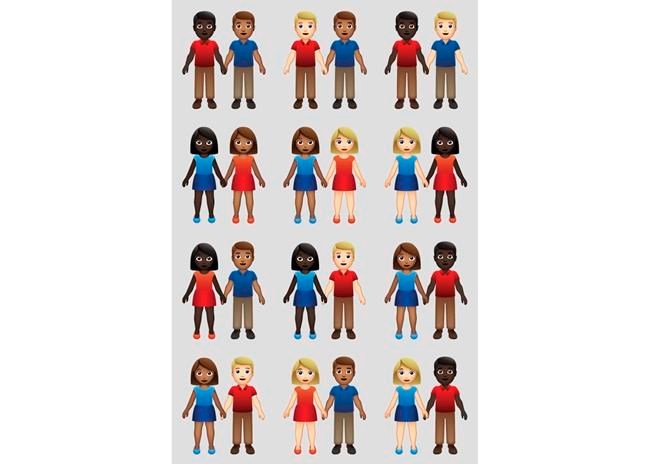
Until now, emoji of two or more people on various platforms and devices have been available only in the default yellow. While the Unicode Consortium, where Google, Microsoft and Apple have voting seats, signed off on the skin-tone additions, companies will decide for themselves starting later this year whether to add them and how they will look.
Jenny Campbell, the chief marketing officer for Tinder, isn’t worried about distribution after the company mounted a campaign and petition drive in support of the technical proposal it submitted to Unicode.
“Ultimately, we wanted to get the interracial emoji couple on people’s keyboards not only for equality, but also to spread acceptance for all couples no matter what their race,” she told The Associated Press on Thursday. “Our users are craving a way to express themselves visually and see themselves reflected in our everyday tech language.”
So are lots of other emoji enthusiasts of colour left in the wings for years. More than 50,000 people signed Tinder’s online petition at Change.org.
While facial features and hair textures are yet to be determined by some vendors, Tinder said the use of six existing skin tones already available for one-person emoji and various others is a step in the right direction at a time when the text- and chat-friendly characters remain a readily accessible way for the world to express itself. The lack of colour options in couples, the company said, felt like a slight.
“Even as our social behaviours have evolved and interracial dating and marriage has become more prevalent, visual representation of these relationships in technology has lagged far behind,” Campbell said.
Emoji of single people of colour and same-sex couples were added in the last several years, but not in mixed-tone combinations. In real life, the rate of interracial marriage has increased over the years, especially since the 1967 U.S. Supreme Court decision Loving v. Virginia that struck down all anti-miscegenation laws remaining in 16 states. But such marriages remain a small portion of marriages overall.
Tinder is taking credit for its industry in pushing interracial dating along, citing data that indicates couples who meet online are more likely to be interracial than those who don’t.
“We know that equal forms of representation are important to our users,” Campbell said, “and important to us.”
Skin tones for limited use were added to the Unicode Standard for emoji in 2015. More representation of women in 2016, some “gender-inclusive” people in 2017 and hair colour options last year.
Also approved this year: A waffle, a much-requested white heart, a guide dog and people in wheelchairs. Oh, and a sloth.