EXPLAINER: Why US inflation is so high, and when it may ease
Advertisement
Read this article for free:
or
Already have an account? Log in here »
To continue reading, please subscribe:

Digital Subscription
One year of digital access for only $205*
- Enjoy unlimited reading on winnipegfreepress.com
- Read the E-Edition, our digital replica newspaper
- Access News Break, our award-winning app
- Play interactive puzzles
*First annual payment billed as $205.00 + GST for one year. This annual subscription will automatically renew at $233.00 + GST every 52 weeks (10% off the regular annual price of $259.35). Offer available to new and qualified returning subscribers only. Cancel any time.
To continue reading, please subscribe:
Add Free Press access to your Brandon Sun subscription for only an additional
$1 for the first 4 weeks*
- Enjoy unlimited reading on winnipegfreepress.com
- Read the E-Edition, our digital replica newspaper
- Access News Break, our award-winning app
- Play interactive puzzles
*Your next Brandon Sun subscription payment will increase by $1.00 and you will be charged $17.95 plus GST for four weeks. After four weeks, your payment will increase to $24.95 plus GST every four weeks.
Read unlimited articles for free today:
or
Already have an account? Log in here »
Hey there, time traveller!
This article was published 10/12/2021 (1741 days ago), so information in it may no longer be current.
WASHINGTON (AP) — Inflation is starting to look like that unexpected — and unwanted — houseguest who just won’t leave.
For months, many economists had sounded a reassuring message that a spike in consumer prices, something that had been missing in action in the U.S. for a generation, wouldn’t stay long. It would prove “transitory,’’ in the soothing words of Federal Reserve Chair Jerome Powell and White House officials, as the economy shifted from virus-related chaos to something closer to normalcy.
Yet as any American who has bought a carton of milk, a gallon of gas or a used car could tell you, inflation has settled in. And economists are now voicing a more discouraging message: Higher prices will likely last well into next year, if not beyond.
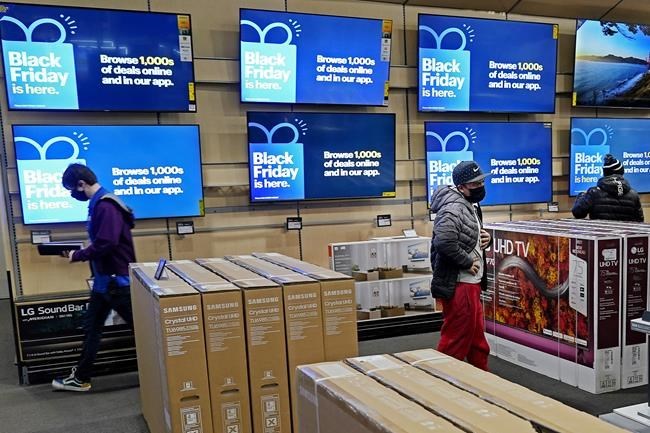
On Friday, the government reinforced that message with its report that the consumer price index soared 6.8% last month from a year earlier — the biggest 12-month jump since 1982.
And the sticker shock is hitting where families tend to feel it most. At the breakfast table, for instance: Bacon prices are up 21% over the past year, egg prices 8%. Gasoline has surged 58%. Furnishing your living room, dining room or kitchen will set you back 14% more than it would have a year ago. Used cars? Up 31%.
And though pay is up sharply for many workers, it isn’t nearly enough to keep up with prices. Last month, average hourly wages in the United States, after accounting for inflation, actually fell 2.4% compared with November 2020.
Economists at Wells Fargo have joked grimly that the Labor Department’s CPI — the Consumer Price Index — should stand for “Consumer Pain Index.’’ Unfortunately for consumers, especially lower-wage households, it’s all coinciding with their higher spending needs right before the holiday season.
The price squeeze is escalating pressure on the Fed to shift more quickly away from years of easy-money policies. And it poses a threat to President Joe Biden, congressional Democrats and their ambitious spending plans.
___
WHAT CAUSED THE PRICE SPIKES?
Much of it is the flipside of very good news. Slammed by COVID-19, the U.S. economy collapsed in the spring of 2020 as lockdowns took effect, businesses closed or cut hours and consumers stayed home as a health precaution. Employers slashed 22 million jobs. Economic output plunged at a record-shattering 31% annual rate in last year’s April-June quarter.
Everyone braced for more misery. Companies cut investment. Restocking was put off. And a brutal recession ensued.
Yet instead of sinking into a prolonged downturn, the economy staged an unexpectedly rousing recovery, fueled by massive government spending and a bevy of emergency moves by the Fed. By spring, the rollout of vaccines had emboldened consumers to return to restaurants, bars and shops.
Suddenly, businesses had to scramble to meet demand. They couldn’t hire fast enough to plug job openings — a near record 11 million in October — or buy enough supplies to fill customer orders. As business roared back, ports and freight yards couldn’t handle the traffic. Global supply chains became snarled.
Costs rose. And companies found that they could pass along those higher costs in the form of higher prices to consumers, many of whom had managed to sock away a ton of savings during the pandemic.
“A sizeable chunk of the inflation we’re seeing is the inevitable result of coming out of the pandemic,’’ said Jason Furman, an economic adviser in the Obama White House now at the Harvard Kennedy School.
Furman suggested, though, that misguided policy played a role, too. Policymakers were so intent on staving off an economic collapse that they “systematically underestimated inflation,” he said.
“They poured kerosene on the fire.’’
A flood of government spending — including President Joe Biden’s $1.9 trillion coronavirus relief package, with its $1,400 checks to most households in March — overstimulated the economy, Furman said.
“Inflation is a lot higher in the United States than it is in Europe,’’ he noted. “Europe is going through the same supply shocks as the United States is, the same supply chain issues. But they didn’t do nearly as much stimulus.’’
Biden has acknowledged that inflation hurts Americans’ pocketbooks and said that containing inflation is a priority. But he said his $1 trillion infrastructure package, including spending on roads, bridges and ports, will help ease supply bottlenecks and therefore inflationary pressures.
___
HOW LONG WILL IT LAST?
Consumer price inflation will likely endure as long as companies struggle to keep up with consumers’ prodigious demand for goods and services. A resurgent job market — employers have added 6.1 million jobs this year — means that Americans can continue to splurge on everything from lawn furniture to new cars.
“The demand side of the U.S. economy will continue to be something to behold,’’ says Rick Rieder, chief investment officer for global fixed income at Blackrock, “and companies will continue to have the luxury of passing through prices.”
Megan Greene, chief economist at the Kroll Institute, suggested that inflation and the overall economy will eventually return to something closer to normal.
“I think it will be ‘transitory’,’’ she said of inflation. “But economists have to be very honest about defining transitory, and I think this could last another year easily.’’
“We need a lot of humility talking about how long this lasts,” Furman said. “I think it’s with us for a while. The inflation rate is going to come down from this year’s blistering pace, but it’s still going to be very, very high compared to the historical norms we have been used to.’’
___
WILL WE SUFFER A RETURN OF 1970’S-STYLE ‘STAGFLATION’?
The run-up in consumer prices has raised the specter of a return to the “stagflation’’ of the 1970s. That was when higher prices coincided with high unemployment in defiance of what conventional economists thought was possible.
Yet today’s situation looks very different. Unemployment is relatively low, and households overall are in good shape financially. The Conference Board, a business research group, found that consumers’ inflation expectations last month were the highest they’d been since July 2008. But their overall confidence remains at high levels.
Economic growth, after slowing from July through September in response to the highly contagious delta variant, is thought to be bouncing back in the final quarter of 2021.
“Most economists are expecting growth to accelerate in the fourth quarter,” Greene said. “So it doesn’t suggest that we’re facing both a tanking of growth and higher inflation. We’re just facing higher inflation.’’
___
WHAT SHOULD POLICYMAKERS DO?
The pressure is on the Fed, which is charged with keeping a lid on inflation, to control prices.
The central bank has begun to counter inflation pressures by reducing its $120 billion in monthly bond purchases by $15 billion a month. Those purchases, launched last summer, were intended to hold down long-term interest rates to spur borrowing and spending.
But with inflation pressures persisting longer than the Powell Fed had expected, the central bank is widely expected to announce as soon as next week that it will accelerate its pullback of the bond purchases.
Doing so would put the Fed on a path to begin raising its key short-term interest rate as early as the first half of next year. That rate has been pegged at nearly zero since March 2020, when the coronavirus sent the economy into a deep recession. Raising rates that soon would be much earlier than was expected as recently as this summer, when Fed policymakers forecast that they wouldn’t do so until late 2023.
“We’ve been fighting non-existent inflation since the 1990s,’’ said Diane Swonk, chief economist at the accounting and consulting firm Grant Thornton, “and now we’re talking about fighting an inflation that is real.’’
___
AP Economics Writer Christopher Rugaber contributed to this report.