Raising voice to help Baha’is can make difference

Advertisement

Advertise with us

IN a world rife with the murder of innocent people, why should we care about seven law-abiding Iranian Baha'is jailed for a year in Evin Prison in Tehran, until recently without charges, and without access to their lawyer, Nobel Laureate Shirin Ebadi?

Read this article for free:


or

Already have an account? Log in here »

To continue reading, please subscribe:

Subscribe and receive a limited-edition Free Press branded hat or tote.

Digital Subscription

One year of digital access for only $205*

  • Enjoy unlimited reading on winnipegfreepress.com
  • Read the E-Edition, our digital replica newspaper
  • Access News Break, our award-winning app
  • Play interactive puzzles

*First annual payment billed as $205.00 + GST for one year. This annual subscription will automatically renew at $233.00 + GST every 52 weeks (10% off the regular annual price of $259.35). Offer available to new and qualified returning subscribers only. Cancel any time.

To continue reading, please subscribe:

Add Free Press access to your Brandon Sun subscription for only an additional

$1 for the first 4 weeks*

  • Enjoy unlimited reading on winnipegfreepress.com
  • Read the E-Edition, our digital replica newspaper
  • Access News Break, our award-winning app
  • Play interactive puzzles
Start now

*Your next Brandon Sun subscription payment will increase by $1.00 and you will be charged $17.95 plus GST for four weeks. After four weeks, your payment will increase to $24.95 plus GST every four weeks.

Hey there, time traveller!
This article was published 07/06/2009 (6313 days ago), so information in it may no longer be current.

IN a world rife with the murder of innocent people, why should we care about seven law-abiding Iranian Baha’is jailed for a year in Evin Prison in Tehran, until recently without charges, and without access to their lawyer, Nobel Laureate Shirin Ebadi?

Why, indeed.

Daily news of such horrors has inured us. We simply don’t care anymore. It makes no sense to stress about situations over which we have no power. At least that’s how we’ve come to think, and understandably so.
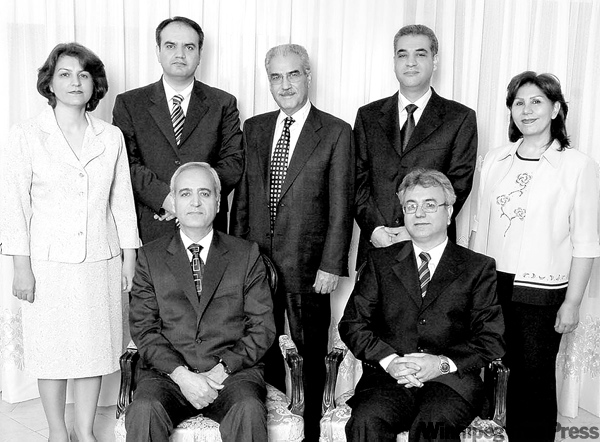
Yet our voices could have made a difference had they been raised in defence of the Jews in Germany, or the Rwandans. So why would the voices of us, the people, not make a difference for these seven “Friends of Iran” or “Yaran,” who, as a consequence of co-ordinating spiritual and community affairs, are now rumoured to have been charged with “spreading corruption in the land.” This same charge resulted in death for some of the more than 200 Baha’is executed in the wake of the Islamic Revolution in 1979.

Violations of the human rights of Baha’is in Iran have increased in intensity since 2005 and the election of President Ahmadinejad, especially in recent months. Baha’is have faced systematic harassment and intimidation including the circulation of lists of Baha’is with instructions to secretly monitor their community events; dawn raids on Baha’i homes; the confiscation of personal property; a dramatic increase in the number of Baha’is arrested; daily incitement to hatred of the Baha’is in all forms of government-sponsored mass media; anti-Baha’i symposia and seminars organized by clerics followed by orchestrated attacks on Baha’i homes and properties; destruction of Baha’i cemeteries; demolition of Baha’i holy places and shrines; acts of arson against Baha’i homes and properties; denial of access to higher education; vilification of Baha’i children at school by their teachers; debarring Baha’is from numerous occupations and businesses; refusal to extend bank loans or to issue or renew business licences; closure of Baha’i shops; harassment of landlords of Baha’i business tenants to force their eviction and threats against Muslims who associate with Baha’is.

In the face of reports that elements inimical to the Baha’i faith have redoubled their efforts to cripple the community in the land of its birth, here in Winnipeg last week there was some good but quiet (for obvious reasons) news: a Winnipeg Baha’i learned that her cousin, imprisoned in an undisclosed Iranian city for the past several months, was released in exchange for the deed to the house, valued at approximately $150,000 Cdn.

So what have we, the people, done lately to protect Iran’s largest religious minority of over 300,000 as well as the seven Baha’is facing grave but totally baseless charges?

A lot!

On March 30, the House of Commons unanimously adopted a strongly worded motion condemning the persecution of the Baha’is in Iran as well as noting that attacks on Baha’is “constitute a number of warning signs that often foreshadow widespread ethnic, racial or religious cleansing.”

And on May 14, Canada’s minister of foreign affairs, Lawrence Cannon, issued a similar statement, which reads in part, “The government of Canada calls upon the Iranian authorities to immediately release the seven Baha’i prisoners and to cease the harassment of members of the Baha’i faith.”

Nor was Cannon Canada’s first foreign minister to advocate on behalf of the Baha’is in Iran. At the United Nations in May 2008, then foreign minister Maxime Bernier criticized Iran for jailing six of the seven leaders. On a number of occasions when he was minister of foreign affairs, Lloyd Axworthy, now president of the University of Winnipeg, spoke out strongly on their behalf.

Then there is the Feb. 3 open letter addressed to the Baha’is in Iran and signed by 243 Iranian Muslims — intellectuals, scholars, writers, journalists, activists and artists worldwide. It is a letter of apology for their silence during Iran’s long-running persecution of Baha’is that began with the murder of 20,000 of that faith’s earliest followers.

Internationally, a number of governments, international organizations and prominent individuals have reacted to the announcement of a trial for the seven members of the Friends in Iran, including most recently, British Prime Minister Gordon Brown.

So, why should we speak out about these Baha’is? Because what’s going on in Iran is unjust. Religious freedom is a fundamental right outlined in the International Covenant on Civil and Political Rights (ICCPR) as well as a number of international conventions and treaties.

No price tag, material or otherwise, should be attached to one’s beliefs. And we do have a voice. Raising it in protest might make the difference.

Shar Mitchell, writer, recently returned to Winnipeg after 38 years.

The Free Press is committed to covering faith in Manitoba through our Religion in the News project. This reporting continues because readers like you step forward to fund it.

Donate now to support our reporting on religion.

Your donation is eligible for a charitable tax receipt. BECOME A FAITH JOURNALISM SUPPORTER

Report Error Submit a Tip

The Free Press acknowledges the financial support it receives from members of the city’s faith community, which makes our coverage of religion possible.

More Stories

A life’s story: activist, educator, organizer knew the true meaning of community

Janine LeGal 7 minute read Preview

A life’s story: activist, educator, organizer knew the true meaning of community

Janine LeGal 7 minute read 3:00 AM CDT

Somewhere between a love for sharing stories and a love of community connections, Michael (Mike) Maunder lived his life. Giving voice to people and neighbourhoods was a passion for the natural-born community organizer.

An author, teacher and principal, Maunder lived in a one-bedroom apartment in West Broadway and devoted himself to community development, education and neighbourhood renewal.

He maintained a connection with Augustine United Church, whose commitment to social justice he appreciated, volunteered at the Sandy-Saulteaux Spiritual Centre, and found comfort in a Buddhist prayer community.

Maunder died on July 15 at the age of 80.

Read
3:00 AM CDT

Family account spiced with magic realism, geopolitical intrigue and a ghost story

Reviewed by Zilla Jones 4 minute read Preview

Family account spiced with magic realism, geopolitical intrigue and a ghost story

Reviewed by Zilla Jones 4 minute read 2:01 AM CDT

Tom Lin’s second novel Babylon, South Dakota moves beyond a historical account of an immigrant family’s struggle, delightfully blending and bending genres.

Lin is a Chinese-born novelist whose family emigrated to the U.S. when he was four years old. His debut novel, The Thousand Crimes of Ming Tsu, won the 2022 Andrew Carnegie Medal for Excellence in Fiction, making him the youngest ever recipient of that award. He earned a PhD in English from the University of California Davis and is currently an assistant professor of English and creative writing at the University of Iowa.

Babylon, South Dakota takes place in an unspecified time period that can be understood to be during the Mao era — likely the 1950s or ’60s. A young Chinese couple, the Hsuis, immigrate to the rural community that gives the book its title. They take the names Saul and Mei and settle on a 160-acre homestead left to them by a distant relative.

Saul’s dream is to breed and sell chrysanthemums from seeds he brought from China, while Mei wants to raise livestock. They speak no English, know nothing of life in the United States, are unprepared for the harshness of winter and the isolation of the farm and bring nothing with them except some gold, which Mei hides around the house for emergencies. Their only link to the outside world is a discarded and marginally functioning TV set, which Saul rescues and rigs up.

Read
2:01 AM CDT

Cabernet Sauvignon star of wine festival

Ben Sigurdson 5 minute read Preview

Cabernet Sauvignon star of wine festival

Ben Sigurdson 5 minute read 3:00 AM CDT

The Winnipeg Wine Festival will celebrate the king of red wine grapes next weekend — the theme of this year’s festival, which takes place Sept. 25 and 26 at the RBC Convention Centre, is Cabernet Sauvignon.

Cab Sauv, as it’s also known, is the world’s most widely planted wine grape of any colour, first coming to prominence in the 1800s in France’s Bordeaux region, where the grape is still popular. Rather than single-variety wines, Bordeaux reds tend to be blends, with those coming from the left bank of the Gironde estuary being Cabernet-dominant, while right-bank wines are Merlot-dominant, with Cabernet Sauvignon playing a supporting role. Cabernet and Merlot work well together and many other countries have followed suit in blending the two.

A team at University of California Davis put Cabernet Sauvignon through a DNA test in 1996 and discovered its parent grapes are Cabernet Franc and Sauvignon Blanc — it’s likely that at some point the two varieties, planted next to each other in some vineyard, crossed and mutated and became the grape we know today. (Someone growing grapes in the 19th century must have had an inkling of what was up, as the grape has been called Cabernet Sauvignon since long before the DNA test.)

Flavour-wise, most Cabernet Sauvignon wines are big and bold, with a core of deep dark berry flavours, some graphite and spice notes and relatively bright acidity. It’s a grape that is well-suited to barrel aging, with most examples seeing at least some time in wood.

Read
3:00 AM CDT

Puzzles Palace

1 minute read Monday, Jul. 27, 2026

To solve our puzzles, please subscribe with this special offer: |

Jets vets weigh in on franchise goalie Hellebuyck not reporting to training camp

Mike McIntyre 7 minute read Preview

Jets vets weigh in on franchise goalie Hellebuyck not reporting to training camp

Mike McIntyre 7 minute read Thursday, Sep. 17, 2026

Hockey is the ultimate team sport, where it’s supposed to be about the crest on your chest rather than the name on your back.

So how is Connor Hellebuyck’s trade request and subsequent training camp strike playing out inside the Winnipeg Jets locker room — particularly among other core players he’s gone to battle with over the years?

“Obviously the news is heartbreaking,” Jets forward Kyle Connor said Thursday.

“It feels like we had such a special group here and for whatever reason — I can’t speak to the reason until we hear from the man, I’m not going to speculate on what it is but I know that a lot of guys in that room that are heartbroken.”

Read
Thursday, Sep. 17, 2026

Manitoba abandoning spring, fall clock changes

Carol Sanders 8 minute read Preview

Manitoba abandoning spring, fall clock changes

Carol Sanders 8 minute read Updated: Yesterday at 8:48 AM CDT

Time’s up for the time change in Manitoba.

Manitobans won’t be setting their clocks back an hour in November. The province has decided to permanently stay on daylight time after surveying residents on the twice annual clock adjustment.

“We heard from Manitobans loud and clear — no more changing the clocks in Manitoba,” Premier Wab Kinew said in a news release Thursday.

Most of the 72,000 votes submitted in an online EngageMB survey — 92 per cent — said they would like to see the practice end. The survey asked if they preferred earlier sunrises in winter with standard time or the later sunsets in summer with daylight time. More than half of survey participants (58 per cent) indicated a preference to stay on permanent daylight time; 34 per cent voted to eliminate the time change but stay on standard time.

Read
Updated: Yesterday at 8:48 AM CDT