City woman making history by ritually copying Jewish scripture

Advertisement
Read this article for free:
or
Already have an account? Log in here »
To continue reading, please subscribe:

Digital Subscription
One year of digital access for only $205*
- Enjoy unlimited reading on winnipegfreepress.com
- Read the E-Edition, our digital replica newspaper
- Access News Break, our award-winning app
- Play interactive puzzles
*First annual payment billed as $205.00 + GST for one year. This annual subscription will automatically renew at $233.00 + GST every 52 weeks (10% off the regular annual price of $259.35). Offer available to new and qualified returning subscribers only. Cancel any time.
To continue reading, please subscribe:
Add Free Press access to your Brandon Sun subscription for only an additional
$1 for the first 4 weeks*
- Enjoy unlimited reading on winnipegfreepress.com
- Read the E-Edition, our digital replica newspaper
- Access News Break, our award-winning app
- Play interactive puzzles
*Your next Brandon Sun subscription payment will increase by $1.00 and you will be charged $17.95 plus GST for four weeks. After four weeks, your payment will increase to $24.95 plus GST every four weeks.
Read unlimited articles for free today:
or
Already have an account? Log in here »
Hey there, time traveller!
This article was published 20/02/2010 (6054 days ago), so information in it may no longer be current.
With each stroke of her quill, Winnipegger Irma Penn is inking an ancient text — and creating something entirely new at the same time.
As a Jewish scribe, she’s a copyist of the Torah, following a 3,300-year-old tradition of how the Hebrew scriptures are inked on parchment and respecting thousands of laws pertaining to every aspect of the process, right down to the placement and spacing of each letter.
As one of a handful of women worldwide who are trained in this craft of ritually copying the Jewish scriptures, she’s making history by participating in the first- ever Torah scribed by an international community of women.
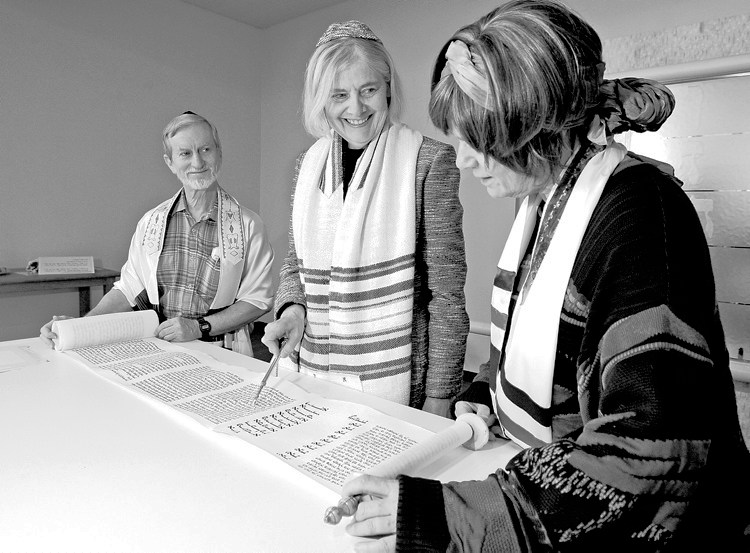
“I’m happy. I feel energized by this,” Penn says of being one of six scribes — and the only Canadian — with the Women’s Torah Project, based in Seattle, Wash.
The Torah is the first five books in the Old Testament. A Torah scroll, which contains the first five books of the Old Testament, can have a lifespan of several centuries if it is carefully handled and stored.
The brainchild of organizational consultant Wendy Graff, the female-scribed Torah was commissioned by the Kadima Reconstructionist Community in 2003 after Graff realized at her daughter’s bat mitzvah that all the sacred Jewish scriptures were traditionally scribed by men.
“It was a profound epiphany for me,” says Graff, who serves as volunteer director for the $100,000 project. “I just could not believe that my daughter who carried this Torah would not be allowed to write it.”
At about the same time, Graff’s synagogue was raising funds to buy their own Torah scroll, which could cost upwards of $10,000. Instead of their original plan to purchase it second-hand, the congregation decided to commission one from a female scribe. And the Women’s Torah Project was born.
“Our intention was to have one person scribe it, because that’s the model,” says Graff, explaining how a Torah is traditionally produced. “(But women) are communityminded. All of a sudden, it just made sense (to do it in a group) and women are becoming Torah scribes.”
As news of the project spread through its Facebook page (www.womenstorah.com) and by some ethereal female scribal network, more and more women asked to participate as scribes and artists. Several women, like Penn, underwent the rigorous study and apprenticeship in Israel and joined the project along the way. In addition to Penn, who is working on Deuteronomy, the Torah is being scribed by two American women, two from Israel and one from Brazil.
These six women and a handful of others are believed to be the only traditionally trained Jewish scribes in the world, says Graff, who realizes not every Jew would be comfortable with a Torah produced by women.
“It just feels right. Once the doors open, you can’t go back,” Graff says of how her project has created new possibilities for Jewish women. “To know that women have shared that responsibility is liberating for men, unburdening for men.”
For Penn, an artist, retired archivist and former school teacher, learning how to scribe was the fulfilment of a longtime dream.
“It’s something I’ve always wanted to do,” she explains of her new vocation of less than a year. “Now is the right time.”
These days, Penn spends her time at her easel in her Tuxedo highrise apartment overlooking Assiniboine Park, carefully writing her section of the Torah on large sheets of parchment, using a turkey-feather quill dipped in imported gallnut ink.
Lettered in a prescribed font reserved for sacred texts, scribing the Torah is more about following the rules than individual creativity, says Penn. The number of words on a panel are laid out so that each newly penned scroll is identical to ones written centuries and millennia before.
One scribe can spend a year or more copying the Torah, but this project, with six scribes on four continents communicating by email, Facebook and telephone, has stretched out over seven years. Some scribes have full-time jobs and letter in their spare time, while some, such as Penn, are able to dedicate themselves to it every day, says Graff, who hopes the Torah will be completed by this summer.
“Really, it is holy work, so we had to work together so it works for every scribe and every artist and our community so the end result is a Torah we’re all comfortable with,” says Graff, who describes her role in the project as “chief nudger.”
So far, Penn hasn’t met Graff or the other scribes, although Graff hopes all the participants can converge in Seattle to sew together the 52 parchments to make the continuous Torah scroll, which is wound around rollers at each end.
In addition to her work on the Women’s Torah Project, Penn has accepted a commission to write a complete Torah. Last November, she completed her first scroll, the Book of Esther, which will be read at Temple Shalom’s Purim celebrations on Feb. 28.
That event will be significant for the congregation, since it marks the first time the passage will be read from a scroll instead of a printed book, says Rabbi Karen Soria. The synagogue has three Torah scrolls, but usually reads the other Hebrew scriptures from printed texts.

“It really is quite extraordinary,” says Soria. “I imagine there are very few congregations who have had a Megillah (scroll) written by a member.”
Although she is modest and understated about her accomplishments, Penn is well aware of the significance of her work copying sacred Jewish texts.
“I’m in awe of it. How does it last so many thousands of years and people are still following it? It’s just amazing,” she says of her feelings toward the scripture and the process of scribing it.
“It’s the best feeling in the world.”
brenda@suderman.com
The Free Press is committed to covering faith in Manitoba through our Religion in the News project. This reporting continues because readers like you step forward to fund it.
Donate now to support our reporting on religion.
Your donation is eligible for a charitable tax receipt.
BECOME A FAITH JOURNALISM SUPPORTER
Brenda Suderman has been a columnist in the Saturday paper since 2000, first writing about family entertainment, and about faith and religion since 2006.
Our newsroom depends on a growing audience of readers to power our journalism. If you are not a paid reader, please consider becoming a subscriber.
Our newsroom depends on its audience of readers to power our journalism. Thank you for your support.
The Free Press is committed to covering faith in Manitoba through our Religion in the News project. This reporting continues because readers like you step forward to fund it.
Donate now to support our reporting on religion.
Your donation is eligible for a charitable tax receipt.
BECOME A FAITH JOURNALISM SUPPORTER
Brenda Suderman has been a columnist in the Saturday paper since 2000, first writing about family entertainment, and about faith and religion since 2006.
Our newsroom depends on a growing audience of readers to power our journalism. If you are not a paid reader, please consider becoming a subscriber.
Our newsroom depends on its audience of readers to power our journalism. Thank you for your support.
Advertisement Advertise With Us
Advertisement Advertise With Us
The Free Press acknowledges the financial support it receives from members of the city’s faith community, which makes our coverage of religion possible.