Code of conduct for priests developed by archdiocese

Advertisement
Read this article for free:
or
Already have an account? Log in here »
To continue reading, please subscribe:

Digital Subscription
One year of digital access for only $205*
- Enjoy unlimited reading on winnipegfreepress.com
- Read the E-Edition, our digital replica newspaper
- Access News Break, our award-winning app
- Play interactive puzzles
*First annual payment billed as $205.00 + GST for one year. This annual subscription will automatically renew at $233.00 + GST every 52 weeks (10% off the regular annual price of $259.35). Offer available to new and qualified returning subscribers only. Cancel any time.
To continue reading, please subscribe:
Add Free Press access to your Brandon Sun subscription for only an additional
$1 for the first 4 weeks*
- Enjoy unlimited reading on winnipegfreepress.com
- Read the E-Edition, our digital replica newspaper
- Access News Break, our award-winning app
- Play interactive puzzles
*Your next Brandon Sun subscription payment will increase by $1.00 and you will be charged $17.95 plus GST for four weeks. After four weeks, your payment will increase to $24.95 plus GST every four weeks.
Read unlimited articles for free today:
or
Already have an account? Log in here »
Hey there, time traveller!
This article was published 10/04/2010 (5977 days ago), so information in it may no longer be current.
In the midst of widespread accusations of abuse and scandal in the Catholic church, a local Roman Catholic archdiocese has quietly developed a professional code of conduct for its priests.
Last month, the Archdiocese of Winnipeg released the document outlining expectations, ethical standards and professional behaviour for priests, as well as establishing a formal complaint process for parishioners, the first diocese in Manitoba to do so.
“Given the scenario and what’s taking place in the church right now, for priests, our morale is definitely diminished, it affects us. The accusations are shameful and difficult for us to hear, and also (difficult) for the victims,” says Rev. Eric Giddins, chair of the priestly conduct committee. “Having something like this strengthens our commitment to who we are and we want to portray that to whom we minister and serve.”
The Archdiocese of St. Boniface is in the process of completing a similar code of conduct to be released later this spring, says Rev. Leonce Aubin, chancellor of St. Boniface.
The Ukrainian Catholic Archeparchy of Winnipeg has a policy on sexual abuse, says Archbishop Lawrence Huculak, but not a separate professional code of conduct.
Soon to be available on the website of the Archdiocese of Winnipeg (www.archwinnipeg.ca), the 19-page code of conduct establishes a protocol for reporting concerns around a priest’s behaviour, as well as providing examples of what is and is not acceptable, says Giddins, priest at Good Shepherd Roman Catholic Church in Portage la Prairie.
“We wanted our document to be affirming and giving specific guidelines to raise their (the priests’) conscience,” he explains of the shape and content of the code of conduct. “It’s wasn’t going to be a set of don’ts.”
For example, in the section titled The Priest as Teacher and Spiritual Guide, the document advises parish priests to improve their biblical knowledge, be sensitive to diverse forms of spirituality, and encourage spiritual formation of parishioners, before addressing boundaries in a counselling situation, including not initiating any physical contact such as holding, touching or hugging.
Priest are also encouraged to eat well, get adequate sleep and regular exercise, avoid illegal drugs and not to drink or smoke excessively, as well as avoiding inappropriate relationship with youth, children, employees or parishioners.
In a section relating to money and finances, priests are advised not to accept gifts of goods and services from parishioners, such as dental care, discounts on the purchase of a vehicle or the use of a vacation property.
Giddins says much of the document, developed after three years of consultation with priests in the diocese, simply formalizes what is already standard practice in ministry.
“It’s in writing, plain and simple, what we priests are called to do,” he says. “It’s something in writing that is very public and very visible of what we stand for.”
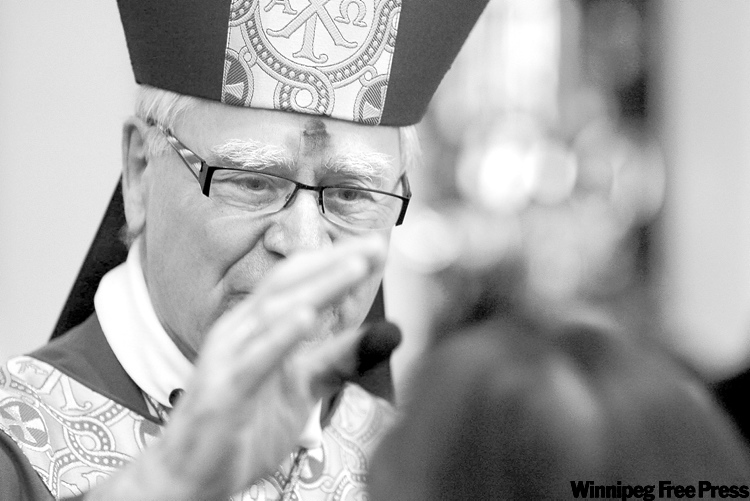
Along with the release of the document, Archbishop James Weisgerber has also set up a six-member advisory council that will deal with reports of improper behaviour by priests. Previously, concerns were addressed by congregations or directly to the archbishop, a procedure he admits was awkward for all parties.
“As the bishop, I have a relationship with everybody. I’m the father and brother to the priests, and I’m the archbishop to everybody,” says Weisgerber.
He says the current media firestorm around sexual misconduct of priests in Ireland and the United States does not recognize that the situation in the Canadian Catholic Church is much different. After news broke two decades ago about widespread abuse of boys at the Catholic-run Mount Cashel Orphanage in Newfoundland, he says the Canadian Conference of Catholic Bishops asked dioceses to develop documents to deal with issues of sexual misconduct.
“What is sort of painful for me is there is no recognition in Canada that we have done anything and we have tried to get our house in order,” says Weisgerber, who recently completed a term as president of the CCCB.
Although he hasn’t yet read the document, the facilitator of a Winnipeg parish welcomes the move to create a professional code of conduct for priests.

“I think it’s a good idea to have things laid out in a clear way, especially if it leads to clarity and accountability,” says Gilles Lorteau of St. Gianna’s Roman Catholic parish.
Giddins says he intends to make the document widely available in his parish by posting notices of where to find electronic versions of it and providing paper copies for those parishioners without computers.
Weisgerber says he hopes publicity around the code of conduct, including a March 31 story in the Catholic paper Prairie Messenger, will give Catholics faith that change can happen.
“The problem is when there is a big difficulty, the people in the Church don’t know how to deal with it,” says Archbishop Weisgerber. “I think there’s also some cynicism about it. They think if they say something, nothing will be done.”
brenda@suderman.com
The Free Press is committed to covering faith in Manitoba through our Religion in the News project. This reporting continues because readers like you step forward to fund it.
Donate now to support our reporting on religion.
Your donation is eligible for a charitable tax receipt.
BECOME A FAITH JOURNALISM SUPPORTER
Brenda Suderman has been a columnist in the Saturday paper since 2000, first writing about family entertainment, and about faith and religion since 2006.
Our newsroom depends on a growing audience of readers to power our journalism. If you are not a paid reader, please consider becoming a subscriber.
Our newsroom depends on its audience of readers to power our journalism. Thank you for your support.
The Free Press is committed to covering faith in Manitoba through our Religion in the News project. This reporting continues because readers like you step forward to fund it.
Donate now to support our reporting on religion.
Your donation is eligible for a charitable tax receipt.
BECOME A FAITH JOURNALISM SUPPORTER
Brenda Suderman has been a columnist in the Saturday paper since 2000, first writing about family entertainment, and about faith and religion since 2006.
Our newsroom depends on a growing audience of readers to power our journalism. If you are not a paid reader, please consider becoming a subscriber.
Our newsroom depends on its audience of readers to power our journalism. Thank you for your support.
Advertisement Advertise With Us
Advertisement Advertise With Us
The Free Press acknowledges the financial support it receives from members of the city’s faith community, which makes our coverage of religion possible.