St. Andrew’s Woodhaven almost a century old
Advertisement
Read this article for free:
or
Already have an account? Log in here »
To continue reading, please subscribe:

Digital Subscription
One year of digital access for only $205*
- Enjoy unlimited reading on winnipegfreepress.com
- Read the E-Edition, our digital replica newspaper
- Access News Break, our award-winning app
- Play interactive puzzles
*First annual payment billed as $205.00 + GST for one year. This annual subscription will automatically renew at $233.00 + GST every 52 weeks (10% off the regular annual price of $259.35). Offer available to new and qualified returning subscribers only. Cancel any time.
To continue reading, please subscribe:
Add Free Press access to your Brandon Sun subscription for only an additional
$1 for the first 4 weeks*
- Enjoy unlimited reading on winnipegfreepress.com
- Read the E-Edition, our digital replica newspaper
- Access News Break, our award-winning app
- Play interactive puzzles
*Your next Brandon Sun subscription payment will increase by $1.00 and you will be charged $17.95 plus GST for four weeks. After four weeks, your payment will increase to $24.95 plus GST every four weeks.
Read unlimited articles for free today:
or
Already have an account? Log in here »
Hey there, time traveller!
This article was published 17/07/2010 (5929 days ago), so information in it may no longer be current.
"St. Andrew’s, a neat little church built on a site donated by the late Andrew McDermot, Esq.” So wrote Rev. A. E. Cowley, rector of the oldest Anglican church in St. James in his Synod report on the Deanery in June 1909.
Not to be confused with the historic old St. Andrew’s on the Red, St. Andrew’s Woodhaven, which sits on Portage Avenue at Sturgeon Creek not far from the banks of the Assinboine River, is now claiming a little bit of history for itself. Originally a mission church of St. James, the "neat little church" will be celebrating its 100th anniversary in 2011.
Although the original mission church of St. James was built in 1907, the official deed of formation of the parish of St. Andrew was issued by Archbishop Matheson in 1911.
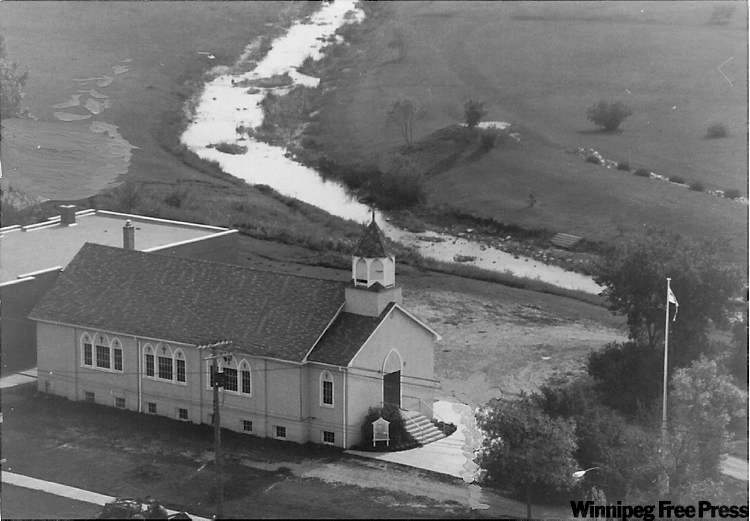
In October 1907 the Manitoba Free Press reported that a new Anglican church was being built on "a very pretty site" on land donated by Andrew McDermot. Andrew McDermot Sr. was Winnipeg’s first pioneer merchant and one of its wealthiest. A 24- by 23-foot church was built on a concrete foundation by builder B. Smith with Rev. A. W. Wood as the clergyman in charge at the time.
In October of that year the Free Press also reported that work was being rushed on the new church at Sturgeon Creek and that it would be ready for opening ceremonies "before the snow flies."
The following month, the paper stated that a new Anglican church opened for worship on Nov. 24, 1907. Built in the Gothic style, the small wooden church was filled with people when it opened on Nov. 24 with a sermon delivered by Archdeacon Fortin.
According to Paula MacRobert, a member of the centenary committee who has recently put together a history of the church, "a 75th anniversary book by Roy and Elsie Low states that it became evident in the spring of 1912 that this plot of land on the south side of the Portage Trail at the Golden Gate Curve was ill chosen. The ground was too low and much of the population was further west on the north side of Portage Avenue."
The son of the previous donor, possibly, Andrew McDermott III, gave two lots on nearby Wallasey Street in exchange for the property at Golden Gate. A concrete foundation was built and the old church was moved there where it stayed until 1948. Rev. Thomas Marshall served for many years as rector of this church from 1917 until his death in 1944.
In the early 1920s, a bell tower was added to the front of the church as well as a vestry and an extension to the rear of the church.
By 1945, there was a need for a new church with a basement that could be used for gatherings for the growing congregation. The two lots on Wallasey Street were given up for three lots on Portage Avenue and Ronald Street, east of Woodhaven Boulevard.
Originally designed to seat 256 people, the plans were soon adjusted to accommodate about 150 people in order to reduce costs. Work began after much fundraising in 1947 and the church was completed for about $23,000, largely due to volunteer labour from parishioners and others.

Rev. A. E. Thain was the rector of the new church and being a trained electrician, he helped by doing the wiring. Also artistic, the rector carved two angels, which still are on display at the back of the altar. Three stained glass windows, an organ, a communion table and a brass plaque, all in memory of long-time Rev. Marshall, were all brought from the old church as well as many other historic memorials and furnishings.
Debt-free, the church was consecrated by Archbishop L. R. Sherman on Nov. 12, 1950. A new rectory was completed in 1954 and in 1961 a new parish hall was built.
According to Paula MacRobert, a long-time parishioner, Bob Lane, recalls that "the property belonging to the church included land which extended south of Sturgeon Creek beside the existing mound of earth that is the original location of Grant’s Mill." Don Aiken’s It Happened in Manitoba tells us that the original water mill was built by Cuthbert Grant in 1829 to help improve conditions for the Grantown settlement, now, St. Francois Xavier. A replica sits along Sturgeon Creek. The land was given to the parks department in the late 1970s in exchange for frontage on Woodhaven Boulevard.
In 1985, an extension was added to the west and southwest sides of the church. This allowed for increased seating capacity, a wider stairway and a larger entrance, among other things, to meet the needs of the growing membership. More recently, other renovations have been made including replacing the church roof with a green metal roof and the addition of a prayer garden.
The parish at Sturgeon Creek, which at one time flowed through an area of mostly tall-grass prairie and mud trails, has already scheduled some events to commemorate the church’s history to begin in the fall. So far, some plans include a social, a tree planting and a worship service in period costume, complete with the arrival of a horse-drawn buggy.
The Free Press is committed to covering faith in Manitoba through our Religion in the News project. This reporting continues because readers like you step forward to fund it.
Donate now to support our reporting on religion.
Your donation is eligible for a charitable tax receipt.
BECOME A FAITH JOURNALISM SUPPORTER
The Free Press acknowledges the financial support it receives from members of the city’s faith community, which makes our coverage of religion possible.