St. François Xavier Parish has a fascinating history

Advertisement

Advertise with us

A mysterious white horse, a well-known Métis leader of Scottish and Cree descent and the second-oldest Roman Catholic parish on the Prairies all have something in common -- they are all part of the story behind the historic community of St. François Xavier.

Read this article for free:


or

Already have an account? Log in here »

To continue reading, please subscribe:

Subscribe and receive a limited-edition Free Press branded hat or tote.

Digital Subscription

One year of digital access for only $205*

  • Enjoy unlimited reading on winnipegfreepress.com
  • Read the E-Edition, our digital replica newspaper
  • Access News Break, our award-winning app
  • Play interactive puzzles

*First annual payment billed as $205.00 + GST for one year. This annual subscription will automatically renew at $233.00 + GST every 52 weeks (10% off the regular annual price of $259.35). Offer available to new and qualified returning subscribers only. Cancel any time.

To continue reading, please subscribe:

Add Free Press access to your Brandon Sun subscription for only an additional

$1 for the first 4 weeks*

  • Enjoy unlimited reading on winnipegfreepress.com
  • Read the E-Edition, our digital replica newspaper
  • Access News Break, our award-winning app
  • Play interactive puzzles
Start now

*Your next Brandon Sun subscription payment will increase by $1.00 and you will be charged $17.95 plus GST for four weeks. After four weeks, your payment will increase to $24.95 plus GST every four weeks.

Opinion

Hey there, time traveller!
This article was published 28/08/2010 (5881 days ago), so information in it may no longer be current.

A mysterious white horse, a well-known Métis leader of Scottish and Cree descent and the second-oldest Roman Catholic parish on the Prairies all have something in common — they are all part of the story behind the historic community of St. François Xavier.

Standing at the junction of Highways 1 and 26, west of Headingley, is the striking monument of a beautiful horse that commemorates one of the most famous legends in the history of Manitoba. So haunting was the legend of love between members of two warring tribes, their murder and the escape of their mystical white horse that continued to roam the Prairies for years afterwards, that the area soon became known as the White Horse Plains.

A Métis settlement founded by Cuthbert Grant in 1824 sprang up along the banks of the winding Assiniboine River and in that settlement was established the second-oldest Roman Catholic parish in Western Canada, the historic St. François Xavier Parish.
Submitted photo
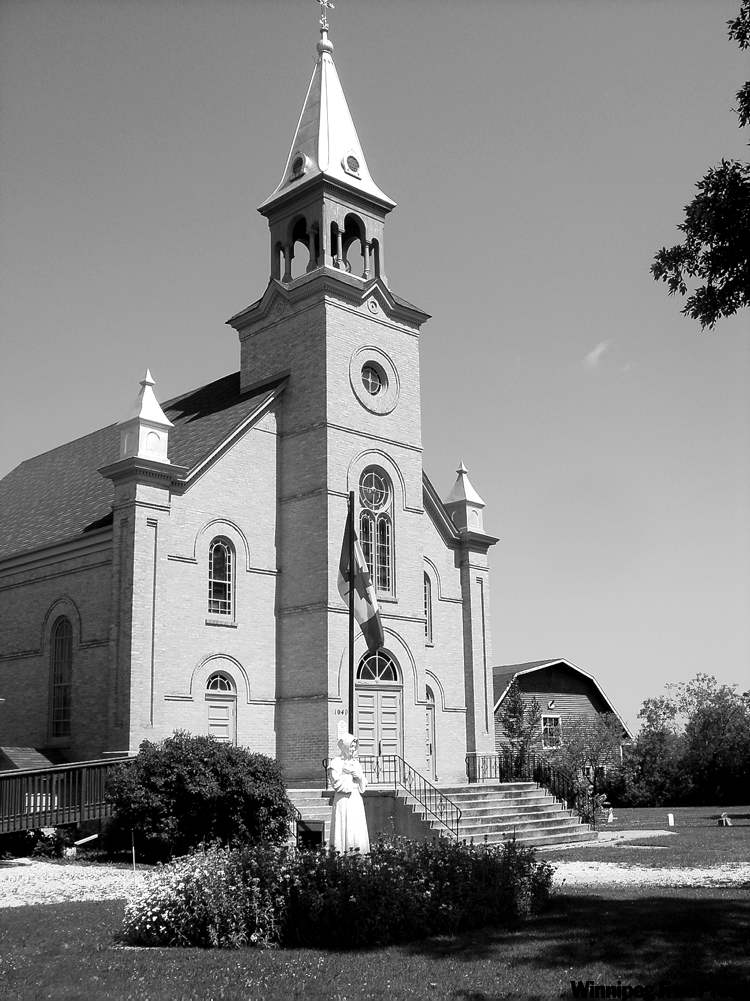
St. Francois Xavier Roman Catholic Church is part of the second oldest Catholic parish in the Canadian Prairies.
Submitted photo St. Francois Xavier Roman Catholic Church is part of the second oldest Catholic parish in the Canadian Prairies.

To the right of the horse off Highway 26, the town originally known as Grantown in honour of its founder, and now known as St. François Xavier, comes slowly into view. Once home to Cree and Sioux tribes, the area provided a rich supply of bison used for food and fur. Grant, having received a grant of land in the area, brought many colonists from Pembina, mostly of Métis origin, many of them his relatives, to settle on the river lots there.

The Métis leader placed the settlement under the patronage of St. François Xavier, a Spanish priest born in 1506 who helped bring Christianity to India and Japan. Bison hunting was the main occupation then, although farming was practised in later years as well.

After leading the North West Company forces in the battle of Seven Oaks, Grant began to work for the Hudson’s Bay Company, founded Grantown and became Warden of the Plains in 1828, defending the Red River settlement from the Sioux. He began to be looked upon as the leader of the Métis.

Until 1827, Grantown was served by the missionary Father Destroismaisons. According to community history, the first church services were held in Grant’s home. Eventually, the first chapel was built in 1828.

Liber Historicus, a parish journal written in French and dated 1824 to 1931, was discovered in the attic of the current church by parishioners some 80 years later. It was recently painstakingly translated from old French to modern Canadian French and then to English.

The journal, written by parish priests, contained a record of religious events, civil events and personal reflections on the times, stretching from 1824 through the First World War and ending abruptly on June 7, 1931.

According to the journal, compiled by Odile Thibert, the first church became too small and a larger church was built in 1832. The first Christmas mass was celebrated in 1833 and in 1834 a register was begun for baptisms, marriages and burials. The mission was granted parish status in 1834.

Several sisters of the Grey Nuns of Montreal arrived in the community at the request of Bishop Provencher in 1850 in order to look after the education of the children of the parish. A monument in memory of the Grey Nuns stands in the churchyard today.

The mission was served by various priests over the years until the arrival of one particularly well-loved and popular priest in 1866. Father François Xavier Kavanagh of Quebec became the residential priest of the parish in 1869 and served in that post for the next 40 years. At that time, the parish consisted of about 400 Métis families. A humble, quiet man, Father Kavanagh was loved for his devotion to the people and to the parish as well as for his remarkable faith.

The Historicus notes that when Archbishop Langevin made his second pastoral visit to the mission, he found the church to be in a "very dilapidated state" and consequently Father Kavanagh was entrusted with overseeing the building of an impressive new brick church.

Designed by the architect M. Sénécal of St. Boniface, the church was completed in 1900 and blessed by Archbishop Langevin on Dec. 4, 1900.

The journal states that "a long line of sleighs awaited the visitors at the station of The White Horse Plains. On approaching the village, rifle shots were fired to express the joy of the parishioners, all grouped around the church. A magnificent French flag waved graciously near the rectory."

The "new" brick church with its soaring spire sits in the peaceful pastoral setting of St. François Xavier and continues to serve the modern community today. The parish is now 186 years old.


Cheryl Girard is a Winnipeg writer.

The Free Press is committed to covering faith in Manitoba through our Religion in the News project. This reporting continues because readers like you step forward to fund it.

Donate now to support our reporting on religion.

Your donation is eligible for a charitable tax receipt. BECOME A FAITH JOURNALISM SUPPORTER

Report Error Submit a Tip

The Free Press acknowledges the financial support it receives from members of the city’s faith community, which makes our coverage of religion possible.

More Stories

Winnipeggers witness unveiling of Japanese Canadian monument in B.C.

Morgan Modjeski 6 minute read Preview

Winnipeggers witness unveiling of Japanese Canadian monument in B.C.

Morgan Modjeski 6 minute read Yesterday at 8:39 PM CDT

As Miki Stewart gathered with her family at the Japanese Cultural Association of Manitoba on Saturday afternoon, she was thinking of her parents, Yoshimaru and Yoshi Abe.

Both Stewart, 80, and her sister Yumi Falk, 81, alongside an older brother, were born in the Tashme internment camp in British Columbia. They were among more than 2,600 Japanese Canadians who were forcefully removed and interred at the camp following the bombing of Pearl Harbour and Canada’s declaration of war on Japan in 1941.

“They didn’t talk much about how they suffered,” Stewart said of her parents. “But they did.”

She was amongst a group of more than 150 people who gathered at the association’s McPhillips headquarters on Saturday afternoon to watch the unveiling of the Japanese Canadian Monument in Victoria B.C.

Read
Yesterday at 8:39 PM CDT

Province looks to seize notorious drug den

Erik Pindera 5 minute read Preview

Province looks to seize notorious drug den

Erik Pindera 5 minute read Yesterday at 12:00 PM CDT

Provincial justice officials are trying to seize a Dominion Street drug den that has been the source of trouble in the West End for years.

The owner of 982 Dominion St., 45-year-old Robert Edward Johnson, was most recently arrested in June along with several others after a lengthy Winnipeg Police investigation into thefts and illicit drug sales connected to the house.

“The residence has a reputation within the neighbourhood as being a location where individuals habitually attend for the purpose of purchasing and/or consuming controlled substances,” reads a statement of claim filed by the province’s director of civil forfeiture in the Court of King’s Bench last week.

“For several years, the residence has been associated with criminal activity, violence, and disorder, resulting in numerous police attendances and complaints from members of the surrounding community.”

Read
Yesterday at 12:00 PM CDT

’Disgusting’ posters being investigated by police

Morgan Modjeski 4 minute read Yesterday at 2:22 PM CDT

The Winnipeg Police Service major crimes unit is investigating what some have labelled offensive and hateful posters on full-display at a Winnipeg home.

One of the people irked by the display is Gracie Garrett. She’s has lived on Ashburn Street in Winnipeg’s Minto neighbourhood for almost ten years. She’s never felt unsafe in the neighbourhood before, but now, a set of posters plastered on a nearby house are making her feel uneasy.

The five signs, posted facing the street prominently on a front window, contain a slur, refer to Nazis as “heroes” and call Muslims, Christians and other groups “evil.”

Learning of the signs Friday, Garrett said she’ll be reporting the posters to police, as she worries they incite and promote violence.

Six high school hockey programs ceased operations following new Hockey Manitoba policy

Joshua Frey-Sam 7 minute read Preview

Six high school hockey programs ceased operations following new Hockey Manitoba policy

Joshua Frey-Sam 7 minute read Friday, Oct. 2, 2026

She lived the best of both worlds.

For the last three years, the 17-year-old wore a sweater for two different hockey programs — her high school team and AAA club in the Manitoba Female Hockey League — and was preparing to flourish in both colours again this winter.

Recently, however, the blue-liner was disappointed to learn she is no longer eligible to play her Grade 12 season with her school owing to a new policy imposed by Hockey Manitoba that bans players from participating in the Manitoba Women’s High School Hockey League if they are rostered on a U18 AAA team.

The rule applies to all athletes who play for both Winnipeg-based and rural AAA teams.

Read
Friday, Oct. 2, 2026

Creative powerhouse Perry Rosemond never lost Winnipeg roots

Ben Waldman 7 minute read Preview

Creative powerhouse Perry Rosemond never lost Winnipeg roots

Ben Waldman 7 minute read Yesterday at 6:00 AM CDT

He created King of Kensington, directed the troops in the Royal Canadian Air Farce, and his creative eye was behind the lens for television shows starring Johnny Cash, Tom Jones, Mr. Dress-Up and the Friendly Giant.

He also wrote and developed the Canadian version of Sesame Street during his time as the head of school and preschool programming for CBC in Toronto, and directed a televised special in 2002 for Winnipeg sketch comedy troupe Royal Liechtenstein Theatre Company.

But before his name featured in the credits of some of the most iconic and influential pieces of the Cancon canon, Perry Rosemond was an only child living in a crammed, multi-generational home in Winnipeg’s North End, racing each day to beat the morning bell next door at William Whyte School.

In memoirs that have yet to be published, the late television producer recalled his childhood. “(T)here were 14 of us in the house at 193 Andrews St., and it wasn’t that big of a house,” he writes.

Read
Yesterday at 6:00 AM CDT

Letters, Oct. 3

7 minute read Yesterday at 2:01 AM CDT

A morning in the life …

My very first lesson does not start when I walk into that lecture hall, oh no — it starts long before. It begins when I walk to my car, check the estimated arrival time to the University of Manitoba and hope that Winnipeg traffic agrees with it.

A drive that appears completely manageable changes almost immediately when I’m greeted by a tsunami of orange pylons and a line of cars that appears to go on forever. Traffic moves by the inch, lanes magically disappear and the detour I took yesterday now has a detour of its own. These factors make me do a calculation that I have become all too familiar with. How late can I arrive and still find parking, run to my class across campus and get to class with enough time left to make it worth it?

I have grown used to people saying, “Why not just leave earlier?” I do. But when I’m already leaving for my 8:30 a.m. class at 7 a.m., there’s only so much I can do. This drive that some would think is relaxing is one that feels like an assignment that I didn’t know I had to complete and is due at 8:30 a.m.