Should mob bosses get church funerals?

Advertisement
Read this article for free:
or
Already have an account? Log in here »
To continue reading, please subscribe:

Digital Subscription
One year of digital access for only $205*
- Enjoy unlimited reading on winnipegfreepress.com
- Read the E-Edition, our digital replica newspaper
- Access News Break, our award-winning app
- Play interactive puzzles
*First annual payment billed as $205.00 + GST for one year. This annual subscription will automatically renew at $233.00 + GST every 52 weeks (10% off the regular annual price of $259.35). Offer available to new and qualified returning subscribers only. Cancel any time.
To continue reading, please subscribe:
Add Free Press access to your Brandon Sun subscription for only an additional
$1 for the first 4 weeks*
- Enjoy unlimited reading on winnipegfreepress.com
- Read the E-Edition, our digital replica newspaper
- Access News Break, our award-winning app
- Play interactive puzzles
*Your next Brandon Sun subscription payment will increase by $1.00 and you will be charged $17.95 plus GST for four weeks. After four weeks, your payment will increase to $24.95 plus GST every four weeks.
Read unlimited articles for free today:
or
Already have an account? Log in here »
Hey there, time traveller!
This article was published 27/11/2010 (5761 days ago), so information in it may no longer be current.
How is it possible for a mob boss to be accorded a Christian funeral?
That was the question that crossed my mind as I watched news coverage of the funeral of Mafia godfather Nicolo Rizzuto earlier this month.
Rizzuto was murdered Nov. 10; his funeral was conducted in Montreal’s Notre Dame de la Defense Roman Catholic Church five days later.
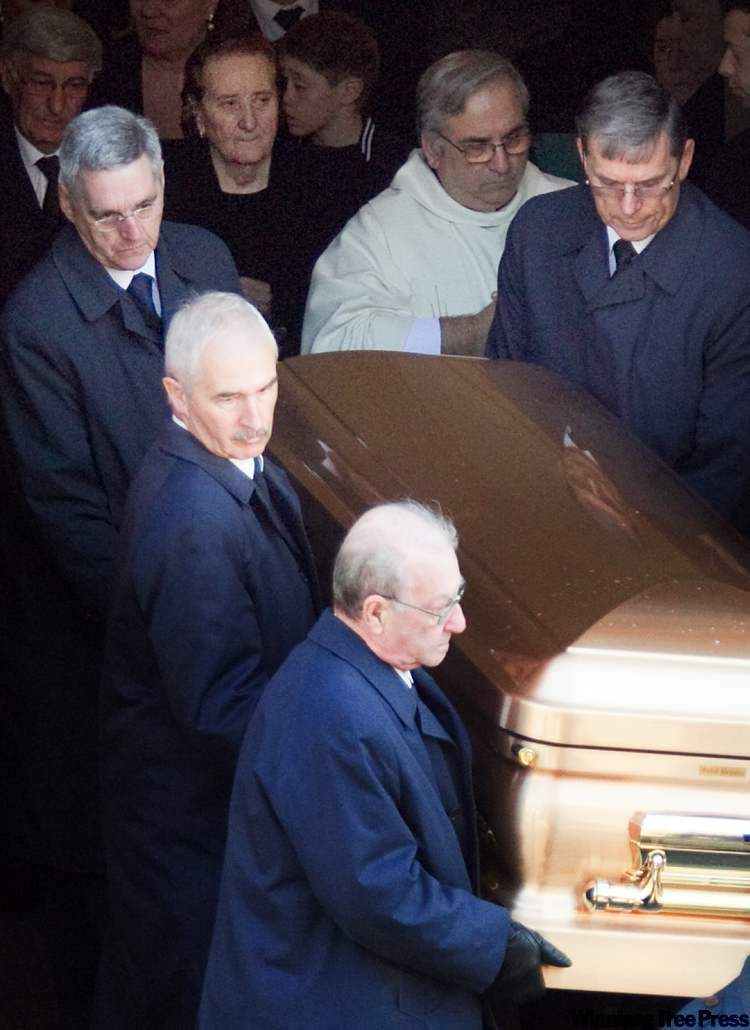
I know the church is supposed to be a hospital for sinners, not a rest home for the saints. And, like a family home, it’s a place that has to take you in when you’ve got no place left to go. But still, it seemed wrong for Rizzuto’s funeral to be held in a church. How could someone who was involved in murder, drug trafficking and other crimes be given a proper religious send-off?
I decided to take my questions to Archbishop James Weisgerber, the head of the Archdiocese of Winnipeg’s Roman Catholic Church. How would he explain this to a non-Catholic, like me?
“I can understand your disquiet,” the archbishop wrote back. He explained that “Catholic funerals are not a reward for a good life. The centrepiece of the funeral is the celebration of the Eucharist, the death and resurrection of the Lord, which is our hope. We pray for His mercy upon the one who has died.”
The funeral Eucharist, he went on to say, is “centred on Christ and the gift of His Spirit and not on the person who has died. Eulogies are discouraged or delivered at the prayer vigil the night before.”
In other words, he said, “the Catholic funeral Eucharist is not ‘the celebration of the life of… ‘ as we often read in obituaries. Saint and sinner are all brought before the mercy of God in Christ.”
And yet, he noted, there is an out for churches that want to take it: Canon law 1184 permits the local bishop to forbid the celebration of a Catholic funeral if the deceased is considered “a manifest sinner,” and if the funeral in a church would be a source of scandal.
“This judgment would usually be based on heresy, schism, publicly separating oneself from the church or if it (the funeral) was clearly against the wishes of the person who died,” Weisgerber wrote. “The question of sin is left to the judgment of God.”
A bit of research revealed this law has been applied to the Mafia before. In 2002, the Diocese of Brooklyn denied a Mass of Christian burial to notorious New York mob boss John Gotti, who was responsible for at least five murders during his reign atop the Gambino crime family. The law was also used to deny Christian funerals to American mobsters “Big Paul” Castellano, Carmine Galante and Frank DeCicco.
Here in Canada, Bishop Anthony Tonnos, of the Diocese of Hamilton, used the law in 1997 to deny a Catholic funeral mass to murdered mobster Johnny “Pops” Papalia. In making the decision, the bishop noted Paplia’s criminal lifestyle, which included convictions for assault and drug trafficking.
Why wasn’t that law applied to Rizzuto? After all, when it comes to manifest sinning, the former mob boss would seem to qualify.
I posed that question to Eric Durocher, who directs English communications for the Archdiocese of Montreal.
“The view of the Catholic Church in Montreal regarding the funeral of Mr. Rizzuto is the same as for all baptized members of the community,” he replied. “The church does not presume to know the state of soul a person is in at the time of his or her death. Only God truly knows; only God can judge.”
But what, I asked him, about how it looks? Giving Rizzuto a church funeral seemed scandalous to me, and maybe to others.

“The reference to manifest sinners in Canon 1184 is not based on public perception, but rather on church precepts,” Durocher replied, adding a Catholic funeral “does not constitute a tribute to a person, but is the concluding rite the church offers for those who were baptized in the death and resurrection of Christ.”
At a funeral, he explained, “the Christian community gathers to pray for the deceased and for those who mourn. In the funeral rite, we bid adieu to the deceased until we meet again in Christ Jesus, who is to judge the living and the dead.”
My exchanges with Weisgerber and Durocher helped me better understand the Roman Catholic approach to funerals. I also was reminded that situations like these are not only about theology, but are deeply pastoral matters — caring for the living while burying the dead. But my sense of disquiet remains.
Then again, maybe a funeral isn’t the right time to raise these kinds of questions. As Louis Gigante, pastor of St. Anthanasius Roman Catholic Church in the Bronx put it in 1985, when his diocese decided not to offer a Christian burial to mobster Paul Castellano: “If he was not a Catholic in life, we should have told him, ‘You’re no good.’ Don’t say it now, when the family is going to get hurt.”
jdl562000@yahoo.com
The Free Press is committed to covering faith in Manitoba through our Religion in the News project. This reporting continues because readers like you step forward to fund it.
Donate now to support our reporting on religion.
Your donation is eligible for a charitable tax receipt.
BECOME A FAITH JOURNALISM SUPPORTER
Our newsroom depends on a growing audience of readers to power our journalism. If you are not a paid reader, please consider becoming a subscriber.
Our newsroom depends on its audience of readers to power our journalism. Thank you for your support.
The Free Press is committed to covering faith in Manitoba through our Religion in the News project. This reporting continues because readers like you step forward to fund it.
Donate now to support our reporting on religion.
Your donation is eligible for a charitable tax receipt.
BECOME A FAITH JOURNALISM SUPPORTER
Our newsroom depends on a growing audience of readers to power our journalism. If you are not a paid reader, please consider becoming a subscriber.
Our newsroom depends on its audience of readers to power our journalism. Thank you for your support.
Advertisement Advertise With Us
Advertisement Advertise With Us
The Free Press acknowledges the financial support it receives from members of the city’s faith community, which makes our coverage of religion possible.