Horse-and-buggy Mennonites
University of Winnipeg conference will look at their lifestyle, values, beliefs

Advertisement
Read this article for free:
or
Already have an account? Log in here »
To continue reading, please subscribe:

Digital Subscription
One year of digital access for only $205*
- Enjoy unlimited reading on winnipegfreepress.com
- Read the E-Edition, our digital replica newspaper
- Access News Break, our award-winning app
- Play interactive puzzles
*First annual payment billed as $205.00 + GST for one year. This annual subscription will automatically renew at $233.00 + GST every 52 weeks (10% off the regular annual price of $259.35). Offer available to new and qualified returning subscribers only. Cancel any time.
To continue reading, please subscribe:
Add Free Press access to your Brandon Sun subscription for only an additional
$1 for the first 4 weeks*
- Enjoy unlimited reading on winnipegfreepress.com
- Read the E-Edition, our digital replica newspaper
- Access News Break, our award-winning app
- Play interactive puzzles
*Your next Brandon Sun subscription payment will increase by $1.00 and you will be charged $17.95 plus GST for four weeks. After four weeks, your payment will increase to $24.95 plus GST every four weeks.
Read unlimited articles for free today:
or
Already have an account? Log in here »
Hey there, time traveller!
This article was published 15/10/2011 (5443 days ago), so information in it may no longer be current.
Although he drives a horse and buggy and won’t use a computer, cellphone or digital camera, Levi Frey knows his group of Old Order Mennonites can’t push back against the currents of change forever.
“It’s no secret if you look back 50 or 100 years, we’re moving along at a different rate or pace,” says the bookkeeper and hobby farmer from Mount Forest, Ont., about how the traditions of his conservative Mennonite group are evolving.
“We can’t sit still. All we can do is regulate our pace.”
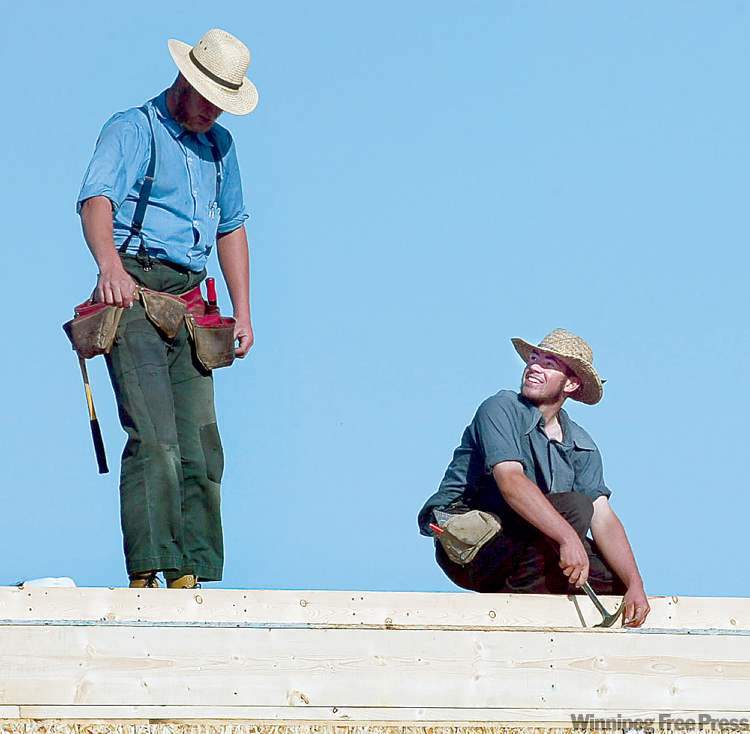
A two-day conference at the University of Winnipeg, titled Anti-Modern Pathways, will focus on the lifestyle, values and beliefs of horse-and-buggy Mennonites such as Frey in Canada, Belize and Latin America.
Scheduled for Friday, Oct. 21 and Saturday, Oct. 22, the free event includes a keynote address at 7:30 p.m. Friday by Donald Kraybill, author of Amish Grace, which dealt with the 2006 school tragedy at Nickel Mines, Penn.
The only genuine horse-and-buggy Mennonite on the program, Frey was scheduled to speak on Friday morning but recently decided against making the two-day trip to Winnipeg by bus because of family obligations. No other Old Order Mennonites are planning to come, says conference organizer Royden Loewen.
“I would think it is too close an association with the world,” says Loewen, chairman of Mennonite studies at the university.
“And they don’t believe in higher education. It’s at the University of Winnipeg and it’s an academic conference.”
But people with higher education are fascinated with these groups who have clung to a pre-industrial lifestyle for reasons of faith, with the conference attracting academics from across North America, as well as a contingent from the Free University in Amsterdam.
“People are interested in folks who stand up to modern society and say no to everything we take for granted,” Loewen says of Mennonite groups who have removed themselves from modern society for reasons of faith.
“They say no to middle-class values. That includes the consumption of energy, upward mobility, generational gaps, indebtedness, consumer culture, competition, the penchant we have for institutionalizing handicapped (people) and seniors.”
Saying no means finding ways around the prevailing digital culture and lobbying to be exempted from contributing to government insurance plans, says Frey, a part of a five-member committee working on exemption from CPP and workers’ compensation.
Old Order Mennonites do not use computers or the Internet and do not believe in having their photos taken. They also believe in a strong separation of church and state and do not vote in elections, explains Frey.
“We believe as Christians that the Bible tells us the government is secular and has nothing to do with the church. We pray for the government and that’s the extent of it,” he explains.
In Canada, Frey is among 4,000 horse-and-buggy Mennonites, the majority of whom live in Ontario. A small group of more conservative Mennonites, sometimes mistaken for Amish, live near Gladstone, Man.
Another 70,000 Old Colony Mennonites who reject modern society have settled in Central and South America, many of them descended from the 6,000 Manitoba Mennonites who moved south in 1922.
“This is the single largest group of people who left Canada voluntarily because they saw Canada as threatening to their simple egalitarian, communitarian lifestyle,” says Loewen.
In Manitoba, the 100 or so members of Westbourne Orthodox Mennonite Church, near Gladstone, live without telephones and electricity and use horses to pull their farm machinery, explains Peter Rempel of Mennonite Central Committee Manitoba.
Rempel has visited this group of about 20 families several times, attempting to make connections with the larger Mennonite community. He says they are busy, industrious people attempting to shield their children from the influences of the world.
“People should not mistake their commitment to a simpler lifestyle to lacking in intelligence. They work hard,” says Rempel, pointing to their furniture and window businesses.
“Their ecological footprint is a fraction of yours and mine. Their lifestyle is more sustainable.”
Although they might draw attention for their distinctive dress, simple lifestyle and slow-motion travel, Old Order Mennonites are more than curiosities. They are people who are fiercely committed to living out their faith, Frey says.
“We are people like anyone else, and we just choose to do things differently. We’re humans. We have our joys and sorrow and problems. We try to live a Christian life, same as everyone else.”
For a listing of the events at Anti-Modern Pathways: ‘Horse and Buggy’ Mennonites in Canada, Belize, and Latin America, check out the links at www.plettfoundation.org/wp/
brenda@suderman.com
Navigating in the
horse-and-buggy lane
NAVIGATING the world — whether on a paved road or by avoiding the information highway — is becoming more complicated each year for plain people, says a member of the Old Order Mennonite Conference.
Levi Frey says living without computers is possible but becoming more difficult as government agencies turn to digital documents instead of mailing out forms.

“It’s one of the biggest issues at the present time. It doesn’t really matter what you’re involved in, whether you’re a farmer or a mechanic or an accountant. It’s this electronic communication,” explains Frey, who fills out 500 income tax forms annually in his bookkeeping business.
“I simply tell them ‘I don’t have a fax machine, I don’t have a computer, I need paper.’ “
Frey’s group of Old Order Mennonites from Mount Forest, Ont., have telephones and electricity but use horse-drawn vehicles as their transportation.
Travelling with horse and buggy at an average speed of 15 km/h has its own challenges, especially for Old Order Mennonites in the more densely populated Waterloo County, where roundabouts have recently been installed in intersections, says Frey.
“When you have traffic going in four different directions, it’s almost impossible to get in and out with a horse.”
The Free Press is committed to covering faith in Manitoba through our Religion in the News project. This reporting continues because readers like you step forward to fund it.
Donate now to support our reporting on religion.
Your donation is eligible for a charitable tax receipt.
BECOME A FAITH JOURNALISM SUPPORTER
Brenda Suderman has been a columnist in the Saturday paper since 2000, first writing about family entertainment, and about faith and religion since 2006.
Our newsroom depends on a growing audience of readers to power our journalism. If you are not a paid reader, please consider becoming a subscriber.
Our newsroom depends on its audience of readers to power our journalism. Thank you for your support.
The Free Press is committed to covering faith in Manitoba through our Religion in the News project. This reporting continues because readers like you step forward to fund it.
Donate now to support our reporting on religion.
Your donation is eligible for a charitable tax receipt.
BECOME A FAITH JOURNALISM SUPPORTER
Brenda Suderman has been a columnist in the Saturday paper since 2000, first writing about family entertainment, and about faith and religion since 2006.
Our newsroom depends on a growing audience of readers to power our journalism. If you are not a paid reader, please consider becoming a subscriber.
Our newsroom depends on its audience of readers to power our journalism. Thank you for your support.
Advertisement Advertise With Us
Advertisement Advertise With Us
The Free Press acknowledges the financial support it receives from members of the city’s faith community, which makes our coverage of religion possible.