

Nixon aide’s conversion proved fruitful

Advertisement
Read this article for free:
or
Already have an account? Log in here »
To continue reading, please subscribe:
Monthly Digital Subscription
$1 per week for 24 weeks*
- Enjoy unlimited reading on winnipegfreepress.com
- Read the E-Edition, our digital replica newspaper
- Access News Break, our award-winning app
- Play interactive puzzles
*Billed as $4.00 plus GST every four weeks. After 24 weeks, price increases to the regular rate of $19.95 plus GST every four weeks. Offer available to new and qualified returning subscribers only. Cancel any time.
Monthly Digital Subscription
$4.99/week*
- Enjoy unlimited reading on winnipegfreepress.com
- Read the E-Edition, our digital replica newspaper
- Access News Break, our award-winning app
- Play interactive puzzles
*Billed as $19.95 plus GST every four weeks. Cancel any time.
To continue reading, please subscribe:
Add Free Press access to your Brandon Sun subscription for only an additional
$1 for the first 4 weeks*
- Enjoy unlimited reading on winnipegfreepress.com
- Read the E-Edition, our digital replica newspaper
- Access News Break, our award-winning app
- Play interactive puzzles
*Your next Brandon Sun subscription payment will increase by $1.00 and you will be charged $17.95 plus GST for four weeks. After four weeks, your payment will increase to $24.95 plus GST every four weeks.
Read unlimited articles for free today:
or
Already have an account? Log in here »
Hey there, time traveller!
This article was published 28/04/2012 (5127 days ago), so information in it may no longer be current.
William Hamilton had a belief in God, but gave him up. Charles Colson didn’t believe in God, but found him. The two men, who died recently, had a dramatic impact on Christianity, but for different reasons.
Hamilton, who died Feb. 28, was best known for declaring that God was dead.
Today, such a declaration would draw little attention. But back in 1966, when Time magazine put the stark question “Is God Dead?” on its cover, it rocked the Christian world.
The cover became one of the most notable in the magazine’s history, and thrust Hamilton — at the time, an unknown theologian and academic — into the limelight.
Hamilton was no militant atheist, nor was he contemptuous of faith or the faithful. Like many Christians, he struggled to reconcile an idea of an all-powerful and all-knowing God with human suffering.
“I wrote out my two choices,” he said in a 2007 interview about his crisis of faith. “God is not behind such radical evil, therefore he cannot be what we have traditionally meant by God, or God is behind everything, including the death camps, and therefore he is a killer.”
He decided to adopt a third possibility — that God was dead. “We needed to redefine Christianity as a possibility without the presence of God,” he said.
But even though he believed that God was dead, Hamilton remained a Christian. In particular, he was a follower of Christ’s teachings, believing that churches should encourage people to care for each other without resorting to belief in a deity or afterlife.
Thomas Altizer, who co-authored the book Radical Theology and the Death of God with Hamilton, described him as an “atheistic Christian” and the first theologian to “formulate a theological acceptance of the death of God.”
For countless numbers of Christians, Hamilton made it acceptable to ask hard questions about God and human suffering — even if they didn’t arrive at the same conclusions. He also helped pave the way for other radical theologians, such as feminists, who expanded the image of God beyond the traditional patriarchal descriptions, and liberationists, who saw God in poverty and suffering.
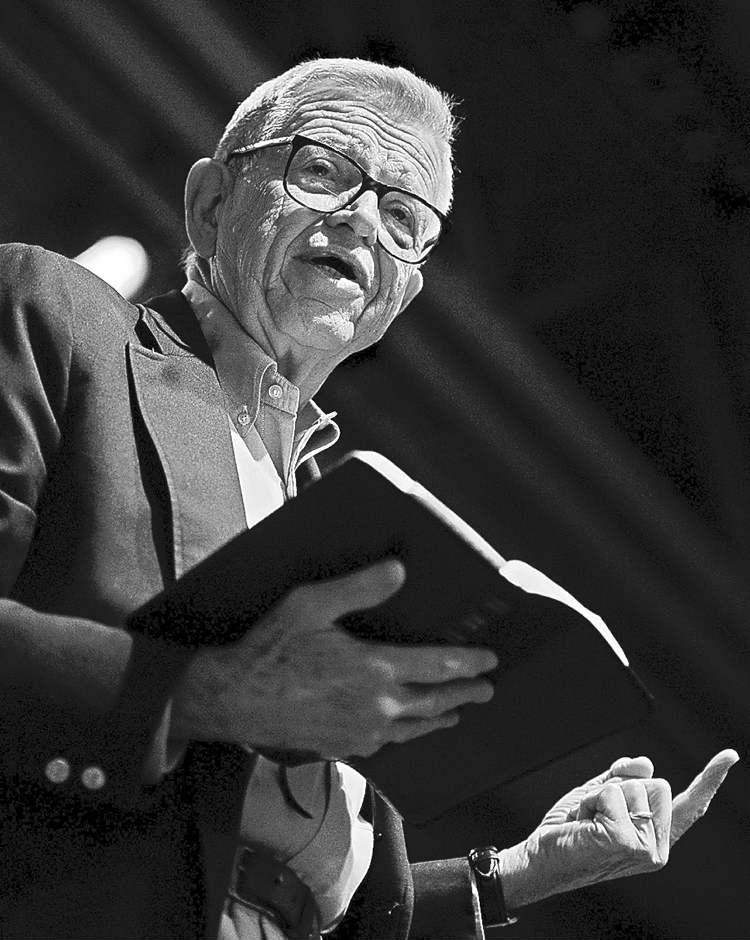
A little less than two months after Hamilton’s death, Charles Colson died on April 21.
Best known as one of U.S. president Richard Nixon’s most dedicated henchmen, Colson had a reputation for ruthlessness. “I would walk over my grandmother for Richard Nixon,” he was quoted as saying.
In 1973, he was described as being “probably more disliked, as well as feared, than any other White House aide.” Of faith he stated: “Religion is fine, provided one has as little of it as possible.”
While working for Nixon, Colson became involved in the illegal activities that led to the president’s downfall and imprisonment. But while under investigation for his role in Watergate and other dirty tricks, he was converted after reading C.S. Lewis’s book Mere Christianity.
There were many cynics who felt his conversion was only designed to win him sympathy and a more lenient sentence. But his change of heart proved to be deep and authentic.
Upon release from jail, he founded Prison Fellowship, an organization dedicated to prison reform and to serving prisoners and ex-offenders. Today, the organization is active in more than 100 countries.
Through his work with Prison Fellowship, Colson called for more humane treatment of offenders and better prison conditions. He believed those convicted of nonviolent crimes should be sentenced to community service instead of being locked up.
“You can’t leave a person in a steel cage and expect something good to come out of him when he is released,” he said.
Ultimately, Colson credited the Watergate scandal and his imprisonment with enriching his life. God, he said, “used the experience to raise up a ministry that is reaching hundreds of thousands of people. So I’m probably one of the few guys around that’s saying, ‘I’m glad for Watergate.’ “
Colson’s life also left a mark for many, reminding that everyone — no matter how bad, or how serious their crimes — was deserving of mercy and grace. As the Boston Globe put it in 1973: “If Charles Colson can repent of his sins, there just has to be hope for everyone.”
Reflecting on Colson’s life, Senate Republican Leader Mitch McConnell stated: “His famous redemption story and tireless advocacy on behalf of the marginalized and the outcast have called all of us to a deeper reflection on our lives and priorities. He lives on as a modern model of redemption and a permanent rebuttal to the cynical claim that there are no second chances in life.”
Two men, two different paths. One left what he felt was a prison of conventional belief to find a new way of believing, in the process freeing other Christians to ask tough questions. The other went into a literal prison, emerging with a new belief in a God who desired those in jail to be set free. Both left significant marks on the world.
jdl562000@yahoo.com
The Free Press is committed to covering faith in Manitoba through our Religion in the News project. This reporting continues because readers like you step forward to fund it.
Donate now to support our reporting on religion.
Your donation is eligible for a charitable tax receipt.
BECOME A FAITH JOURNALISM SUPPORTER
Our newsroom depends on a growing audience of readers to power our journalism. If you are not a paid reader, please consider becoming a subscriber.
Our newsroom depends on its audience of readers to power our journalism. Thank you for your support.
The Free Press is committed to covering faith in Manitoba through our Religion in the News project. This reporting continues because readers like you step forward to fund it.
Donate now to support our reporting on religion.
Your donation is eligible for a charitable tax receipt.
BECOME A FAITH JOURNALISM SUPPORTER
Our newsroom depends on a growing audience of readers to power our journalism. If you are not a paid reader, please consider becoming a subscriber.
Our newsroom depends on its audience of readers to power our journalism. Thank you for your support.
Advertisement Advertise With Us
Advertisement Advertise With Us
The Free Press acknowledges the financial support it receives from members of the city’s faith community, which makes our coverage of religion possible.