Breaking down the fortress
Lutheran-Anglican conference seeks to increase interfaith understanding

Advertisement
Read this article for free:
or
Already have an account? Log in here »
To continue reading, please subscribe:

Digital Subscription
One year of digital access for only $205*
- Enjoy unlimited reading on winnipegfreepress.com
- Read the E-Edition, our digital replica newspaper
- Access News Break, our award-winning app
- Play interactive puzzles
*First annual payment billed as $205.00 + GST for one year. This annual subscription will automatically renew at $233.00 + GST every 52 weeks (10% off the regular annual price of $259.35). Offer available to new and qualified returning subscribers only. Cancel any time.
To continue reading, please subscribe:
Add Free Press access to your Brandon Sun subscription for only an additional
$1 for the first 4 weeks*
- Enjoy unlimited reading on winnipegfreepress.com
- Read the E-Edition, our digital replica newspaper
- Access News Break, our award-winning app
- Play interactive puzzles
*Your next Brandon Sun subscription payment will increase by $1.00 and you will be charged $17.95 plus GST for four weeks. After four weeks, your payment will increase to $24.95 plus GST every four weeks.
Read unlimited articles for free today:
or
Already have an account? Log in here »
Hey there, time traveller!
This article was published 01/07/2012 (5167 days ago), so information in it may no longer be current.
On the occasional Sunday morning, Rev. Diane Guilford trades her liturgical robes for a bright blue baggy outfit, a red fright wig, and white makeup.
As she transforms into her alter ego Barnabas the clown, the priest of St. Stephen’s Anglican Church also mimes her way through a theological lesson to show how messengers — and their messages — come in many forms.
“It requires big movement and everything has to be exaggerated,” Guilford says of clowning.
“The wonderful gift of clowning is you are free of all your inhibitions and you do everything in a big way.”
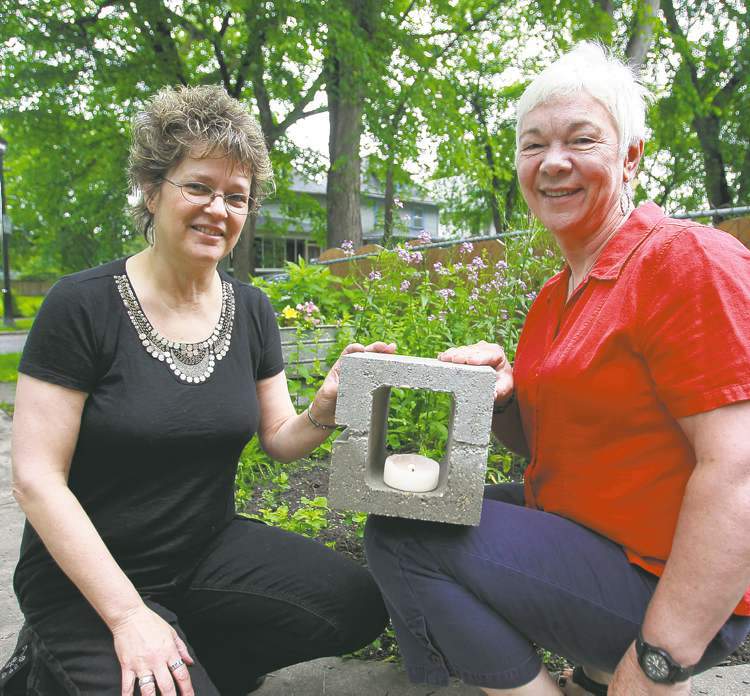
Guilford is sharing some of her experience in clowning in Christian worship at a national Lutheran and Anglican worship conference, taking place until Tuesday at the University of Manitoba.
Built around the theme of moving beyond the fortress, the conference invokes Martin Luther’s famous 16th-century hymn, A Mighty Fortress is our God.
“We come to worship in our church where we have our safety, our traditions,” explains Michéle Barr, a Lutheran diaconal minister co-chairing the event with Guilford.
“How do we break down those walls so we hear what (others) are saying and we can share the Gospel? Sometimes we’re inside our little fortress.”
In her job as the music minister at St. Mark’s Lutheran Church, she attempts to break down some musical walls by including hymns and songs from beyond the Lutheran hymnal.
“I try to explore hymns from other denominations that also fit in (the worship.) If we have to teach it to the congregation, we do that,” she says.
That’s a good start, but mainline churches will have to smash through more barriers in order to thrive, or even survive, suggests one of the conference speakers.
Douglas Cowling goes so far to suggest some churches need to take the conference theme literally when it comes to their current worship spaces.
The Toronto writer and musician advocates smaller congregations bust out of the pews and sit in a tight circle to symbolize how worship is the work of the people.
“That space we inherited, our beautiful, historic churches, are from a time where lay people sat in a row and listened,” says Cowling, music director at St. Philip’s Anglican Church in Etobicoke, Ont., in a telephone interview.
“We’re fighting our buildings.”
Not only are some churches fighting their buildings, they’re also attempting to keep up a model of worship that isn’t viable for their congregation, says Cowling, who studies the role of music in small churches.
He says the days are past when every small church could have a regular organist or choir leader, and that means congregations with fewer people and financial resources need to be more adaptable.
“More likely we’re looking at a volunteer musician who’s talented on another instrument, such as guitar, piano, or a wind instrument,” says Cowling, who was involved in several of the Juno award-winning Classical Kids albums, which introduced children to classical compositions through stories and music.
“We need to recover the community aspect of music making.”
Cowling also suggests liturgical denominations might consider following evangelicals in moving away from hymn books and other printed materials. But instead of totally embracing songs and words projected on the wall, he suggests another way.
“Paperless liturgy, paperless worship, where there are no books, no paper, where the leaders come prepared to teach the congregation,” he says of the call-and-response approach.
“It’s recognition that in our highly technical society, there is a place for low tech.”
And there’s also a place for the fool, says Guildford, who sees a role for humour and absurdity in the midst of worship.

“The clown moves our brain to the other side to help us see God in a new way and maybe in an unexpected way, and to demonstrate that God speaks through all people, even the clown,” she says.
brenda@suderman.com
For more information on Beyond the Fortress worship conference, check out www.nationalworshipconference.org/
For more information on Beyond the Fortress worship conference, check out http://www.nationalworshipconference.org/
The Free Press is committed to covering faith in Manitoba through our Religion in the News project. This reporting continues because readers like you step forward to fund it.
Donate now to support our reporting on religion.
Your donation is eligible for a charitable tax receipt.
BECOME A FAITH JOURNALISM SUPPORTER
Brenda Suderman has been a columnist in the Saturday paper since 2000, first writing about family entertainment, and about faith and religion since 2006.
Our newsroom depends on a growing audience of readers to power our journalism. If you are not a paid reader, please consider becoming a subscriber.
Our newsroom depends on its audience of readers to power our journalism. Thank you for your support.
The Free Press is committed to covering faith in Manitoba through our Religion in the News project. This reporting continues because readers like you step forward to fund it.
Donate now to support our reporting on religion.
Your donation is eligible for a charitable tax receipt.
BECOME A FAITH JOURNALISM SUPPORTER
Brenda Suderman has been a columnist in the Saturday paper since 2000, first writing about family entertainment, and about faith and religion since 2006.
Our newsroom depends on a growing audience of readers to power our journalism. If you are not a paid reader, please consider becoming a subscriber.
Our newsroom depends on its audience of readers to power our journalism. Thank you for your support.
Advertisement Advertise With Us
Advertisement Advertise With Us
The Free Press acknowledges the financial support it receives from members of the city’s faith community, which makes our coverage of religion possible.