‘Sistine Chapel of the Prairies’
Turn-of-century art puts church 'in a class all itself'
Advertisement
Read this article for free:
or
Already have an account? Log in here »
To continue reading, please subscribe:

Digital Subscription
One year of digital access for only $205*
- Enjoy unlimited reading on winnipegfreepress.com
- Read the E-Edition, our digital replica newspaper
- Access News Break, our award-winning app
- Play interactive puzzles
*First annual payment billed as $205.00 + GST for one year. This annual subscription will automatically renew at $233.00 + GST every 52 weeks (10% off the regular annual price of $259.35). Offer available to new and qualified returning subscribers only. Cancel any time.
To continue reading, please subscribe:
Add Free Press access to your Brandon Sun subscription for only an additional
$1 for the first 4 weeks*
- Enjoy unlimited reading on winnipegfreepress.com
- Read the E-Edition, our digital replica newspaper
- Access News Break, our award-winning app
- Play interactive puzzles
*Your next Brandon Sun subscription payment will increase by $1.00 and you will be charged $17.95 plus GST for four weeks. After four weeks, your payment will increase to $24.95 plus GST every four weeks.
Read unlimited articles for free today:
or
Already have an account? Log in here »
Hey there, time traveller!
This article was published 04/08/2012 (5156 days ago), so information in it may no longer be current.
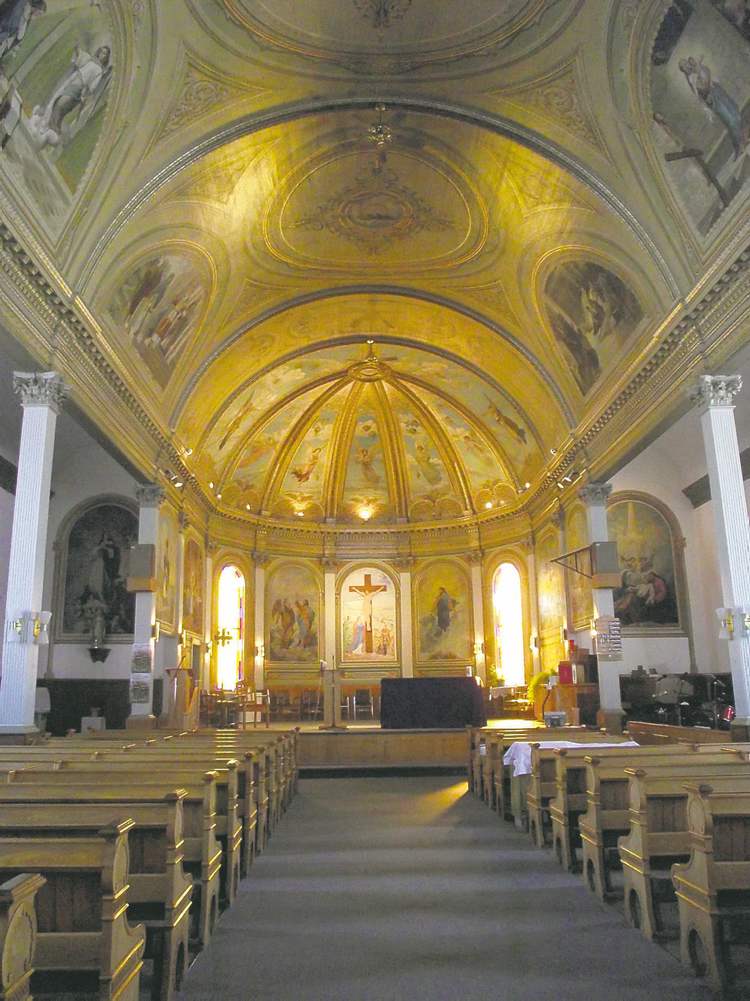
Along the historic Dawson Road, not far from the winding Seine River, sits an unobtrusive structure, its humble exterior and small-Prairie-town surroundings offering no hint of the wondrous and awe-inspiring splendour within.
“Our church building has often been referred to as ‘the Sistine Chapel of the Prairies’ because of the many oil paintings on its ceiling and altar area,” says Bill Grossman, co-director of parish life of Notre Dame de Lorette.
Petite Pointe de Chenes was the original name of this community, because of the many oak trees that dotted the fields. But according to local history, an early missionary Father Forget-Despatis, later named the parish of Lorette after a famous place of pilgrimage he had visited in Loreto, Italy.
Some say Loreto contains the house in which the Virgin Mary once lived and so this church is likewise dedicated to Mary.
Grossman says it was around 1860 that the first people settled here. They were Métis. French Canadians soon followed. Among them was Elzéar Lagimodière, the grandson of Jean Baptiste Lagimodière and cousin of Louis Riel.
In 1884, a year before the first church was built, the parish register listed 44 French Canadian, 26 Métis and three Irish families.
Today, says Grossman, who counts himself among one of Riel’s distant relatives, “the community is growing all the time… young people with young children… some move back because they have connections… because their grandparents lived here.”
This is the second church. Built around 1894 at a cost of $20,000, it was designed by local parishioner Auguste Gauthier.
But it was the decision to hire Louis-Eustache Monty at the turn of the 20th century that resulted in the magnificent interior today.

Hired in 1901, this painter from Québec considered it his calling to travel from church to church covering the walls with religious art. He is said to have decorated more than 200 churches in Canada and the United States.
In the 1930s because “they used to heat with coal and wood the paintings were so dirty that you could not see them,” Grossman says, “and so parishioners had to clean them.”
The entire church was once covered with Monty’s work, he adds, but in 1958 renovations took place — “gyprock was put up and they painted the side walls” covering some of the artist’s work. Fortunately, much remains.
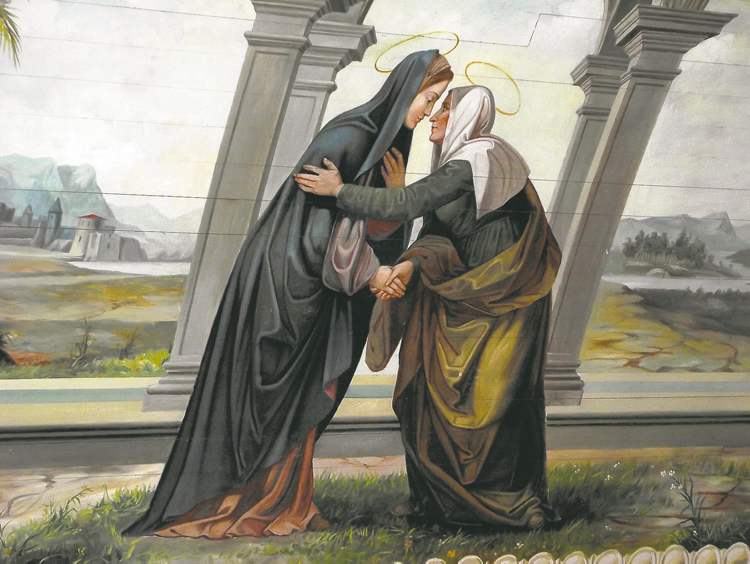
The vaulted ceiling of the nave displays eight milestones in the life of Mary, painted by Monty directly onto the wood — all framed in semi-circular arches. Flowing, curving, rounded lines are everywhere. Pale blue and gold hues abound in scenes that sweep from one end of the ceiling to the other.
Four huge medallion paintings draw the eye upwards to the very centre of the ceiling — all symbolic of Jesus and surrounded by intricately detailed ornamentation.
“The altar area is pretty amazing,” says Grossman. “I know of no other church, even the cathedrals — that have such an area.”
Seven enormous paintings fill the walls of the altar area with the first being a painting of St. Patrick. “There was a huge contingent of Irish families and they contributed greatly and so this was to honour their generosity and help,” he says.
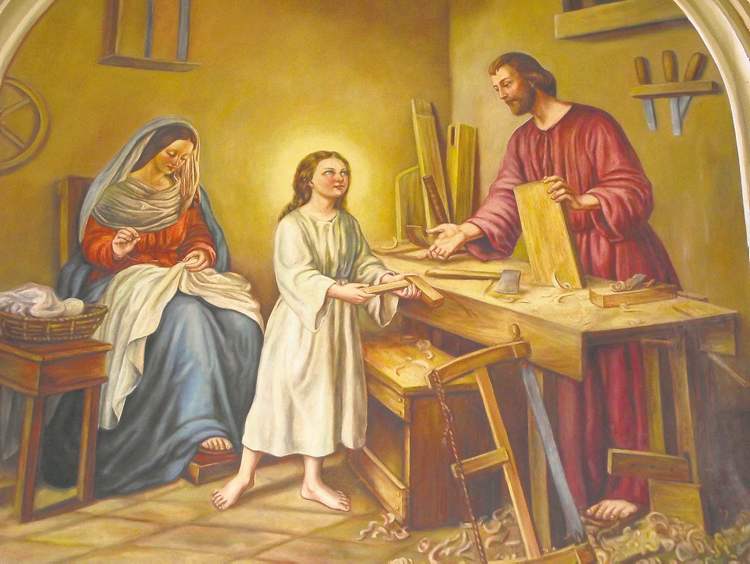
A painting of the Holy Family is one of only two paintings not done by Monty. Because foundation problems resulted in the destruction of his original work, a local artist, Noëlla Gauthier-Yoeman, was commissioned in 1948 to replace it.
The Crucifixion dominates the back of the altar and is a wooden sculpture mounted on a painted mural created in 1999 by Robert Freynet, a Manitoban artist.
A painting depicting the Apparition of Jesus to St. Anthony of Padua is said to be of special significance as many of Lorette’s first settlers were Métis and this saint was particularly revered by them. Angels and cherubim hover above.

Twelve of Monty’s original Stations of the Cross adorn the side walls. “I have been in a lot of churches and I have not seen anything like this anywhere… it’s in a class all itself in Manitoba,” says Grossman.
Tours may be arranged by phoning 204-878-2221.
If you’d like to see a place of worship featured here, email:
girard.cheryl@gmail.com
The Free Press is committed to covering faith in Manitoba through our Religion in the News project. This reporting continues because readers like you step forward to fund it.
Donate now to support our reporting on religion.
Your donation is eligible for a charitable tax receipt.
BECOME A FAITH JOURNALISM SUPPORTER
The Free Press acknowledges the financial support it receives from members of the city’s faith community, which makes our coverage of religion possible.