Sikhs, Amish reject vengeance, embrace forgiveness

Advertisement
Read this article for free:
or
Already have an account? Log in here »
To continue reading, please subscribe:

Digital Subscription
One year of digital access for only $205*
- Enjoy unlimited reading on winnipegfreepress.com
- Read the E-Edition, our digital replica newspaper
- Access News Break, our award-winning app
- Play interactive puzzles
*First annual payment billed as $205.00 + GST for one year. This annual subscription will automatically renew at $233.00 + GST every 52 weeks (10% off the regular annual price of $259.35). Offer available to new and qualified returning subscribers only. Cancel any time.
To continue reading, please subscribe:
Add Free Press access to your Brandon Sun subscription for only an additional
$1 for the first 4 weeks*
- Enjoy unlimited reading on winnipegfreepress.com
- Read the E-Edition, our digital replica newspaper
- Access News Break, our award-winning app
- Play interactive puzzles
*Your next Brandon Sun subscription payment will increase by $1.00 and you will be charged $17.95 plus GST for four weeks. After four weeks, your payment will increase to $24.95 plus GST every four weeks.
Read unlimited articles for free today:
or
Already have an account? Log in here »
Hey there, time traveller!
This article was published 18/08/2012 (5144 days ago), so information in it may no longer be current.
Earlier this month, as I tried to absorb the senseless shooting at the Sikh Gurdwara in Oak Creek, Wis., I found myself thinking about another terrible mass killing — the shooting of the little Amish girls in Nickel Mines, Penn., in 2006. Although the circumstances were different, I was struck by the similarities in how members of the two faith communities responded to the tragedies.
Six years ago, people were horrified when Charles Carl Roberts shot 10 girls in an Amish school, killing five, before killing himself. What happened next amazed the world; within hours of the shooting, local Amish were speaking of forgiving the killer and reaching out to his family.
“We have to forgive,” an Amish woman told Reuters shortly after the killings. “We have to forgive him in order for God to forgive us.” Of the killer, the grandfather of one victim told reporters: “We must not think evil of this man.”
In 2011, on the fifth anniversary of the shooting, members of the community were interviewed about their decision to forgive.
“It’s all part of healing,” a father of one of the victims told a reporter. “I guess that’s basically from our belief and the way we were brought up that we realize it doesn’t help to hold a grudge against anybody. It doesn’t help us move on.”
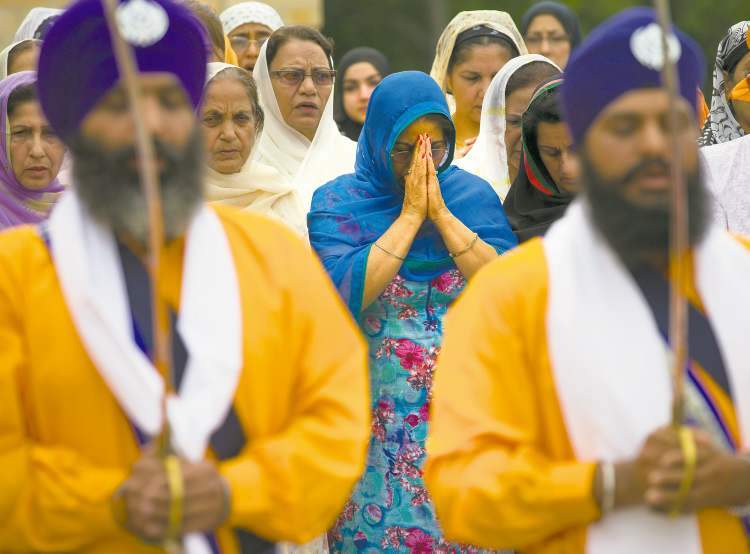
Something similar happened in the Sikh community after the shooting in Wisconsin. I didn’t see all the news coverage, but what I did catch showed people who were hurt, disbelieving, fearful, shocked and sorrowful. But I didn’t hear any calls for vengeance. Instead, Sikh community leaders emphasized a need to pray and seek healing.
“Together, we will try our best to heal from this tragedy,” said Saptal Singh, president of the World Sikh Council. “Together we will try to bring peace to the misguided and troubled minds. Together we will ensure that no person and no community feels unsafe and intimidated by such senseless violence.”
In the Huffington Post, Simran Jeet Singh, a Sikh community activist and doctoral candidate in religion at Columbia University, wrote an article titled I Refuse To Live In Fear And Negativity.
Said Singh: “As a Sikh, I believe that people are inherently good. Our faith instils a sense of perpetual optimism, and our traditions teach us to always make the best of a tough situation.
“Fear and negativity are foreign to our vocabulary. Sikhs are not a God-fearing people; we are God-loving.
“The commitment to love and optimism shapes the way that Sikhs interact with their societies, and I’m concerned that becoming cynical and negative might lead us down a slippery slope.
“So I am making a conscious decision. I am refusing to accept that human beings are malicious and hateful, and I am rejecting the notion that we need to live in fear.”
He went on to invite all Americans and Sikhs to draw from their traditions “by continuing to respond with love and compassion. Let us stand up together and turn the tragedy in Wisconsin into a turning point for our nation.”
If there is any good to be found in the Nickel Mines or Wisconsin shootings, it is in seeing how the Amish and Sikhs have modelled a different response to violence — not an eye for an eye, but a desire to forgive, to understand, to heal and to promote harmony among all religions and all people.

For both the Amish and Sikhs, such responses grow out of their faith. For the Amish, forgiveness and living at peace with others is woven into the fabric of their faith. For Sikhs, it’s about being taught from an early age to avoid anger, see everyone as equal, practise charity, show compassion and serve others.
In a post on the Sojourners magazine website, Christian Piat, director of church growth and development at First Christian Church in Portland, Ore., wrote that “no one would fault them (Sikhs and the Amish) for wanting vengeance or for defending themselves, but in taking the approaches both have to the violence, both communities have demonstrated a strength and faith that far exceeds that of any security system or jail cell.”
At its heart, he went on to say, “both the Sikh and Amish message is that of the indomitable human spirit, guided and inspired by faith traditions that practise peace, particularly when it is confronted with quite the opposite… I’d like to think that I’ll never let go of the feelings of hope and courage that I gain from the witness of these two remarkable communities of faith.”
I feel the same way — and I hope many others do, too.
jdl562000@yahoo.com
The Free Press is committed to covering faith in Manitoba through our Religion in the News project. This reporting continues because readers like you step forward to fund it.
Donate now to support our reporting on religion.
Your donation is eligible for a charitable tax receipt.
BECOME A FAITH JOURNALISM SUPPORTER
Our newsroom depends on a growing audience of readers to power our journalism. If you are not a paid reader, please consider becoming a subscriber.
Our newsroom depends on its audience of readers to power our journalism. Thank you for your support.
The Free Press is committed to covering faith in Manitoba through our Religion in the News project. This reporting continues because readers like you step forward to fund it.
Donate now to support our reporting on religion.
Your donation is eligible for a charitable tax receipt.
BECOME A FAITH JOURNALISM SUPPORTER
Our newsroom depends on a growing audience of readers to power our journalism. If you are not a paid reader, please consider becoming a subscriber.
Our newsroom depends on its audience of readers to power our journalism. Thank you for your support.
Advertisement Advertise With Us
Advertisement Advertise With Us
The Free Press acknowledges the financial support it receives from members of the city’s faith community, which makes our coverage of religion possible.