Beyond the treaty
St. Boniface Cathedral honours its past, looks to future

Advertisement
Read this article for free:
or
Already have an account? Log in here »
To continue reading, please subscribe:

Digital Subscription
One year of digital access for only $205*
- Enjoy unlimited reading on winnipegfreepress.com
- Read the E-Edition, our digital replica newspaper
- Access News Break, our award-winning app
- Play interactive puzzles
*First annual payment billed as $205.00 + GST for one year. This annual subscription will automatically renew at $233.00 + GST every 52 weeks (10% off the regular annual price of $259.35). Offer available to new and qualified returning subscribers only. Cancel any time.
To continue reading, please subscribe:
Add Free Press access to your Brandon Sun subscription for only an additional
$1 for the first 4 weeks*
- Enjoy unlimited reading on winnipegfreepress.com
- Read the E-Edition, our digital replica newspaper
- Access News Break, our award-winning app
- Play interactive puzzles
*Your next Brandon Sun subscription payment will increase by $1.00 and you will be charged $17.95 plus GST for four weeks. After four weeks, your payment will increase to $24.95 plus GST every four weeks.
Read unlimited articles for free today:
or
Already have an account? Log in here »
Hey there, time traveller!
This article was published 15/07/2017 (3340 days ago), so information in it may no longer be current.
THIS month, Manitobans mark the 200th anniversary of the Selkirk Treaty, which was signed on July 18, 1817, between Thomas Douglas, fifth Earl of Selkirk, and Chief Peguis, along with four other Indigenous chiefs. Later, Lord Selkirk designated land to establish Protestant and Roman Catholic churches. St. John’s Anglican Cathedral was constructed on the west side of the Red River, near Point Douglas, and St. Boniface Roman Catholic Church was established on a large land grant on the east side across from The Forks.
Brenda Suderman visited both cathedrals to understand the challenges and concerns of these two faith communities two centuries later.
Anglicans, Presbyterians, and Catholics will commemorate the anniversary with an ecumenical prayer service Sunday at 3 p.m. at St. Boniface Cathedral. For more information, visit peguisselkirk200.ca.

After two centuries in St. Boniface, the shape and mission of the city’s oldest Roman Catholic church is still a work in progress.
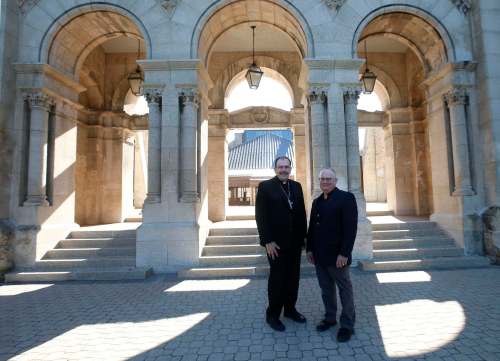
Many changes flow from spending nearly $7 million for renovations and improvements to the “new” St. Boniface Roman Catholic Cathedral, built in 1972 within the ruins of the 1908 basilica.
Recent renovations include replacing the original metal roof and repairing walkways in the ruins and cemetery. Crews are constructing four meeting spaces in the cathedral’s basement and building new staff offices on the mezzanine level, freeing up the former adjacent rectory for rental space.
“How can we be a more welcoming community, whether it is to tourists or to worshippers or to people who want to take time to meditate?” asks Rev. Marcel Carrière of the mission of the nearly 200-year-old parish, now more diverse thanks to recent immigration from French-speaking African countries. “How can we be open to others and yet faithful to who we are as a church?”
The presence of Roman Catholics east of the Red River dates back 200 years to July 1817, when Lord Selkirk set aside 13,000 acres for a parish and mission. Protestants received a smaller land grant on the west side of the Red, which led to the establishment of St. John’s Cathedral, the first Anglican parish in Western Canada.
That anniversary will be marked by a 3 p.m. ecumenical prayer service at St. Boniface Cathedral on Sunday.
Hosted by the city’s Anglican, Presbyterian and Catholic churches, the 90-minute service includes a smudging ceremony within the stone wall of the ruins, prayers in English, Ojibway, French, Cree and Gaelic, a message by St. Boniface Archbishop Albert LeGatt, and an explanation of the treaty between Chief Peguis and Lord Selkirk by Niigaanwewidam James Sinclair.
“We’re recognizing all the good things out of the treaty,” LeGatt says. “The more important focus is how do we live that out today and in the future?”
For Catholics, one answer to that question involved opening space occupied for two centuries by monks, seminarians and previous archbishops. Recently, the archdiocese’s office staff moved from the former seminary dormitory at 622 Taché Ave., to the archbishop’s residence, freeing up space to house newcomers to Winnipeg.
About 50 people at a time stay for up to 30 days in the top floor of the three-storey building now rented by Accueil francophone du Manitoba, says Daniel Boucher, executive director of the Franco-Manitoban Society, which runs the refugee and immigrant resettlement program.
The same organization also rents the cathedral’s former rectory for its administrative offices.
“Taking care of the poor and people in need is part of our mission,” says Carrière of why the parish chose to rent to a refugee resettlement agency. “There’s no direct link (with Accueil francophone) to our parish, but the building still serves people in need.”

That commitment to service also underlies the conversion of the private grounds of the archbishop’s house into a public park with interpretative panels explaining the history of Catholic missionary work. An estimated 100,000 people visit the ruins and cemetery annually, and are welcome to cross the street to wander the grounds around the archbishop’s house.
“We’re saying we’re a cathedral open to the city, open to the world, a church open to the city, and open to the world,” LeGatt says.
Whatever changes occur, the parish remains committed to its long history of providing French language masses for parishioners and visitors to the cathedral, Carrière says.
“We are a French-speaking parish. That aspect will remain,” he says of the eight weekly masses.
brenda@suderman.com
The Free Press is committed to covering faith in Manitoba through our Religion in the News project. This reporting continues because readers like you step forward to fund it.
Donate now to support our reporting on religion.
Your donation is eligible for a charitable tax receipt.
BECOME A FAITH JOURNALISM SUPPORTER
Brenda Suderman has been a columnist in the Saturday paper since 2000, first writing about family entertainment, and about faith and religion since 2006.
Our newsroom depends on a growing audience of readers to power our journalism. If you are not a paid reader, please consider becoming a subscriber.
Our newsroom depends on its audience of readers to power our journalism. Thank you for your support.
Brief history of St. Boniface Roman Catholic Cathedral
● Five churches have been built on this site, the first a simple log structure in 1818. It was replaced in 1825, and a twin-spired cathedral was built in 1832. In 1908, a grand French Romanesque cathedral was completed, but it was destroyed by fire in 1968. In 1972, the current cathedral, designed by Winnipeg architect Étienne Gaboury, was completed within the ruins of the former stone cathedral.
● The original land grant of 13,000 acres became a centre for Catholic missionary activity in 1818 under the leadership of Rev. Joseph-Norbert Provencher, who later became the first bishop of St. Boniface. Provencher and subsequent bishops lent their names to Winnipeg streets, including Bishop Alexandre-Antonin Taché and Bishop Vital-Justin Grandin.
● Provencher invited the Grey Nuns and other religious communities to move to St. Boniface, where they established a hospital, schools and more parishes.
● The historic cemetery at the corner of Taché Avenue and Avenue de la Cathédrale is the final resting place for Métis leader Louis Riel and several former archbishops and priests of the diocese.
Source: cathedralestboniface.ca
The Free Press is committed to covering faith in Manitoba through our Religion in the News project. This reporting continues because readers like you step forward to fund it.
Donate now to support our reporting on religion.
Your donation is eligible for a charitable tax receipt.
BECOME A FAITH JOURNALISM SUPPORTER
Brenda Suderman has been a columnist in the Saturday paper since 2000, first writing about family entertainment, and about faith and religion since 2006.
Our newsroom depends on a growing audience of readers to power our journalism. If you are not a paid reader, please consider becoming a subscriber.
Our newsroom depends on its audience of readers to power our journalism. Thank you for your support.
Related Articles
Chiefs, Lord Selkirk renew bond after 200 years

Advertisement Advertise With Us
Advertisement Advertise With Us
The Free Press acknowledges the financial support it receives from members of the city’s faith community, which makes our coverage of religion possible.