Can Bible help with reconciliation?
Curator says it's a way to 'rediscover some good things' about a historical source of pain

Advertisement
Read this article for free:
or
Already have an account? Log in here »
To continue reading, please subscribe:

Digital Subscription
One year of digital access for only $205*
- Enjoy unlimited reading on winnipegfreepress.com
- Read the E-Edition, our digital replica newspaper
- Access News Break, our award-winning app
- Play interactive puzzles
*First annual payment billed as $205.00 + GST for one year. This annual subscription will automatically renew at $233.00 + GST every 52 weeks (10% off the regular annual price of $259.35). Offer available to new and qualified returning subscribers only. Cancel any time.
To continue reading, please subscribe:
Add Free Press access to your Brandon Sun subscription for only an additional
$1 for the first 4 weeks*
- Enjoy unlimited reading on winnipegfreepress.com
- Read the E-Edition, our digital replica newspaper
- Access News Break, our award-winning app
- Play interactive puzzles
*Your next Brandon Sun subscription payment will increase by $1.00 and you will be charged $17.95 plus GST for four weeks. After four weeks, your payment will increase to $24.95 plus GST every four weeks.
Read unlimited articles for free today:
or
Already have an account? Log in here »
Hey there, time traveller!
This article was published 23/06/2018 (2991 days ago), so information in it may no longer be current.
When Mary Carpenter, an Inuk from Sachs Harbour, N.W.T., was a little girl, she was forced to go to a church-run residential school.
One of the first things the nuns who ran the school did was give her a new name.
They “took away my native name, Tungoyuq, and replaced it with ‘Mary,’ a name from their Bible,” Carpenter writes.
In class, the students “sat in long wooden pews watching and listening to priests and nuns as they instructed us from a strange, big, black book with a gold-embossed ‘BIBLE’ emblazoned on the cover,” she recalls.
That Bible, she adds, “was often used to justify the ill treatment of innocent children.”
Carpenter’s experience was not unique. As part of the Canadian government’s assimilationist policies, many Indigenous children were given new names to sever traditional ties and promote assimilation.
Many of those names were taken from the Bible — the same book that caused them so much pain and loss.
So it’s not surprising many Indigenous people today, and many of their Christian allies, have an ambivalent view of the Bible. How can anything good be found in a book that caused so many people so much sorrow?
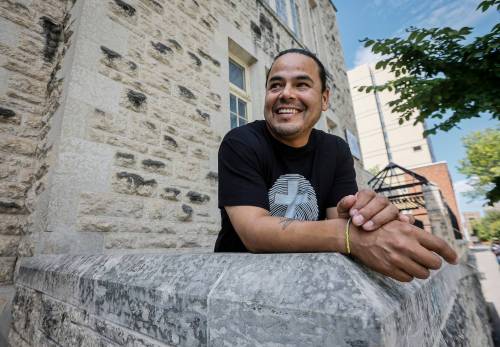
That was the question facing Steve Heinrichs, who directs Mennonite Church Canada’s Indigenous-settler relations program.
Heinrichs loves the Bible. He reads it every day as part of his devotional life. And yet he knows that many people distrust and dislike it because of how it was used against Indigenous people in Canada.
“The Bible has a bad reputation for many Indigenous people and their allies,” he says. “But can it be reclaimed and used to promote justice and fuel us in our efforts to promote decolonization?”
His answer is yes, and a new book, Unsettling the Word: Biblical Experiments in Decolonization, is the result.
In the book, which was curated by Heinrichs, 60 contributors — settlers and Indigenous people, Christians and non-Christians — engage stories and passages from the Bible to see if it can be reimagined in a positive way for the current settler-Indigenous context.
For Heinrichs, the book is a way to “deal honestly” with some of the harder parts of the Bible, but also “rediscover some good things in it.”
The hard passages include things from the Old Testament, where the ancient Israelites are instructed by God to invade other countries, take their land and kill the inhabitants — something that has unfortunate echoes in Canada’s colonial past.
It’s easy to dismiss the war stories of the Old Testament, Heinrichs says, noting that “some texts are quite destructive and simply bad.”
But he also wonders about things like the Great Commission in the New Testament, which has been used to harm Indigenous people.
“What do we say about the spiritual violence inflicted on Indigenous communities as different churches compete for members in Indigenous communities, and show a lack of respect for Indigenous spirituality?” he asks.
In addition to addressing those questions, the book points to positive things in the Bible that can help settlers and Indigenous people find new ways to live together in Canada.
“There are whole streams in the Bible that talk about reconciliation, peace and land reparations,” Heinrichs says. “We can use those texts to help make things right.”
As for those Christians who have written off the Bible because of how it was used against Indigenous people, he reminds them it is “more politically engaged” than many realize — many of the stories were written by and about oppressed and marginalized people, just like how many Indigenous people feel today.
Ultimately, Heinrichs hopes the book will spark conversations, that people will see how Jesus invited everyone into conversations and community — regardless of their political or religious leanings.
“In the Gospels, Jesus invites a tax collector into his group,” he says of how he reached out to someone from the despised establishment of his day. “Who would that be in our context? There are no enemies in the Gospels. Everyone is challenged to change the way they view others. Can we all sit in a circle and hear each other? Can we listen with courage and care?”
He hopes that reading Unsettling the Word is one way many people will begin that journey.
Unsettling the Word is available from Common Word (commonword.ca) in Winnipeg.
jdl562000@yahoo.com
The Free Press is committed to covering faith in Manitoba through our Religion in the News project. This reporting continues because readers like you step forward to fund it.
Donate now to support our reporting on religion.
Your donation is eligible for a charitable tax receipt.
BECOME A FAITH JOURNALISM SUPPORTER
Our newsroom depends on a growing audience of readers to power our journalism. If you are not a paid reader, please consider becoming a subscriber.
Our newsroom depends on its audience of readers to power our journalism. Thank you for your support.
The Free Press is committed to covering faith in Manitoba through our Religion in the News project. This reporting continues because readers like you step forward to fund it.
Donate now to support our reporting on religion.
Your donation is eligible for a charitable tax receipt.
BECOME A FAITH JOURNALISM SUPPORTER
Our newsroom depends on a growing audience of readers to power our journalism. If you are not a paid reader, please consider becoming a subscriber.
Our newsroom depends on its audience of readers to power our journalism. Thank you for your support.
Advertisement Advertise With Us
Advertisement Advertise With Us
The Free Press acknowledges the financial support it receives from members of the city’s faith community, which makes our coverage of religion possible.