Peace of mind
Renowned Mennonite author discusses controversial novel, faith

Advertisement
Read this article for free:
or
Already have an account? Log in here »
To continue reading, please subscribe:
Digital Subscription
One year of digital access for only $1.44 a week*
- Enjoy unlimited reading on winnipegfreepress.com
- Read the E-Edition, our digital replica newspaper
- Access News Break, our award-winning app
- Play interactive puzzles
*Billed as $5.77 plus GST every four weeks. After 52 weeks, price increases to the regular rate of $19.95 plus GST every four weeks. Offer available to new and qualified returning subscribers only. Cancel any time.
To continue reading, please subscribe:
Add Free Press access to your Brandon Sun subscription for only an additional
$1 for the first 4 weeks*
- Enjoy unlimited reading on winnipegfreepress.com
- Read the E-Edition, our digital replica newspaper
- Access News Break, our award-winning app
- Play interactive puzzles
*Your next Brandon Sun subscription payment will increase by $1.00 and you will be charged $17.95 plus GST for four weeks. After four weeks, your payment will increase to $24.95 plus GST every four weeks.
Read unlimited articles for free today:
or
Already have an account? Log in here »
Hey there, time traveller!
This article was published 30/03/2019 (2760 days ago), so information in it may no longer be current.
Fifty-seven years ago, a young Mennonite author living in Winnipeg published a book that turned the Canadian Mennonite world upside down.
That author was Rudy Wiebe, and the book was Peace Shall Destroy Many — the first novel about Mennonites in Canada in English.
The book, which offered an honest and pointed portrait of Mennonite life on the Prairies during the Second World War, provoked a great deal of anger and pain.
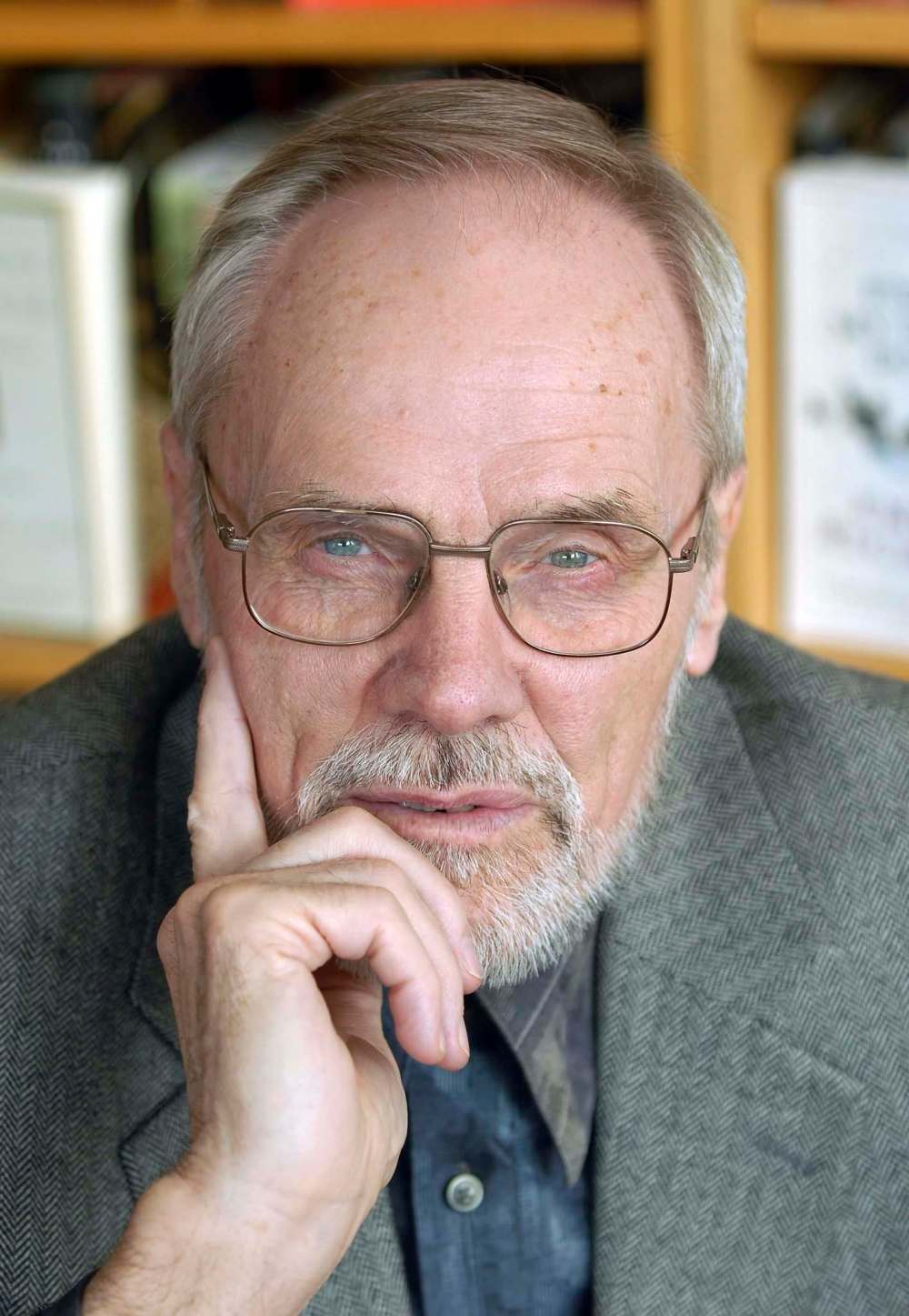
“It was hard on them,” Wiebe, 84, says of how the book affected some members of his denomination. “It was a tough story.”
In the book, Wiebe explored how Mennonites in the fictitious community of Wapiti, Sask., opposed the war, and how their church was divided by conflict and broken relationships.
“It was difficult for the older generation to handle,” he says of the book, which he once described as a “bombshell” for many Canadian Mennonites.
“They didn’t speak English, they weren’t accustomed to reading fiction and they didn’t share insider problems with the outside world,” he says.
The publication of the book was hard on Wiebe, too. At the time, he was the new editor of the Mennonite Brethren Herald, the official English-language publication of that denomination.
As the criticism mounted, Wiebe knew he couldn’t stay editor of the Herald.
“I wasn’t fired, but I resigned before they would have fired me. There was no question I couldn’t continue.”
That decision led to a distinguished 25-year career as a professor of English at the University of Alberta, and as an award-winning author of 33 books, anthologies and collections of essays about faith, life on the Canadian Prairies, and about Western Canada’s Indigenous Peoples.
Along the way, Wiebe became a two-time recipient of the Governor General’s Award for Fiction, received the Writers’ Trust Prize for Nonfiction and received the Charles Taylor Prize for his memoir about growing up in Saskatchewan. In 2000, he was named an officer of the Order of Canada.
On April 4, Wiebe will return to Winnipeg to receive another honour when he is given the PAX Award from Canadian Mennonite University.
The award, created to honour people “who lead exemplary lives of service, leadership, and reconciliation in church and society,” is being given to Wiebe for how “his works have been critical in exposing societal concerns,” and for “the patience and empathy his works awaken,” according to CMU president Cheryl Pauls.
For Wiebe, the award from CMU is “particularly welcome” since it is coming from members of his own faith.
Despite how some Mennonites responded to Peace Shall Destroy Many, Wiebe never became angry with the church, or lost his faith.
He recently got a letter from an old friend who said “he can’t figure out how I stuck with church,” Wiebe says.
For Wiebe, “there’s no great mystery about it.”
One reason is growing up as one of seven children in a caring and supportive religious refugee family in Speedwell, in northern Saskatchewan.
His early church experience was also positive; there were “hardline” leaders, he says, but he also heard messages about the love and mercy of God.
Another reason is the church where he and his wife, Tena, worship in Edmonton — Lendrum Mennonite.
The church has “been very supportive of me and my writing and the work I’ve been doing all my life,” he says, adding members of the church have never been “judgmental” about what he has written.
The church was also a huge support when his son, Michael, died by suicide in 1985.
“When Michael died, it was just shortly after there was a very large controversy about what I had written. But they stood with us.”
Although the mainstream writing world is a quite secular place, Wiebe is happy to call himself a Christian writer.
“That means I’m a believer and a follower of Jesus Christ. I try to look at the world in the way Jesus tried to teach us,” he says.
That doesn’t mean he has faith all figured out, or that he lives perfectly as a Christian. Living faithfully is “sometimes hard to maintain,” he says.
His understanding of his faith has also changed over the decades.
“We live as Christians in a world that keeps changing,” he says. “You just can’t go plodding along thinking I know what’s right and what we’ve been taught for the last 500 years or something like that is the only right thing.
“The world changes, and you need an imagination to understand that. You can’t just say that certain practices today are out the window because they didn’t exist in Jesus’ time. This is where the imagination and spiritual discernment are important.”
As for whether being so open about his faith has ever hurt him as a writer, Wiebe says no.
“People kept publishing my books,” he says, noting Peace Shall Destroy Many has never gone out of print and is still taught in high schools.
“There was never any question about what my approach to the story was, and they didn’t object to my philosophy in life. Nobody objected to me (about my faith) in terms of the publishing world.”
In addition to writing about Mennonites, Wiebe is also well-known for his books about Indigenous Peoples in Western Canada.
He traces that interest to growing up on the northern Prairies, “so close to the land.”
His interest in Indigenous people led him to want to write books about them.
“What I basically was trying to do was tell the story of what happened to them, a story that that basically had never been talked about in Western Canada before,” he says.
Of his 1973 book The Temptations of Big Bear, he says: “I don’t think there had been a book from an Indigenous standpoint” until it came out, where the Indigenous character is “the hero of the book.”
Until then, he says, Indigenous people were “stereotyped basically, either romanticized or portrayed as down and out, poverty stricken, addicted people, on the fringes. Certainly never worthy of being the protagonists of a major work of fiction.”
He is sensitive to the issue of cultural appropriation, but says Indigenous people have always told him, “if you treat us with respect and know what you’re writing about, go ahead and do it.”
Wiebe’s experiences with Indigenous people have also influenced how he sees his own faith.
“I can’t believe that the God who created the world would just give one little vision (of himself) to one small group of people in the Middle East and keep everything else hidden from everyone or every human being all over the Earth,” he says. “That’s not from the kind of God I understand.”
He also believes Mennonites are well-placed to be empathetic toward Indigenous people, due to their own history of displacement and refugee flight.
Noting how many Mennonites, including his own family, were forced off their land in the former Soviet Union in the 20th century, “you start thinking about what it would be like for someone to invade your country, and taking over your home… these are profoundly the same issues.”
Something else he’s thinking about now is mortality. “I have Parkinson’s,” he says, noting he needs a cane for walking.
“It’s uncomfortable and painful in the morning, and it’s not going to improve,” he says. “It’s debilitating, but you don’t lose your mind to it. That’s the main thing.”
Is he worried about losing his mind to something like dementia?
“That kind of thing, well, God knows,” he says. “I need to take what life brings. It’s part of what life is. And we take what it is.”

For now, his mind is focused on the award he will receive next week.
“The award is called PAX — peace,” he says, noting that when Peace Shall Destroy Many was published, “it destroyed peace for many.”
But because of it, “I have never been able to stop writing, not for the rest of my life.”
Wiebe will speak and receive the PAX Award at Spring at CMU, the university’s annual fundraising reception, on April 4 at 7 p.m. at 500 Shaftesbury Blvd. All are welcome; call 204-594-0517 to reserve a place.
faith@freepress.mb.ca
The Free Press is committed to covering faith in Manitoba through our Religion in the News project. This reporting continues because readers like you step forward to fund it.
Donate now to support our reporting on religion.
Your donation is eligible for a charitable tax receipt.
BECOME A FAITH JOURNALISM SUPPORTER
Our newsroom depends on a growing audience of readers to power our journalism. If you are not a paid reader, please consider becoming a subscriber.
Our newsroom depends on its audience of readers to power our journalism. Thank you for your support.
One unexpected result of Rudy Wiebe’s first book is his friendship with Omar Khadr, the Canadian who was imprisoned at Guantanamo Bay for committing war crimes in Afghanistan.
Khadr, 15 years old at the time, was taken to there by his father, a member of al-Qaida.
While he was in prison at Guantanamo Bay, professors at The King’s University in Edmonton helped him get a high school education. One of the books they gave him to read was Peace Shall Destroy Many.
“Omar liked it and wrote me a long letter about it, and so we start corresponding,” Wiebe says.
When Khadr came to Canada, he was sent to a Edmonton prison, where Wiebe went to visit him.
“We had a number of conversations through the prison glass. Through that, our friendship and our understanding of each other grew. It’s quite wonderful,” Wiebe says.
As for why Khadr liked the book, Wiebe says, he saw in it how a person could “struggle with the teachings of a father… being dominated by an overwhelming patriarch and getting into real difficulties over it.”
Of course, his experience was “far more drastic” than those of the characters in his book, Wiebe says.
As for Khadr today, “he strikes me as a wonderful man. I have always marvelled at how little anger he has,” Wiebe says.
The Free Press is committed to covering faith in Manitoba through our Religion in the News project. This reporting continues because readers like you step forward to fund it.
Donate now to support our reporting on religion.
Your donation is eligible for a charitable tax receipt.
BECOME A FAITH JOURNALISM SUPPORTER
Our newsroom depends on a growing audience of readers to power our journalism. If you are not a paid reader, please consider becoming a subscriber.
Our newsroom depends on its audience of readers to power our journalism. Thank you for your support.
Advertisement Advertise With Us
Advertisement Advertise With Us
The Free Press acknowledges the financial support it receives from members of the city’s faith community, which makes our coverage of religion possible.