Ten Thousand Villages’ proud legacy
Much to celebrate despite closure of Canadian fair trade stores

Advertisement
Read this article for free:
or
Already have an account? Log in here »
To continue reading, please subscribe:

Digital Subscription
One year of digital access for only $205*
- Enjoy unlimited reading on winnipegfreepress.com
- Read the E-Edition, our digital replica newspaper
- Access News Break, our award-winning app
- Play interactive puzzles
*First annual payment billed as $205.00 + GST for one year. This annual subscription will automatically renew at $233.00 + GST every 52 weeks (10% off the regular annual price of $259.35). Offer available to new and qualified returning subscribers only. Cancel any time.
To continue reading, please subscribe:
Add Free Press access to your Brandon Sun subscription for only an additional
$1 for the first 4 weeks*
- Enjoy unlimited reading on winnipegfreepress.com
- Read the E-Edition, our digital replica newspaper
- Access News Break, our award-winning app
- Play interactive puzzles
*Your next Brandon Sun subscription payment will increase by $1.00 and you will be charged $17.95 plus GST for four weeks. After four weeks, your payment will increase to $24.95 plus GST every four weeks.
Read unlimited articles for free today:
or
Already have an account? Log in here »
Hey there, time traveller!
This article was published 01/02/2020 (2435 days ago), so information in it may no longer be current.
Last month, Mennonite Central Committee (MCC) announced it was closing Ten Thousand Villages Canada, its fair trade retailer in this country, due to declining sales and changes in the retail sector.
For Rick Cober Bauman, executive director of MCC Canada, the closure is sad and disappointing. At the same time, he feels a sense of gratitude.
“I know it seems odd, given the news, but there is so much to be grateful for from the story of Ten Thousand Villages,” he says.
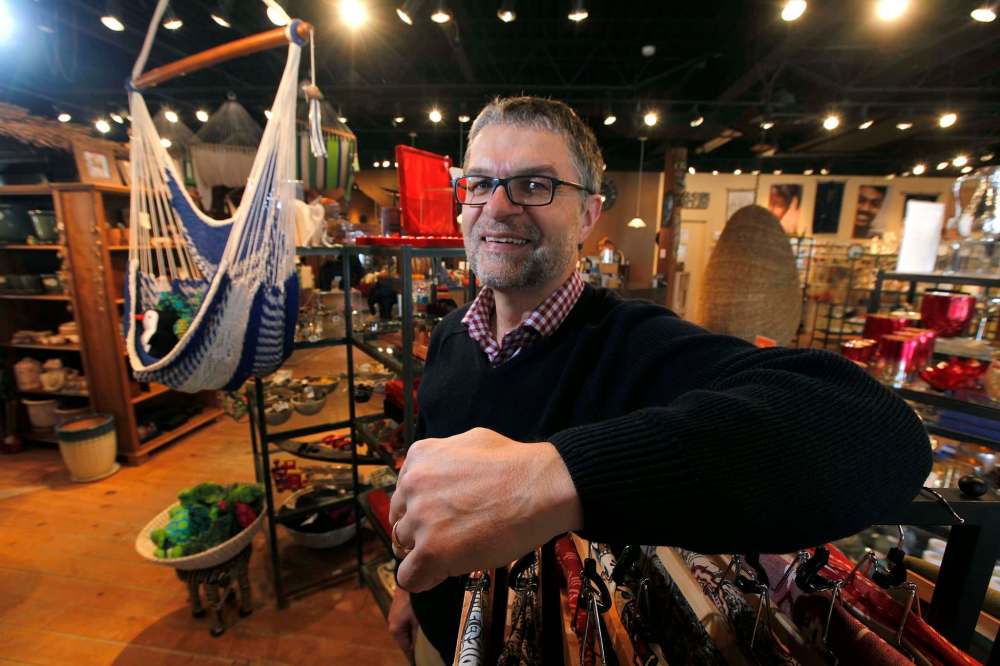
For starters, the business — which used several names in its 74-year history — is widely credited with starting the global fair trade movement.
It goes back to 1946, when an American Mennonite woman named Edna Ruth Byler was visiting Puerto Rico. While there, she met women struggling to feed their children. She wanted to help, but didn’t know how.
Then she saw the beautiful embroidery they made, and had an idea: what if she took their handiwork back home to the U.S. and sold it to friends and neighbours, and sent the money back to the women? It worked, and when MCC saw what she was doing, it decided to become involved — and Ten Thousand Villages was the result.
“We owe a debt of gratitude to Edna,” says Cober Bauman. “She had no idea what she was birthing.”
He’s also grateful for the artisans in 59 producer groups in the developing world who sold their crafts to Ten Thousand Villages; for the staff and volunteers who worked in the stores; and for the customers who bought the products.
And he’s grateful for how MCC, through Ten Thousand Villages, not only helped create the fair trade movement, but how it also caused people to become more aware of the impact of their shopping decisions.
“I think we contributed to helping move the needle on how people think about how they spend their money,” he says. It also had an impact on the wider business world, he adds; Canadian companies today are more sensitive to wages and working conditions at factories they order from in the developing world.
Of course, that still doesn’t remove the sting of having to shutter the organization in Canada. But, he states, there was no way around it.
Until 2007, Ten Thousand Villages Canada had healthy surpluses. After that, it experienced multiple years of losses due to falling sales at its retail stores across the country.
“We had faithful customers who came back regularly, but not enough of them,” he says.
Like other retailers, they started selling online. There was some success, but not enough to make up for losses.
“MCC couldn’t keep underwriting the business,” he says, noting the organization had to ensure its ability to operate its many relief and development programs was not compromised.
“The decision was not made lightly. We looked at all kinds of possible options to keep it open. In the end, I believe we made the right decision.”
Canadians who want to buy items from Ten Thousand Villages after it shuts down in May in Canada will still be able to order online from Ten Thousand Villages U.S. And eight independent stores in Canada are staying open, including in Steinbach and Brandon.
As for the artisans overseas, he is sorry they are losing some business. However, it will be lessened a bit since they didn’t only sell to Ten Thousand Villages.

“It’s always been our goal to help artisans sell to other organizations and retailers, not just to us,” says Cober Bauman. “We didn’t take a selfish course and keep them to ourselves. I’m grateful none of them are completely dependent on us.”
As for the fair trade sector as a whole, it is also under a lot of pressure. In addition to changing consumer tastes, the business model is a challenge: it’s costly to transport crafts and other items long distances from poor countries to rich countries.
“Maybe it’s time to explore helping artisans sell into growing middle-class economies in the developing world,” Cober Bauman says.
So while it’s sad to see it close, Canadians can still celebrate the impact of Ten Thousand Villages — and the vision of Edna Ruth Byler, the woman who got the whole thing started.
faith@freepress.mb.ca
The Free Press is committed to covering faith in Manitoba through our Religion in the News project. This reporting continues because readers like you step forward to fund it.
Donate now to support our reporting on religion.
Your donation is eligible for a charitable tax receipt.
BECOME A FAITH JOURNALISM SUPPORTER
Our newsroom depends on a growing audience of readers to power our journalism. If you are not a paid reader, please consider becoming a subscriber.
Our newsroom depends on its audience of readers to power our journalism. Thank you for your support.
The Free Press is committed to covering faith in Manitoba through our Religion in the News project. This reporting continues because readers like you step forward to fund it.
Donate now to support our reporting on religion.
Your donation is eligible for a charitable tax receipt.
BECOME A FAITH JOURNALISM SUPPORTER
Our newsroom depends on a growing audience of readers to power our journalism. If you are not a paid reader, please consider becoming a subscriber.
Our newsroom depends on its audience of readers to power our journalism. Thank you for your support.
Advertisement Advertise With Us
Advertisement Advertise With Us
The Free Press acknowledges the financial support it receives from members of the city’s faith community, which makes our coverage of religion possible.