Silencing the songs
Church choir music in jeopardy due to coronavirus

Advertisement
Read this article for free:
or
Already have an account? Log in here »
To continue reading, please subscribe:

Digital Subscription
One year of digital access for only $205*
- Enjoy unlimited reading on winnipegfreepress.com
- Read the E-Edition, our digital replica newspaper
- Access News Break, our award-winning app
- Play interactive puzzles
*First annual payment billed as $205.00 + GST for one year. This annual subscription will automatically renew at $233.00 + GST every 52 weeks (10% off the regular annual price of $259.35). Offer available to new and qualified returning subscribers only. Cancel any time.
To continue reading, please subscribe:
Add Free Press access to your Brandon Sun subscription for only an additional
$1 for the first 4 weeks*
- Enjoy unlimited reading on winnipegfreepress.com
- Read the E-Edition, our digital replica newspaper
- Access News Break, our award-winning app
- Play interactive puzzles
*Your next Brandon Sun subscription payment will increase by $1.00 and you will be charged $17.95 plus GST for four weeks. After four weeks, your payment will increase to $24.95 plus GST every four weeks.
Read unlimited articles for free today:
or
Already have an account? Log in here »
Hey there, time traveller!
This article was published 23/05/2020 (2300 days ago), so information in it may no longer be current.
Can you imagine a church service without singing?
I can’t. But that might be the case for the next year or more if warnings from scientists and public health officials about the spread of the novel coronavirus are correct.
According to experts, one of the easiest ways to spread the virus is by singing. That’s what Dr. Lucinda Halstead, the president of the Performing Arts Medical Association and the Medical Director of the Department of Otolaryngology at the University of South Carolina, and Dr. Donald Milton, an infectious bio-aerosol specialist at the University of Maryland, told the National Association of Teachers of Singing and the American Choral Directors Association earlier this month.
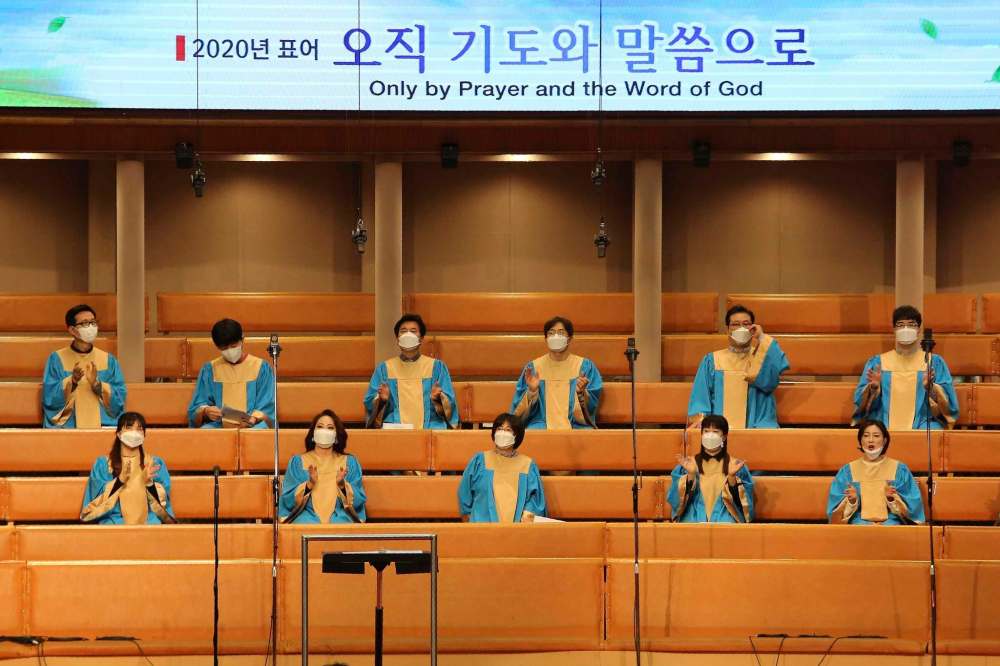
In their presentation, the two stated there is no safe way for singers to rehearse together until there is a COVID-19 vaccine and a 95 per cent effective treatment in place — something they think is at least 18-24 months away.
They went on to say there is no spacing solution for singing groups that would eliminate risk, noting singing can transmit the virus up to 16 feet.
According to Halstead, physical distancing is not an option. “You would need a football stadium to space apart the… choir,” she said.
Masks may also not provide safe methods for singing, they added; Milton said experiments with the flu found people still spread the influenza virus from their breath in fine particles even when wearing masks.
What’s true for choirs and choral groups is also true for congregations. And if it is, who can imagine a church service with no singing?
Jeremy Penner can’t. For the director of worship and media at Portage Church here in Winnipeg, “the word that comes to mind about this news is ‘devastating.’”
And yet, he also wants everyone to be safe. Once his church is allowed to gather in person, Penner said he wants to follow health advice about singing, suspending it if it is not safe to do so.
Although that will be difficult, he notes Christians throughout history have suffered much more. This includes persecuted Christians who met secretly and avoided singing in order not to be discovered.
That was also true worship, he noted. It focused “on the hope we have in God, that He will bring us through it like He has always brought His people through hard times in the past… if God is leading us to go through a similar period of restraint in our worship, then our rejoicing will be even greater when we come through it.”
Michael Wilson, minister at Charleswood United Church, said his church would also follow health guidelines about singing if it isn’t safe. But even if that happens, it doesn’t mean there will never be congregational or choir singing ever again, he said.
“The future of congregational singing is that there will be congregational singing,” he said. “When and how are fair questions, but there is no need to rush to an answer before there has been time to reflect on what that means.”
Janet Brenneman is a professor of music at Canadian Mennonite University. The dire warnings have “sparked real concern and panic for some,” she noted.
For Brenneman, who conducts the university’s choirs and often leads singing at her church, Bethel Mennonite, it’s hard to imagine what life might look like with no choral singing.
But, she said, directives from public health officials need to be taken seriously. “We don’t want to put anybody at risk,” she said.
And yet, the loss of congregational singing in churches would be a huge blow, she said.
“That’s the way the congregation finds its collective voice, how many participate in worship,” she said. Without singing, “it just wouldn’t be the same.”

When the question about singing in churches, once groups can gather again, was posed to provincial health authorities, a spokesperson noted they are aware about “droplet production” when singing.
“If and when gathering size increases and the situation evolves, Manitoba public health officials will provide guidance based on evidence at that time,” the spokesperson said.
In Luke 19:39-40, we are told some Pharisees told Jesus to tell his disciples to keep quiet. “I tell you,” Jesus replied, “if they keep quiet, the stones will cry out.”
If the coronavirus silences singing in churches until a vaccine is created, I’m sure Christians will still find other ways to praise God.
faith@freepress.mb.ca
The Free Press is committed to covering faith in Manitoba through our Religion in the News project. This reporting continues because readers like you step forward to fund it.
Donate now to support our reporting on religion.
Your donation is eligible for a charitable tax receipt.
BECOME A FAITH JOURNALISM SUPPORTER
Our newsroom depends on a growing audience of readers to power our journalism. If you are not a paid reader, please consider becoming a subscriber.
Our newsroom depends on its audience of readers to power our journalism. Thank you for your support.
The Free Press is committed to covering faith in Manitoba through our Religion in the News project. This reporting continues because readers like you step forward to fund it.
Donate now to support our reporting on religion.
Your donation is eligible for a charitable tax receipt.
BECOME A FAITH JOURNALISM SUPPORTER
Our newsroom depends on a growing audience of readers to power our journalism. If you are not a paid reader, please consider becoming a subscriber.
Our newsroom depends on its audience of readers to power our journalism. Thank you for your support.
Advertisement Advertise With Us
Advertisement Advertise With Us
The Free Press acknowledges the financial support it receives from members of the city’s faith community, which makes our coverage of religion possible.