Church member chronicles cathedral’s story
St. John's is Winnipeg's oldest Anglican parish

Advertisement
Read this article for free:
or
Already have an account? Log in here »
To continue reading, please subscribe:

Digital Subscription
One year of digital access for only $205*
- Enjoy unlimited reading on winnipegfreepress.com
- Read the E-Edition, our digital replica newspaper
- Access News Break, our award-winning app
- Play interactive puzzles
*First annual payment billed as $205.00 + GST for one year. This annual subscription will automatically renew at $233.00 + GST every 52 weeks (10% off the regular annual price of $259.35). Offer available to new and qualified returning subscribers only. Cancel any time.
To continue reading, please subscribe:
Add Free Press access to your Brandon Sun subscription for only an additional
$1 for the first 4 weeks*
- Enjoy unlimited reading on winnipegfreepress.com
- Read the E-Edition, our digital replica newspaper
- Access News Break, our award-winning app
- Play interactive puzzles
*Your next Brandon Sun subscription payment will increase by $1.00 and you will be charged $17.95 plus GST for four weeks. After four weeks, your payment will increase to $24.95 plus GST every four weeks.
Read unlimited articles for free today:
or
Already have an account? Log in here »
Hey there, time traveller!
This article was published 11/07/2020 (2279 days ago), so information in it may no longer be current.
Still standing after several floods, financial mismanagement, and shifting foundations, Winnipeg’s oldest Anglican parish will survive cancelling its bicentennial plans, says the dean of St. John’s Anglican Cathedral.
Poised to celebrate 200 years of Anglicanism in Western Canada with concerts, an international conference and even a bicentennial anthem, Rev. Paul Johnson says more than half of their events have been cancelled due to the global pandemic.
“We had something going every month starting in October 2019,” says the dean of the North End cathedral.
“We wanted to have a year of events.”
Johnson says cancellations include the anthem competition, a conference of 75 deans of Anglican cathedrals from across Canada and the United States, and a two-day celebration in October involving Anglican bishops from across Western Canada and a worship service for 1,400 people.
The cathedral will hold a scaled-back celebration in October instead, says Johnson.
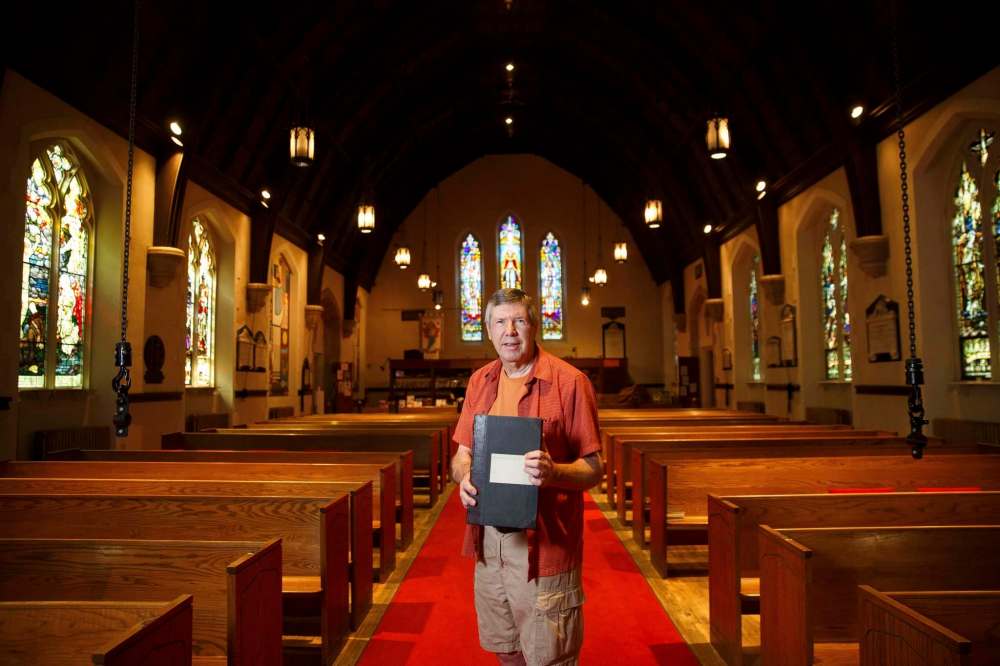
What hasn’t been cancelled is telling the cathedral’s story through short accounts researched and written by church member Terry Moore and published in the church bulletin every Sunday since October 2018.
“I was curious about who the people of St. John’s were and what they did in the church and the community,” the former Free Press editorial writer and editor says about his research.
After three years of weekly visits to the cathedral’s archives, Moore transcribed a book of vestry minutes recorded between 1860 and 1903 and hit up libraries and diocesan archives to fill in the blanks.
Deciphering the handwritten minutes, some recorded in watered down ink when writing materials were scarce, proved to be a challenge forcing Moore to puzzle out some abbreviations and check spellings of surnames against cathedral cemetery records.
That research resulted in 104 paragraphs conveying some of the highs and lows of the parish’s history.
Sometimes those were exactly the same, such as the excitement for a new church to replace one sinking into the Manitoba clay soil, and then having the same structural issues emerge in the new building. Constructed in 1926, the current cathedral is the fourth building on the site, replacing two previous churches with foundation issues. Fifteen years after completion, the congregation was forced to sink more money into their new cathedral to prevent a similar bad ending.
That decision to rebuild on the same location was born both out of optimism and frugality, says Moore, who also documented a campaign by some Anglicans living in the south end of the city to move the cathedral downtown.
“It became a hallowed site,” he says of the continued presence on Anderson Avenue, east of Main Street.
“It was hallowed by continued occupation as a house of worship.”
Moore discovered some metaphorical cracks in the foundation of the church, including significant financial mismanagement by the bishop’s nephew in early 20th century, which resulted in the cathedral parish selling off assets from its original land grant measuring two lots wide by two miles (3.2 km) long.
Anglican missionary priest John West arrived in the Red River settlement in 1820, founding the first Anglican parish in Western Canada and establishing an Anglican presence which grew to include schools, a college (now St. John’s College at University of Manitoba) and many other Anglican churches in Winnipeg.
“We are now worshipping on the last remaining vestige of what was once a great church compound,” explains Moore of the cathedral and its cemetery, occupying 4.7 acres.
“It was the great engine powering the Anglicans of Western Canada.”
At times that engine misfired, says Moore, citing West’s sometimes embarrassing journal entries about his encounters with Indigenous people. After two centuries of Anglican history, including running Indian residential schools, Moore believes Anglicans have finally opened their eyes and ears to their colonial past.
“It’s taken the settlers a long time to learn they should shut up and listen,” says Moore, pointing to a recent national Anglican service marking National Indigenous Day.
“That has been a hard thing for Anglicans to learn and it’s happening before our eyes.”
After unrolling the cathedral’s story for nearly two years, Moore has compiled some of the vignettes into longer chapters but hasn’t committed to writing a history book.

“I’m just pursuing the good stories,” says the lifelong journalist and editor.
“I’m a retired guy in lockdown and I have the opportunity to work at it.”
Intended as a prelude to a big party, Johnson says Moore’s work has grown to become a weekly celebration of the life of a parish and its influence on the growth of the city and province.
“Starting it two years ahead of time was intended to build anticipation and for people to know their own story,” he says.
brenda@suderman.com
The Free Press is committed to covering faith in Manitoba through our Religion in the News project. This reporting continues because readers like you step forward to fund it.
Donate now to support our reporting on religion.
Your donation is eligible for a charitable tax receipt.
BECOME A FAITH JOURNALISM SUPPORTER
Brenda Suderman has been a columnist in the Saturday paper since 2000, first writing about family entertainment, and about faith and religion since 2006.
Our newsroom depends on a growing audience of readers to power our journalism. If you are not a paid reader, please consider becoming a subscriber.
Our newsroom depends on its audience of readers to power our journalism. Thank you for your support.
Snapshots of two centuries of St. John’s Anglican Cathedral
John West, the priest sent to Red River in 1820 by the Church Missionary Society, recorded: “On the 14th of October we reached the settlement, consisting of a number of huts widely scattered along the margin of the river; in vain did I look for a cluster of cottages, where the hum of a small population at least might be heard, as in a village. … There was an unfinished building as a Catholic church, and a small house adjoining, the residence of the Priest; but no Protestant manse, church or schoolhouse…”
On Sunday, May 2, 1852, it was clear a major flood was coming. Bishop Anderson announced a day of prayer and humiliation, held on Wednesday, May 5. At that service, he gave notice that any who chose might lodge wheat in the gallery of the church for safety: thirty bushels were brought immediately after. Many besides deposited articles they most valued such as clocks, saws and seed. One individual brought one hundred bushels of grain, of different kinds, for storage.
The Spanish Influenza epidemic, already raging in Europe as the 1914-18 war wound down, appeared in Winnipeg in October 1918. The provincial Board of Health banned church services and other public gatherings from Oct. 11, 1918 to curb spread of the disease. The ban continued 46 days until it was lifted on Thursday, Nov. 28, allowing Advent 1 services on Dec. 1. St John’s vestry noticed a sharp drop in giving on account of the seven Sundays in October and November when no services were held and no collections taken.
The Free Press is committed to covering faith in Manitoba through our Religion in the News project. This reporting continues because readers like you step forward to fund it.
Donate now to support our reporting on religion.
Your donation is eligible for a charitable tax receipt.
BECOME A FAITH JOURNALISM SUPPORTER
Brenda Suderman has been a columnist in the Saturday paper since 2000, first writing about family entertainment, and about faith and religion since 2006.
Our newsroom depends on a growing audience of readers to power our journalism. If you are not a paid reader, please consider becoming a subscriber.
Our newsroom depends on its audience of readers to power our journalism. Thank you for your support.
Advertisement Advertise With Us
Advertisement Advertise With Us
The Free Press acknowledges the financial support it receives from members of the city’s faith community, which makes our coverage of religion possible.