Tunisia’s turmoil is being watched warily around the globe
Advertisement
Read this article for free:
or
Already have an account? Log in here »
To continue reading, please subscribe:

Digital Subscription
One year of digital access for only $205*
- Enjoy unlimited reading on winnipegfreepress.com
- Read the E-Edition, our digital replica newspaper
- Access News Break, our award-winning app
- Play interactive puzzles
*First annual payment billed as $205.00 + GST for one year. This annual subscription will automatically renew at $233.00 + GST every 52 weeks (10% off the regular annual price of $259.35). Offer available to new and qualified returning subscribers only. Cancel any time.
To continue reading, please subscribe:
Add Free Press access to your Brandon Sun subscription for only an additional
$1 for the first 4 weeks*
- Enjoy unlimited reading on winnipegfreepress.com
- Read the E-Edition, our digital replica newspaper
- Access News Break, our award-winning app
- Play interactive puzzles
*Your next Brandon Sun subscription payment will increase by $1.00 and you will be charged $17.95 plus GST for four weeks. After four weeks, your payment will increase to $24.95 plus GST every four weeks.
Read unlimited articles for free today:
or
Already have an account? Log in here »
Hey there, time traveller!
This article was published 30/07/2021 (1884 days ago), so information in it may no longer be current.
TUNIS, Tunisia (AP) — Days of political turmoil in Tunisia over a crippled economy and surging coronavirus infections have unnerved allies in Europe and the United States, while garnering the support of key Mideast partners watching to see if Islamists and Tunisia’s fragile democracy will survive.
European countries -– most notably nearby Italy — worry about a flood of migrants should Tunisia slide further into chaos.
Autocratic leaders from Egypt to Saudi Arabia hope this week’s power grab by Tunisian President Kais Saied spells doom for the region’s Islamists. But they also fear a reignited Arab Spring, like the region-wide uprisings kindled by Tunisia a decade ago.
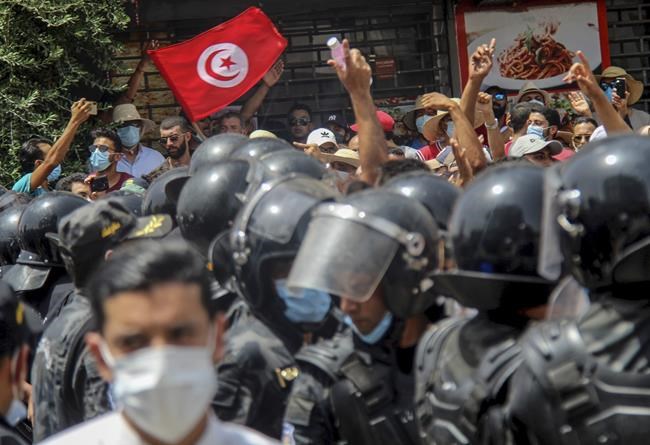
And around the world, pro-democracy campaigners wonder if a country they held up as a beacon is losing its promise of democratic rule, as other nations roiled by Arab Spring protests have.
“The ball is now in the people’s court,” said Egyptian activist el-Ghazaly Harb in a Facebook post. “They are able to correct the path without abandoning the peaceful democratic model that we all hope they can see to the end,” he said. “The answer will always be Tunisia.”
Tunisia, with only 12 million of Africa’s 1.3 billion people, holds outsized symbolism as a nation that designed a democracy from scratch and earned a Nobel Peace Prize after its largely bloodless revolution.
Without warning on Sunday, Saied froze the nation’s parliament, fired top ministers and took over executive powers and supervision of public prosecution, saying he had to save the country, which is suffering from its worst outbreak of the virus to date and a failing economy. While many Tunisians welcomed his move, critics called it a coup. Media and human rights groups expressed alarm at the closure of the Al-Jazeera news bureau in Tunis.
In recent days, Saied has moved against allegedly corrupt lawmakers and tycoons and strengthened military oversight of the nation’s response to the coronavirus. He and his aides held a flurry of meetings with foreign allies, promising that his power grab is temporary.
But his next steps are unclear.
The main victim of his decision -– the Islamist party Ennahdha -– promises to resist, peacefully.
Tunisian analysts don’t expect an army-driven takeover like that seen in Egypt, or a return to the autocratic past, thanks in part to a population that’s no longer afraid to speak out. But the situation is volatile, and new protests may occur Saturday.
Pro-government voices in Egypt, Saudi Arabia and the United Arab Emirates are celebrating the moves as a victory over political Islam, which they see as a threat to their governing systems – notably in Gulf states where political parties are banned.
Egypt is watching carefully; It was the first to follow Tunisia in an outburst of mass protests in 2011. In the aftermath, the highly organized Muslim Brotherhood rose to power, but was ousted in 2013 amid a military-backed popular uprising led by Abdel Fattah el-Sissi, who was supported by Saudi Arabia and the UAE.
El-Sissi has embarked on economic reforms and brought some political stability to the Arab world’s most populous country, but his tenure has been marred by the jailing of tens of thousands of people.
Leading Brotherhood figures now face death sentences or life in prison. The group has been outlawed and branded a “terrorist group” in Egypt and the UAE, which itself has detained dozens of Emirati Islamist figures.
Some activists worry Tunisia could head down a similar path, despite Saied’s credentials as an independent technocrat.
“Coups are not only started by the military; they can be started by a civilian and completed by officers,” said Shady Lewis Boutros, an Egyptian novelist and writer who lives in the U.K., in a Facebook post.
Abdelrahman al-Rashed, who runs a Saudi-owned media group and is close to the royal court, said Saied is saving the country from returning to the chaos sparked by the Arab Spring. In a column for the Arabic Ashraq al-Awsat newspaper, he wrote that political turmoil in Tunisia marks the “death of the Muslim Brotherhood’s authority.”
Ennahdha itself has distanced itself from more militant Islamists, and its leader, Rachid Ghannouchi, told The Associated Press this week that its critics are using it as a scapegoat for Tunisia’s problems. He noted that his party has played a major role in parliament in the decade since the revolution, which opened the way for his return from 22 years of exile in London, and won the most seats in the last legislative elections.
Some question whether the Gulf states had a role in Tunisia’s current tensions. But others argue that Tunisians are more focused on day-to-day concerns than the discourse around the Muslim Brotherhood.
Meanwhile, Tunisia’s strategic importance to the European Union cannot be overstated.
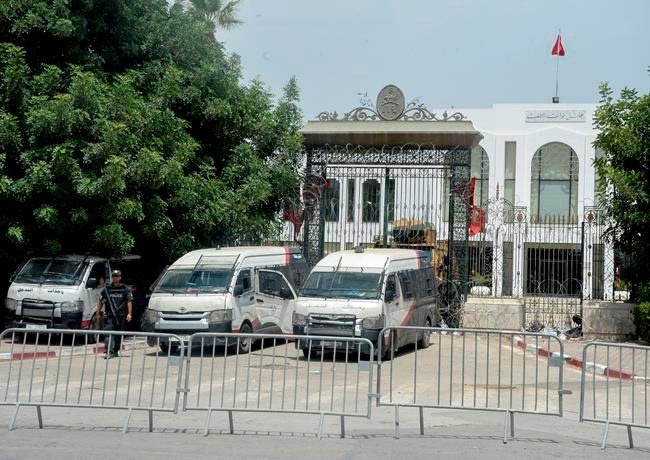
From 2014-20, the bloc invested 1.6 billion euros ($1.9 billion) in Tunisia to build democracy and provide social and economic aid. It has given 330 million euros ($392 million) to help the country recover from the impact of coronavirus restrictions. Another 600 million euros ($712 million) in EU macro-financial assistance was agreed to in May.
Most significantly, Tunisia is a key partner in limiting the flow of migrants from Africa to the EU. The 27 member states are hopelessly divided over how to manage the arrivals of those seeking a better life in Europe, so the bloc has resorted to outsourcing the challenge to other countries.
However, Tunisians now make up one of the largest groups of people seeking asylum in Europe. And the “Tunisia corridor” is a growing concern for the EU’s border and coast guard agency Frontex.
From 2019 to 2020, the number of people reaching Italy from Tunisia grew by almost 400%, to more than 13,000 people, according to some nongovernmental organizations. That includes a period when COVID-19 restrictions significantly reduced migrant movements.
Saied had a “frank discussion on irregular migration” in Brussels last month with top EU officials, and they agreed to work more closely against smugglers and on border management. The latest turmoil adds to concern in Europe that things might get worse.
On Tuesday, the EU’s top diplomat called for Tunisia’s constitutional order to be restored, without directly apportioning any blame.
The U.S. government also is watching closely. In addition to supporting its democracy, the U.S. has helped fund Tunisia’s efforts to tamp down violent Islamic extremism.
Just hours after Saied’s announcement, he spoke with Secretary of State Antony Blinken, who urged him to “adhere to the principles of democracy and human rights” and “maintain open dialogue with all political actors and the Tunisian people.”
Tunisians themselves want jobs and opportunity, which have remained elusive since their revolution, and many support the president — at least for now.

While there is a risk of new mass unrest, Tunisian political scientist Mohamed-Dhia Hammami said “there are strong political actors in Tunisia who can play the role of counterbalance,” including labor unions. And unlike in Egypt, Tunisia’s military has little control over the economy.
Omar Oudherni, a retired Tunisian army brigadier and security expert, said the Tunisian people “will not be silent on any tyrant.”
“Doing what is good will receive support, and if (Saied) wants dictatorship, the people will sweep him up, as they swept others,” he added.
___
Aya Batrawy reported from Dubai, United Arab Emirates, and Lorne Cook reported from Brussels. Elaine Ganley contributed to this report from Paris.
The Free Press acknowledges the financial support it receives from members of the city’s faith community, which makes our coverage of religion possible.