funeral facility ready for service
Society ensures ancient Jewish burial traditions continue

Advertisement
Read this article for free:
or
Already have an account? Log in here »
To continue reading, please subscribe:

Digital Subscription
One year of digital access for only $205*
- Enjoy unlimited reading on winnipegfreepress.com
- Read the E-Edition, our digital replica newspaper
- Access News Break, our award-winning app
- Play interactive puzzles
*First annual payment billed as $205.00 + GST for one year. This annual subscription will automatically renew at $233.00 + GST every 52 weeks (10% off the regular annual price of $259.35). Offer available to new and qualified returning subscribers only. Cancel any time.
To continue reading, please subscribe:
Add Free Press access to your Brandon Sun subscription for only an additional
$1 for the first 4 weeks*
- Enjoy unlimited reading on winnipegfreepress.com
- Read the E-Edition, our digital replica newspaper
- Access News Break, our award-winning app
- Play interactive puzzles
*Your next Brandon Sun subscription payment will increase by $1.00 and you will be charged $17.95 plus GST for four weeks. After four weeks, your payment will increase to $24.95 plus GST every four weeks.
Read unlimited articles for free today:
or
Already have an account? Log in here »
Hey there, time traveller!
This article was published 07/08/2021 (1815 days ago), so information in it may no longer be current.
Built to accommodate death, a new Jewish funeral facility will also breathe life into Winnipeg’s Jewish community for generations, says the executive director of Chesed Shel Emes.
“This building will last for 100 years,” Rena Boroditsky said of their new two-storey office and body preparation space at 1023 Main St.
“Whatever happens to the Jewish community, those who do the preparation work will always have a place to do it.”
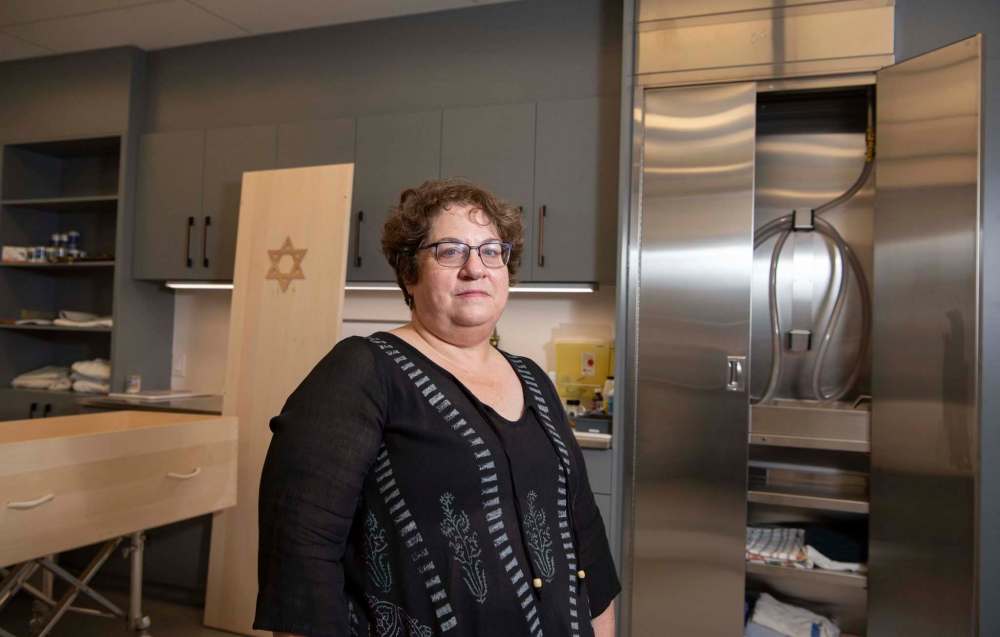
Boroditsky and her 20 staff and volunteers moved into the new 4,000-sq.-ft. building three months ago after operating out of a small, rented room at Chapel Lawn Funeral Home for more than a year. The former Main Street facility was demolished to make room for the new building.
Funded solely through donations from the Jewish community, the beginning of construction coincided with the start of the global pandemic in March 2020.
“The community can be proud of what we’ve done,” she says of the $3.26-million facility completed on schedule.
“It’s a huge thing to say this is what we’re going to do and do it in a really stressful time of COVID.”
Due to public health restrictions around group sizes, Boroditsky has not been able to plan a grand opening, but individuals and families can tour the North End building by appointment.
The previous body preparation space was crammed into a converted house dating back to 1905, with little room for storage or meeting bereaved families. The new two-storey space, which adjoins the large chapel to the north, is equipped with an elevator, and features main floor reception and office space at the front and a lounge with a kitchenette for mourners to sit with the deceased.
“Part of the larger project was to make the building safer, accessible and welcoming so the family and friends can sit as well,” she says of the lounge furnished with comfortable leather chairs and couches.
After a Jewish person dies, the body is washed by trained volunteers in a ritual way, using 24 quarts (27 litres) of continuously poured water and then dressed and placed in an unlined wooden coffin. Before burial, friends, family, or funeral society volunteers sit with the body in a practice call Shmira, the Hebrew term for watching or guarding.
Chesed Shel Emes does not embalm bodies and the organization is not a licensed funeral home but a non-profit religious society that performs a ritual service, says Boroditsky.
The main floors features large body preparation room designed for ease of use, including an overhead lift to move bodies, a large floor drain and a specially designed stainless steel washing closet, with wall-mounted tank holding 24 quarts of water. A built in walk-in freezer in one corner, accommodating six bodies and one casket, can also be accessed from the hallway adjoining the chapel.
“It’s wonderful to be in a space made for us. There’s lots of room for preparation and space for staff,” says Boroditsky.
“It’s a safe, clean modern space.”
The second floor accommodates a large boardroom, small library and storage area for the plain pine wood caskets with rope handles and simple unbleached cotton shrouds used for each Jewish burial.
“Everyone goes the same, so we only have one (style of) casket, and everyone goes wearing the same outfit, which symbolizes purity,” she says.
Manufactured by a Winkler company, the caskets are later decorated with a wooden Star of David. Volunteers sew the one-size-fits-most cotton shrouds at home, says Boroditsky.

“That’s what we do, we look after the dead with true loving kindness,” she says. Chesed Shel Emes is the Hebrew term for true loving kindness.
Since moving into their new home, the funeral society has prepared 29 bodies according to ancient Jewish rituals and is ready to accompany more Jewish families when their loved ones die.
“What we used to have was serviceable and it was good for 80 years,” said president Hillel Kravetsky of the burial society established in 1930.
“We built this in order to ensure this tradition could continue for ourselves and our children.”
brenda@suderman.com
The Free Press is committed to covering faith in Manitoba through our Religion in the News project. This reporting continues because readers like you step forward to fund it.
Donate now to support our reporting on religion.
Your donation is eligible for a charitable tax receipt.
BECOME A FAITH JOURNALISM SUPPORTER
Brenda Suderman has been a columnist in the Saturday paper since 2000, first writing about family entertainment, and about faith and religion since 2006.
Our newsroom depends on a growing audience of readers to power our journalism. If you are not a paid reader, please consider becoming a subscriber.
Our newsroom depends on its audience of readers to power our journalism. Thank you for your support.
The Free Press is committed to covering faith in Manitoba through our Religion in the News project. This reporting continues because readers like you step forward to fund it.
Donate now to support our reporting on religion.
Your donation is eligible for a charitable tax receipt.
BECOME A FAITH JOURNALISM SUPPORTER
Brenda Suderman has been a columnist in the Saturday paper since 2000, first writing about family entertainment, and about faith and religion since 2006.
Our newsroom depends on a growing audience of readers to power our journalism. If you are not a paid reader, please consider becoming a subscriber.
Our newsroom depends on its audience of readers to power our journalism. Thank you for your support.
Advertisement Advertise With Us
Advertisement Advertise With Us
The Free Press acknowledges the financial support it receives from members of the city’s faith community, which makes our coverage of religion possible.