Building community in the snow
Ice church constructed in front of Rosser Grosse Isle United Church every December

Advertisement
Read this article for free:
or
Already have an account? Log in here »
To continue reading, please subscribe:

Digital Subscription
One year of digital access for only $205*
- Enjoy unlimited reading on winnipegfreepress.com
- Read the E-Edition, our digital replica newspaper
- Access News Break, our award-winning app
- Play interactive puzzles
*First annual payment billed as $205.00 + GST for one year. This annual subscription will automatically renew at $233.00 + GST every 52 weeks (10% off the regular annual price of $259.35). Offer available to new and qualified returning subscribers only. Cancel any time.
To continue reading, please subscribe:
Add Free Press access to your Brandon Sun subscription for only an additional
$1 for the first 4 weeks*
- Enjoy unlimited reading on winnipegfreepress.com
- Read the E-Edition, our digital replica newspaper
- Access News Break, our award-winning app
- Play interactive puzzles
*Your next Brandon Sun subscription payment will increase by $1.00 and you will be charged $17.95 plus GST for four weeks. After four weeks, your payment will increase to $24.95 plus GST every four weeks.
Read unlimited articles for free today:
or
Already have an account? Log in here »
Hey there, time traveller!
This article was published 29/01/2022 (1681 days ago), so information in it may no longer be current.
Constructed without a plan using homemade bricks, a small ice sculpture packs a mighty impact at the only church in the village of Rosser.
“That’s an event where we all work together,” explains Sunday school teacher Brooke Darragh of the ice church built in front of Rosser Grosse Isle United Church every December.
“It’s a multi-generational activity and it costs nothing.”
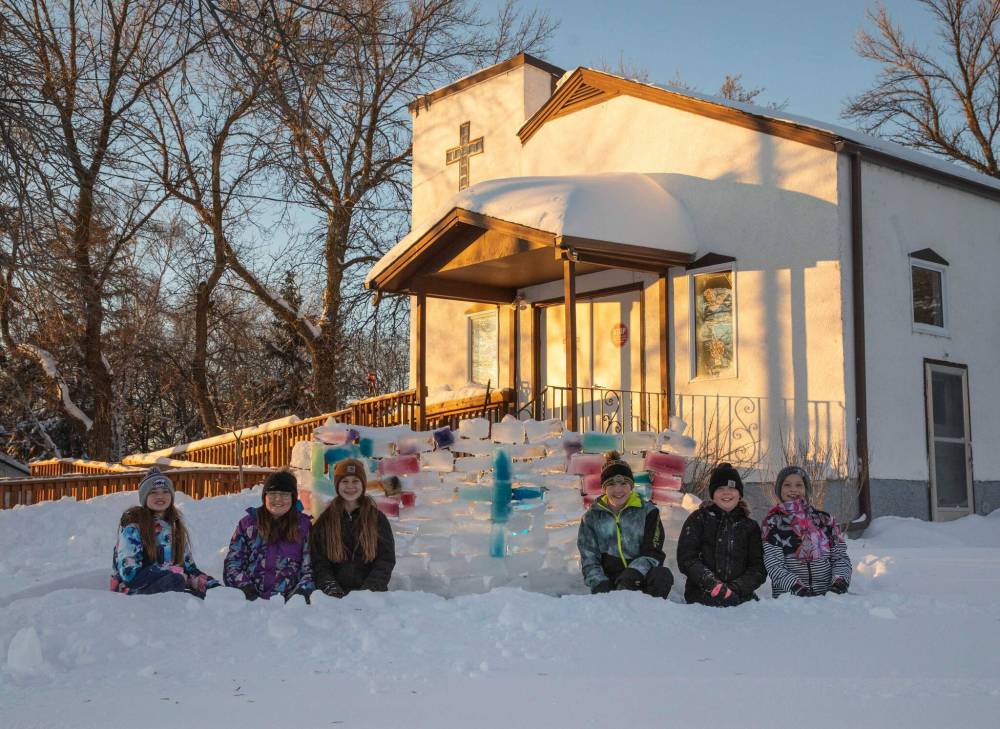
More ice wall than actual building, church families built the structure from ice blocks of all sizes, frozen in milk cartons or other household containers, some tinted with food colouring, says Darragh.
“We never know how may blocks we are going to get and we never ask people for a certain amount,” explains the Grosse Isle resident of the ice church tradition stretching back at least a decade.
Families deliver their ice blocks by early December and then build the structure after a Sunday morning service. In December 2020, members of one household undertook the construction because of pandemic gathering restrictions, but in 2021 a few more people could participate, says Darragh.
“This is so simple, and that’s probably why there’s lots of buy-in from the congregation,” she says of the sculpture, which was lit up with small battery-operated candles on Christmas Eve.
That simplicity combined with the abundance of snow across the prairies inspired a snow and ice building contest for United Church of Canada congregations in Manitoba, Saskatchewan and Alberta.
Until the end of February, congregations are encouraged to decorate their church properties, lawns outside seniors’ homes, or hospital grounds with snow structures or ice decorations, explains Julie Graham, regional minister of justice and communications for three western Canadian regions of the United Church.
Based on the theme of ‘love our neighbours,’ Graham says the competition intends to promote an outdoor intergenerational activity this winter when it is difficult to gather inside because of public health restrictions, as well as demonstrate community spirit in the dark days of winter.
“We’re asking for it to be in a public place,” explains the Saskatoon-based Graham, adding churches should seek permission first.
“It’s something that would bring a little cheer and a little fun.”
After making a snow fort in her urban backyard last summer, Graham discovered a community of passionate snow and ice builders, both locally and online, and decided to continue her frozen experiments.
For this contest, she suggests employing snow, ice or both, and attempting everything from small items like ice candles molded in balloons to larger structures like walls and forts. Participants are asked to submit three photos or videos and a short explanation of how the frozen feature reflects the theme. Graham says the contest is open to any community of faith.
This contest provides a fun way to deal with winter and to connect to others doing the same thing, says Stacey Milne-Ciecko, communications coordinator at the United Church in Meadowood.
She invites her congregants to freeze ice ornaments in aluminum pie plates and consider including organic matter like greenery, lemon slices or blueberries for decoration.
“As they start melting in the spring, bird will eat the berries out of them,” she says of the ornaments which will hang on trees on church property.
Although these structures are temporary, building them together or sharing them with neighbours on front yards and boulevards creates fun for everyone involved, says Graham, whose four-metre diameter backyard football stadium hosted several socially-distanced bonfires and even provided the backdrop for a minister’s Sunday sermon last winter.
“In the moment we bring the community together and try to do something beautiful and later on we move to the next step,” she says of the inevitable melting of the snow and ice creations.
Playing with snow and ice also provides a metaphor for dealing with the ongoing global coronavirus pandemic, suggests Graham. In the depths of winter, just as in a pandemic, people have to deal with what’s in front of them and find joy in the small things.

After years of building their ice church, the congregants of Rosser have come to see themselves in a new way, a lesson underscored by the pandemic, says Rev. Scott MacAuley, pastor at the church just north of Winnipeg for seven years.
“A simple thing like building the ice church means we don’t belong inside the building,” he says of the structure visible to motorists on Highway 221.
“The church exists to be a witness in the world.”
Check out the Regional Council Snow and Ice Competition 2022 Facebook group atfacebook.com/groups/3973143022789464.
Brenda.suderman@freepress.mb.ca
The Free Press is committed to covering faith in Manitoba through our Religion in the News project. This reporting continues because readers like you step forward to fund it.
Donate now to support our reporting on religion.
Your donation is eligible for a charitable tax receipt.
BECOME A FAITH JOURNALISM SUPPORTER
Brenda Suderman has been a columnist in the Saturday paper since 2000, first writing about family entertainment, and about faith and religion since 2006.
Our newsroom depends on a growing audience of readers to power our journalism. If you are not a paid reader, please consider becoming a subscriber.
Our newsroom depends on its audience of readers to power our journalism. Thank you for your support.
The Free Press is committed to covering faith in Manitoba through our Religion in the News project. This reporting continues because readers like you step forward to fund it.
Donate now to support our reporting on religion.
Your donation is eligible for a charitable tax receipt.
BECOME A FAITH JOURNALISM SUPPORTER
Brenda Suderman has been a columnist in the Saturday paper since 2000, first writing about family entertainment, and about faith and religion since 2006.
Our newsroom depends on a growing audience of readers to power our journalism. If you are not a paid reader, please consider becoming a subscriber.
Our newsroom depends on its audience of readers to power our journalism. Thank you for your support.
Advertisement Advertise With Us
Advertisement Advertise With Us
The Free Press acknowledges the financial support it receives from members of the city’s faith community, which makes our coverage of religion possible.