‘Reconciliation was possible:’ Indigenous priest reconciles faith with identity

Advertisement

Advertise with us

Cristino Bouvette’s mind often goes to his grandmother when he thinks about reconciliation: her strength, her empathy and her ability to forgive. He is a Roman Catholic priest and his kokum, Amelia Mae Bouvette, was a residential school survivor.

Read this article for free:


or

Already have an account? Log in here »

To continue reading, please subscribe:

Subscribe and receive a limited-edition Free Press branded hat or tote.

Digital Subscription

One year of digital access for only $205*

  • Enjoy unlimited reading on winnipegfreepress.com
  • Read the E-Edition, our digital replica newspaper
  • Access News Break, our award-winning app
  • Play interactive puzzles

*First annual payment billed as $205.00 + GST for one year. This annual subscription will automatically renew at $233.00 + GST every 52 weeks (10% off the regular annual price of $259.35). Offer available to new and qualified returning subscribers only. Cancel any time.

To continue reading, please subscribe:

Add Free Press access to your Brandon Sun subscription for only an additional

$1 for the first 4 weeks*

  • Enjoy unlimited reading on winnipegfreepress.com
  • Read the E-Edition, our digital replica newspaper
  • Access News Break, our award-winning app
  • Play interactive puzzles
Start now

*Your next Brandon Sun subscription payment will increase by $1.00 and you will be charged $17.95 plus GST for four weeks. After four weeks, your payment will increase to $24.95 plus GST every four weeks.

Hey there, time traveller!
This article was published 24/03/2022 (1655 days ago), so information in it may no longer be current.

Cristino Bouvette’s mind often goes to his grandmother when he thinks about reconciliation: her strength, her empathy and her ability to forgive. He is a Roman Catholic priest and his kokum, Amelia Mae Bouvette, was a residential school survivor.

“She was a woman of deep faith,” Bouvette says from Calgary.

In recent years, Bouvette, 35, has been asked on numerous occasions how he reconciles being Indigenous and being a priest.
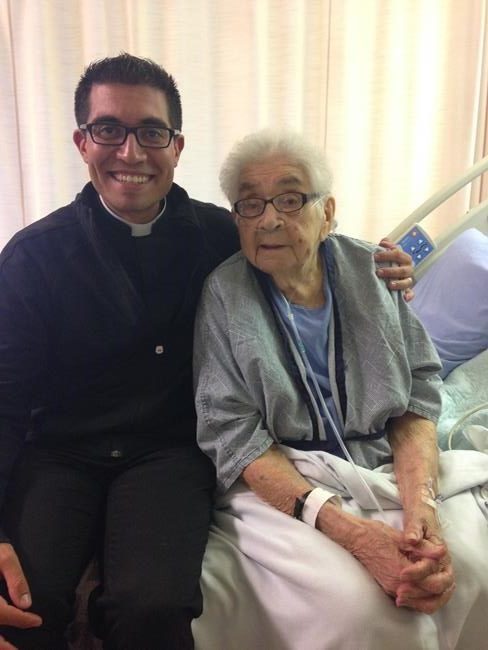
Cristino Bouvette (left), an Indigenous priest, says he often thinks of his grandmother, Amelia Mae Bouvette (right), a residential school survivor, when he considers the Catholic Church’s role in reconciliation. THE CANADIAN PRESS/HO-Gerald McMaster **MANDATORY CREDIT**

For a long time there was no conflict, he says. Christianity was ingrained in his grandmother. She grew up a member of the United Church of Canada and members of the family were ordained ministers.

Hymns echoed through the rooms of her Alberta farmhouse where a young Bouvette would eat his grandmother’s bannock and celebrate his Cree identity.

“There was a harmony, I would say, in all of those factors and components in my life.”

But when the young man was in seminary school, he became much more aware of the tragic implications of residential schools. It was then he thought to himself, “I wonder if this hurts kokum, that her grandson was going to become a priest?”

An estimated 150,000 Indigenous children were forced to attend residential schools over a century.

Amelia Mae Bouvette was seven in 1926 when she was removed from her family on the Saddle Lake Cree Nation in east-central Alberta and taken to the Edmonton Indian Residential School, which was operated by the United Church. She would stay there until 1938. Her grandson says it was a source of indescribable pain.

Decades later, after she’d raised 14 children and had careers helping her community, she was peeling potatoes with her grandson in her kitchen.

Was she offended or worried that he’d decided to become a priest, Bouvette asked?

His grandmother responded that she’d met good nuns and priests in her life, and she hoped he would be one of them.

“She was already then beginning to teach me that reconciliation was possible.”

His grandmother died in 2019 one month short of her 100th birthday.
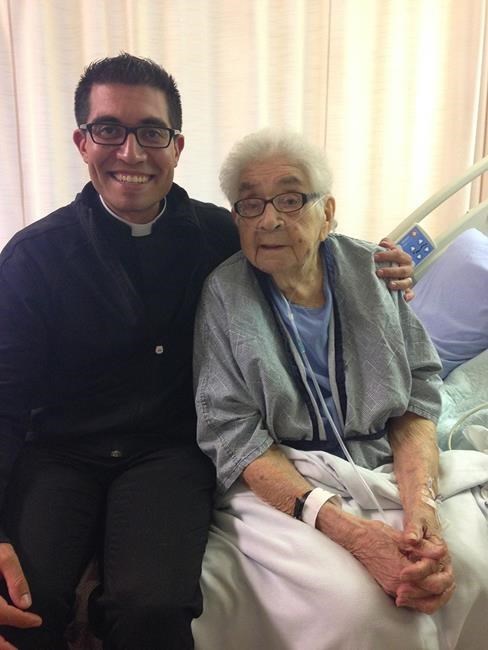
Cristino Bouvette (left), an Indigenous priest, says he often thinks of his grandmother, Amelia Mae Bouvette (right), who was a residential school survivor when he considers the Catholic Church’s role in reconciliation. THE CANADIAN PRESS/HO-Gerald McMaster **MANDATORY CREDIT**

The theme of a delegation to Rome next week is how Indigenous Peoples and the Catholic Church can come together toward healing and reconciliation.

In Winnipeg, Geraldine Shingoose has no intention to forgive or reconcile.

From Tootinaowaziibeeng First Nation in Manitoba, Shingoose spent nine years in the Muscowequan Residential School in Saskatchewan. Shingoose says her time there was her first real exposure to Christianity and it was a traumatic and abusive experience.

The school opened in the 1880s and closed in 1997. Unmarked graves were first discovered there during water line construction in the early 1990s.

In 2018 and 2019, at least 35 potential unmarked graves were located on the site with using ground-penetrating radar.

Shingoose says the injustices at residential schools were thrust back into the spotlight when 215 potential graves were found near the Kamloops Residential School in British Columbia last year.

Shingoose wanted answers.

“The Catholic Church committed a crime,” she says.

Shingoose went to St. Mary’s Cathedral in Winnipeg and sat outside for about 10 hours until she was able to get a meeting with the archbishop.

The conversation didn’t feel sincere and she did not feel heard, she says.

She doesn’t support the delegation to the Vatican and suggests it’s a “colonial tactic” the church is using to distract from ongoing injustices against Indigenous people.
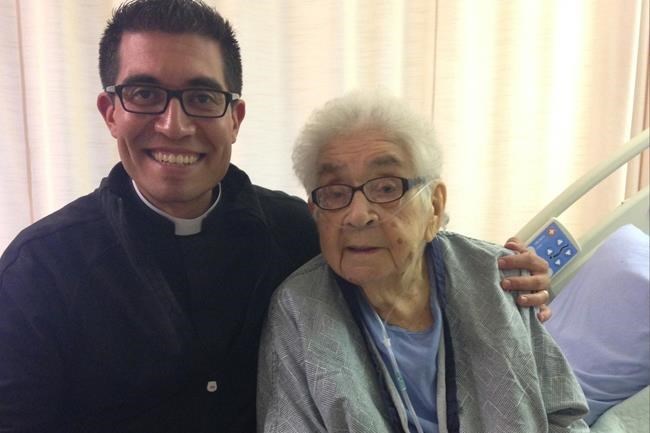
Cristino Bouvette (left), an Indigenous priest, says he often thinks of his grandmother, Amelia Mae Bouvette (right), who was a residential school survivor when he considers the Catholic Church’s role in reconciliation. THE CANADIAN PRESS/HO-Gerald McMaster **MANDATORY CREDIT**

“Would you go visit someone that murdered your child and ask them for an apology?”

Like many Indigenous people who are Christian and Catholic, recent discoveries of unmarked graves at former residential school sites have left Bouvette thinking deeply about the role and responsibility of the church to foster healing.

He understands how the delegation is important to some, but adds the church “cannot give the impression of checking boxes.”

Repairing the relationship and making amends happens in the quiet moments in the living room of a home on a First Nation, he says. It happens when he sits and listens to elders for hours and truly hears what they say.

“Regardless of what happens at the Vatican, regardless of whether the Pope comes to Canada, regardless of what the Pope has to say, there’s so much ongoing work that … we must not lose sight of,” Bouvette says. “We have been doing it and it needs to continue.”

Bouvette says the church must continue working toward forgiveness and understanding even if some Indigenous people aren’t ready to forgive. No number of apologies or money can take away the pain, he says, so reconciliation doesn’t have a timeline.

“We can’t talk about reconciliation if forgiveness is off the table.”

This report by The Canadian Press was first published March 24, 2022.

Report Error Submit a Tip

The Free Press acknowledges the financial support it receives from members of the city’s faith community, which makes our coverage of religion possible.
More Stories

Winnipeggers witness unveiling of Japanese Canadian monument in B.C.

Morgan Modjeski 6 minute read Preview

Winnipeggers witness unveiling of Japanese Canadian monument in B.C.

Morgan Modjeski 6 minute read Yesterday at 8:39 PM CDT

As Miki Stewart gathered with her family at the Japanese Cultural Association of Manitoba on Saturday afternoon, she was thinking of her parents, Yoshimaru and Yoshi Abe.

Both Stewart, 80, and her sister Yumi Falk, 81, alongside an older brother, were born in the Tashme internment camp in British Columbia. They were among more than 2,600 Japanese Canadians who were forcefully removed and interred at the camp following the bombing of Pearl Harbour and Canada’s declaration of war on Japan in 1941.

“They didn’t talk much about how they suffered,” Stewart said of her parents. “But they did.”

She was amongst a group of more than 150 people who gathered at the association’s McPhillips headquarters on Saturday afternoon to watch the unveiling of the Japanese Canadian Monument in Victoria B.C.

Read
Yesterday at 8:39 PM CDT

Bombers get ‘whooped’ in Montreal

Taylor Allen 5 minute read Preview

Bombers get ‘whooped’ in Montreal

Taylor Allen 5 minute read Yesterday at 11:32 PM CDT

MONTREAL — It’s hard to fathom that the Winnipeg Blue Bombers smacked these Montreal Alouettes five weeks ago.

The team that pulled off that 44-28 upset at Princess Auto Stadium was nowhere to be found in La Belle Province on Saturday night.

You can, however, now find them in the basement of the West Division at 7-8 after getting completely outmatched and outclassed by the Als in a 37-10 beatdown.

“This was bad,” left tackle Stanley Bryant told the Free Press postgame. “They basically had their way all around. They whooped our ass.”

Read
Yesterday at 11:32 PM CDT

Mayoral candidate Vogiatzakis criticized for living outside Winnipeg

Malak Abas 4 minute read Preview

Mayoral candidate Vogiatzakis criticized for living outside Winnipeg

Malak Abas 4 minute read Friday, Oct. 2, 2026

A mayoral hopeful took heat from other candidates Friday for living outside Winnipeg while running in the civic election.

Mike Vogiatzakis’s primary residence is in the Rural Municipality of St. Andrews, about 25 kilometres north of Winnipeg — a community with its own mayor and councillors.

But the funeral director said he owns a home in Winnipeg where he divides his time, and he would move to the city full-time if elected mayor.

“It doesn’t matter where a person lives. Why are we dividing St. Andrews and Manitoba and Winnipeg? I’ve met the criteria to run for mayor,” Vogiatzakis said Friday morning.

Read
Friday, Oct. 2, 2026

Khan should’ve taken high road: Goertzen

Carol Sanders 5 minute read Preview

Khan should’ve taken high road: Goertzen

Carol Sanders 5 minute read Friday, Oct. 2, 2026

The veteran Progressive Conservative who championed Obby Khan’s leadership bid says the former Blue Bomber dropped the ball by dissing his Tory teammates before he stepped down.

“I wouldn’t recommend it, and I didn’t recommend it,” Kelvin Goertzen (Steinbach) said in an interview Friday.

Khan resigned as PC leader and quit the caucus Monday saying some members were secretly plotting his ouster, even after he won a confidence vote on Sept. 25.

On Tuesday, Khan lashed out in a CJOB interview, naming the alleged plotters, saying constituents deserved to know which of their elected representatives “lacked moral integrity.” Khan told the Free Press he was “deeply emotionally hurt,” and felt stabbed in the back.

Read
Friday, Oct. 2, 2026

Puzzles Palace

1 minute read Monday, Jul. 27, 2026

To solve our puzzles, please subscribe with this special offer: |

Broadening prediction-market gambling a bad idea

Editorial 4 minute read Preview

Broadening prediction-market gambling a bad idea

Editorial 4 minute read Yesterday at 2:01 AM CDT

Let’s make a prediction: sooner or later, when Canadian governments find a way to take their own cut of the action, prediction-contract gambling on everything from sports to entertainment to political decisions is going to come to Canada.

And that’s a horrible, dangerous, pernicious idea.

Unless you have particular access to information — either inside information or strategic information based on skills or education — you’re not likely to make money at it. In fact, structurally, you’re likely to lose. In prediction markets, you basically pay an amount, plus fees from the company involved, to bet on whether something will or will not happen within a certain time frame. The amount you pay for your contract depends on how other people are also betting.

As Wealthsimple describes it, “You buy whichever side you think is right. Prices move with demand, so if the market leans towards one outcome, the more that side costs. If a lot of people are backing the TSX to finish above 38,000, yes gets more expensive and no gets cheaper.”

Read
Yesterday at 2:01 AM CDT