‘We have to own our past’
Canadian bishops say they bear burden and responsibility for residential school abuses

Advertisement
Read this article for free:
or
Already have an account? Log in here »
To continue reading, please subscribe:

Digital Subscription
One year of digital access for only $205*
- Enjoy unlimited reading on winnipegfreepress.com
- Read the E-Edition, our digital replica newspaper
- Access News Break, our award-winning app
- Play interactive puzzles
*First annual payment billed as $205.00 + GST for one year. This annual subscription will automatically renew at $233.00 + GST every 52 weeks (10% off the regular annual price of $259.35). Offer available to new and qualified returning subscribers only. Cancel any time.
To continue reading, please subscribe:
Add Free Press access to your Brandon Sun subscription for only an additional
$1 for the first 4 weeks*
- Enjoy unlimited reading on winnipegfreepress.com
- Read the E-Edition, our digital replica newspaper
- Access News Break, our award-winning app
- Play interactive puzzles
*Your next Brandon Sun subscription payment will increase by $1.00 and you will be charged $17.95 plus GST for four weeks. After four weeks, your payment will increase to $24.95 plus GST every four weeks.
Read unlimited articles for free today:
or
Already have an account? Log in here »
Hey there, time traveller!
This article was published 09/04/2022 (1624 days ago), so information in it may no longer be current.
A week ago, Indigenous people told their truth about residential schools to the Pope in Rome. And all through the week, the Pope listened, quietly, attentively.
So did five bishops from Canada.
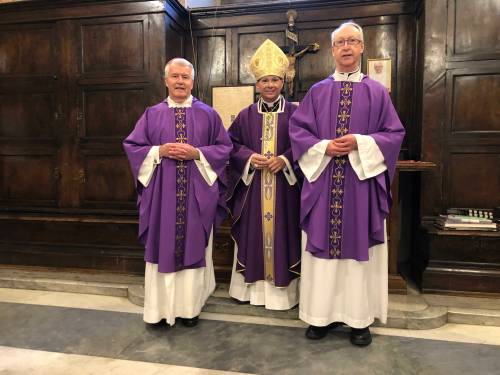
The five — Raymond Poisson of Quebec and president of the Canadian Conference of Catholic Bishops, William McGrattan of Calgary and CCCB vice-president, Richard Smith of Edmonton, Donald Bolen of Regina, Richard Gagnon of Winnipeg and Anthony Krótki of Churchill-Hudson Bay — accompanied the Inuit, First Nations and Métis delegations when they told the Pope about the terrible impact of Roman Catholic Church-operated residential schools on their lives.

Their words about the church’s involvement in the schools were harsh and hard — stories of abuse, shame and despair, and the long-lasting and traumatic effects on the families to this day.
Through it all, I wondered: how were the bishops feeling? What was it like to sit in the room with the Pope, and later at the press briefings, and hear over and over again the stories of what those long-ago fellow priests and others had done to little children?
After all, the bishops weren’t there. They didn’t start the schools or work at them. It couldn’t have been easy to sit quietly and be told day after day how awful your church was to Indigenous people for hundreds of years.
“It’s true, we didn’t build or operate the schools,” said Archbishop Bolen. “But we bear the burden and responsibility for them today.”
“We have to own our past,” said Archbishop Gagnon. “The light and the shade.”
What helped them deal with that burden was knowing they played a part in helping to create the road that led to the meetings with the Pope.
That road started in 2016, after the release of the Truth and Reconciliation Commission report. That’s when the CCCB made its initial contact with national Indigenous leaders.
“We really didn’t have relationships with national Indigenous organizations before that,” said Archbishop Bolen. “All relationships with Indigenous people before that were on the local level.”
The first visit to Rome was planned for 2020. It was postponed by the pandemic, as was a second attempt in December, last year.
Before coming to Rome, none of them knew what the Pope might say in response to the stories told by the delegates. So they were grateful to hear his expression of sorrow, sadness, indignation and shame.
While the Pope’s personal apology was very important, they recognize it was just a step along the way of the healing journey.
For Archbishop McGrattan, the visits and the apology were “like a seed, but it can bear the fruit of healing and forgiveness,” something that can be part of the “path to repair the injustices of the past.”
Just as important as the apology for the bishops was a chance to spend the week getting to know the delegates from across the country — talking, sharing and becoming friends.
“It was a week of building relationships, of expressing our desire to walk with them in healing and reconciliation,” Archbishop Bolen said, adding “It was an enormous privilege to be present as they shared their stories with the Holy Father.”
Said Archbishop Smith: “During the week a number of delegates came to me and said now we are brothers, now we need to not let the past define us, we can move forward together.”
Those words moved him, as did hearing the Pope say “the church stands with you, the church is on your side.”
The bishops echoed that pledge.
“I hope our time together gave Indigenous people confidence that we are committed to truth, justice, healing and reconciliation,” said Archbishop McGrattan.
When discussions with national leaders first started, “we didn’t know where path would take us,” he said. “Now, the Pope’s words need to be followed by action for healing at local levels all across Canada.”
One of those actions is their commitment to assisting in the release of any records and documents about residential schools held by the church or the religious orders. “We have a profound desire to assist in whatever way we can,” said Archbishop Bolen.

Regarding the Pope’s hint that he would like to celebrate the feast day of Saint Anne, July 26, with Indigenous people in Canada, they said that’s possible — but nothing is certain until the Vatican makes a decision.
At the same time, it is important to ensure input from Indigenous people into the visit, they said.
Like anyone else, they appreciated being recognized by their “boss” for good work. When the Pope praised the work of the Canadian bishops during his final audience for making the visits possible, “it was a real boost, an encouragement,” said Archbishop Bolen.
Looking ahead to the task facing Canadian Catholics, the Archbishop added: “We want to transform the church in Canada at a deep level. The apology from the Pope is a good place to start. This is a chance to build a new narrative for relations between the Catholic Church and Indigenous people, and for all Canadians.”
faith@freepress.mb.ca
The Free Press is committed to covering faith in Manitoba through our Religion in the News project. This reporting continues because readers like you step forward to fund it.
Donate now to support our reporting on religion.
Your donation is eligible for a charitable tax receipt.
BECOME A FAITH JOURNALISM SUPPORTER
Our newsroom depends on a growing audience of readers to power our journalism. If you are not a paid reader, please consider becoming a subscriber.
Our newsroom depends on its audience of readers to power our journalism. Thank you for your support.
The Free Press is committed to covering faith in Manitoba through our Religion in the News project. This reporting continues because readers like you step forward to fund it.
Donate now to support our reporting on religion.
Your donation is eligible for a charitable tax receipt.
BECOME A FAITH JOURNALISM SUPPORTER
Our newsroom depends on a growing audience of readers to power our journalism. If you are not a paid reader, please consider becoming a subscriber.
Our newsroom depends on its audience of readers to power our journalism. Thank you for your support.
Advertisement Advertise With Us
Advertisement Advertise With Us
The Free Press acknowledges the financial support it receives from members of the city’s faith community, which makes our coverage of religion possible.