Sturgeon stencils reminder of hydro effect on north

Advertisement

Advertise with us

MAYBE you’ve seen them around Winnipeg, blue fish stencilled on hydro poles, and wondered: What’s that about?

Read this article for free:


or

Already have an account? Log in here »

To continue reading, please subscribe:

Subscribe and receive a limited-edition Free Press branded hat or tote.

Digital Subscription

One year of digital access for only $205*

  • Enjoy unlimited reading on winnipegfreepress.com
  • Read the E-Edition, our digital replica newspaper
  • Access News Break, our award-winning app
  • Play interactive puzzles

*First annual payment billed as $205.00 + GST for one year. This annual subscription will automatically renew at $233.00 + GST every 52 weeks (10% off the regular annual price of $259.35). Offer available to new and qualified returning subscribers only. Cancel any time.

To continue reading, please subscribe:

Add Free Press access to your Brandon Sun subscription for only an additional

$1 for the first 4 weeks*

  • Enjoy unlimited reading on winnipegfreepress.com
  • Read the E-Edition, our digital replica newspaper
  • Access News Break, our award-winning app
  • Play interactive puzzles
Start now

*Your next Brandon Sun subscription payment will increase by $1.00 and you will be charged $17.95 plus GST for four weeks. After four weeks, your payment will increase to $24.95 plus GST every four weeks.

Hey there, time traveller!
This article was published 12/07/2022 (1525 days ago), so information in it may no longer be current.

MAYBE you’ve seen them around Winnipeg, blue fish stencilled on hydro poles, and wondered: What’s that about?

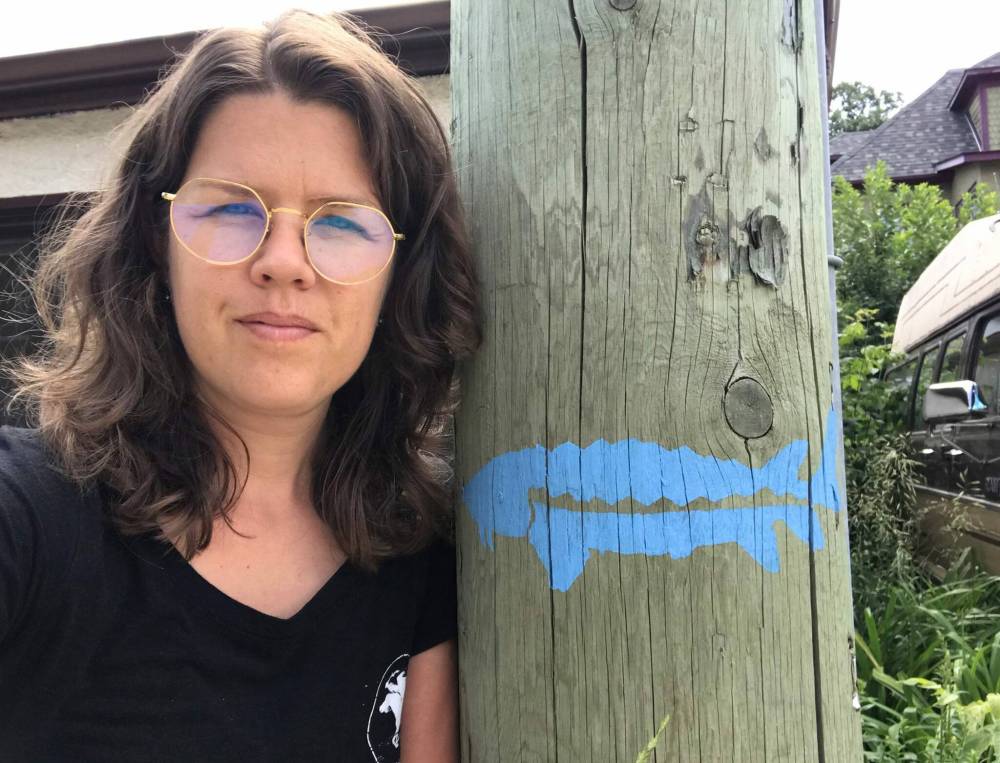
The fish are sturgeon, and they were put there by members of the Interchurch Council on Hydropower as a way to remind Winnipeggers where their electricity comes from — from dams in the northern part of the province.

“We want to draw a connection between the South and North and remind people of the great impacts of the dams on the people, ecosystems and watersheds in the North,” said council member Amanda Leighton.
SUPPLIED
Amanda Leighton, of the interchurch council, with a sturgeon stencilled on a hydro pole.
SUPPLIED Amanda Leighton, of the interchurch council, with a sturgeon stencilled on a hydro pole.

Leighton, who came up with the idea, was inspired by the “Press On” bird stencils found throughout the city.

She modelled the project after salmon stencils that are painted on street drains in B.C. towns and cities to remind people that whatever goes into the drain ends up in the rivers and ocean.

“Most people don’t know about the impact of the dams on people in the North,” she said, noting that some communities were forcibly removed and people lost their livelihoods.

As for why a it’s a sturgeon on the stencil, that’s because the fish is imperilled by the dams, especially on the Lower Churchill River.

These fish, she said, need deep water and lots of space to reproduce, something they only do many years after birth.

“There’s not enough water on the river for them to spawn freely,” she said. “The water is low because so much is diverted to the Nelson River to supply the hydroelectric dam. The river is de-watered most of the time.”

Before hydro development, she said, the Lower Churchill River was fast-moving, with lots of water. Since the completion of the Churchill River Diversion in 1974, that 500-kilometre stretch of the river has been reduced to a trickle.

As well, she noted, many Indigenous people feel connected to the sturgeon socially and spiritually, and the fish is revered by many Indigenous people in Canada.

In the past, when sturgeon were plentiful, it was also a staple for many Indigenous people with one large fish feeding a whole family, she said.

There are about 400 sturgeon stencils on hydro poles in the city, mostly along Henderson Highway, in The Exchange and in the Wolseley and Luxton neighbourhoods. They have been put there by volunteers from the council and from the Manitoba Energy Justice Coalition.

“Our goal is to show we are inter-connected with what we consume,” Leighton said. “Our hope is that the sturgeon symbol will broaden our lens and remind us that we are all in this together.”

faith@freepress.mb.ca

The Free Press is committed to covering faith in Manitoba through our Religion in the News project. This reporting continues because readers like you step forward to fund it.

Donate now to support our reporting on religion.

Your donation is eligible for a charitable tax receipt. BECOME A FAITH JOURNALISM SUPPORTER

John Longhurst

John Longhurst
Faith columnist & reporter

John Longhurst has been writing for Winnipeg's faith pages since 2003. He also writes for Religion News Service in the U.S., and blogs about the media, marketing and communications at Making the News.

Our newsroom depends on a growing audience of readers to power our journalism. If you are not a paid reader, please consider becoming a subscriber.

Our newsroom depends on its audience of readers to power our journalism. Thank you for your support.

Report Error Submit a Tip

The Free Press acknowledges the financial support it receives from members of the city’s faith community, which makes our coverage of religion possible.


More Stories

Bombers bring A-game in avenging Labour Day loss

Taylor Allen 7 minute read Preview

Bombers bring A-game in avenging Labour Day loss

Taylor Allen 7 minute read Yesterday at 7:11 PM CDT

This season hasn’t been overly pretty at times for the Winnipeg Blue Bombers.

But if they’ve proven anything over their last four games, including Saturday’s 19-6 Banjo Bowl victory over the Saskatchewan Roughriders, it’s that they’re capable of beating the CFL’s best when they come to play.

“The sky’s the limit for this team. We can hang with anyone, and we know that,” said receiver Tommy Nield. “It’s just a matter of being consistent and playing team football.”

The Bombers, now 7-6, avenged their Labour Day Classic loss and won the season series with the Riders (8-5) thanks to point differential in their head-to-head meetings.

Read
Yesterday at 7:11 PM CDT

Port of Churchill expansion could chase belugas away, U of M researcher says

Nicole Buffie 4 minute read Preview

Port of Churchill expansion could chase belugas away, U of M researcher says

Nicole Buffie 4 minute read Yesterday at 9:07 AM CDT

As plans to expand the Port of Churchill into a four-season trade corridor gathers momentum, a University of Manitoba researcher has published a report on what ship traffic could mean for the beluga whales that gather in the Churchill River estuary each summer.

Veronica Coppolaro said more vessels in the waterways bring a risk that belugas will stop using the estuary for migration, which would impact the ecological landscape, tourism and communities that rely on the animals for food and cultural purposes.

“There are studies showing that (noises) change the way they swim, they change the way (the whales) are vocalizing, they change their main activity, and so this (expansion) can have consequences at different levels,” she said.

The Churchill river estuary is a marine habitat where the Churchill River empties into Hudson Bay. During the summer months belugas gather in the area to feed and give birth.

Read
Yesterday at 9:07 AM CDT

50 years ago, we thought we could change the world

Robert Milan and Miriam Cooley 8 minute read Preview

50 years ago, we thought we could change the world

Robert Milan and Miriam Cooley 8 minute read 2:00 AM CDT

Winnipeg, 50 years ago.

We began as a small loose unorganized group of teaching friends and educators who shared the same political and social convictions.

We defined ourselves as socialists, feminists and political activists. We were a cross section of educational minds — language arts and social studies teachers, an art teacher, an early childhood educator, a Winnipeg school trustee, a school principal — making our group quite representative of school culture at the time.

Our questions and discussions about politics, education and society arose from a diversity of backgrounds, yet reflected a progressive cohesiveness. The political climate in Manitoba helped bring us together. Sterling Lyon was premier and his Conservative government was pursuing policies that we strongly opposed. To us, his government represented a determined assault on many of the social and political values we believed in, particularly related to education. Eventually we decided that perhaps we should do more than talk. And so the Socialist Teachers Education Movement — STEM — was born.

Read
2:00 AM CDT

The port of Churchill — but done right

Editorial 4 minute read Preview

The port of Churchill — but done right

Editorial 4 minute read Saturday, Sep. 12, 2026

The seagoing grain carrier wasn’t christened with a champagne bottle. There was no confetti or streamers. Nevertheless, the Aug. 31 event marking the first shipment of grain to be loaded at the Port of Churchill since 2020 was celebrated like the launch of a brand new vessel.

The presence of the federal minister of northern and arctic affairs, provincial cabinet ministers and leaders and elders from several northern First Nations signalled that the fast-tracked process of refurbishing and buffing up Manitoba’s deep-water seaport gem is gaining momentum.

For OneNorth, the partnership of 29 First Nations and 12 northern communities which owns the Port of Churchill and the Hudson Bay Railway (both operated by the Arctic Gateway Group) the event heralded a new beginning. It’s been eight years since OneNorth purchased the port and railroad, and six years since grain was moved by rail through Manitoba and then by ship to European markets. Two more grain shipments, plus shipments of potash and critical minerals, will continue through the fall.

When Prime Minister Mark Carney solicited the premiers to suggest “nation-building” projects following his election in 2025, Premier Wab Kinew pitched a Manitoba trade corridor that would move wheat, critical minerals, potash and energy (oil or liquid natural gas) through the Port of Churchill.

Read
Saturday, Sep. 12, 2026

Letters, Sept. 14

7 minute read 2:00 AM CDT

Transit troubles and passes

Re: Growing pains? Maybe, but it’s worth it, Think Tank, Sept. 10.

Worth it for who? Our transit system has been undergoing growing pains for the past year, ever since city staff completely messed up the system with their redesign.

The net result of those changes is reduced ridership, leading to a projected deficit of $18 million in revenues this year (not including the capital costs of those changes). Add that to the annual $126-million subsidy to operate Winnipeg Transit and that’s $144 million being paid annually by Winnipeg taxpayers.

Fathers united by loss share warning about dangers of fentanyl

Marsha McLeod 5 minute read Preview

Fathers united by loss share warning about dangers of fentanyl

Marsha McLeod 5 minute read Yesterday at 7:30 PM CDT

Harlan James Edward Fourre would have turned 35 on Sunday.

But instead of celebrating his birthday, Fourre’s father organized a sombre walk through downtown Winnipeg to commemorate his son and the many others who have died of fentanyl poisoning.

Three and a half years ago, Harlan Fourre took a recreational drug he believed was ecstasy but turned out to contain fentanyl, which killed him, said his father Joseph Fourre, a Red River Métis citizen, actor and filmmaker.

Fourre said his son was a master roofer, working on a job in The Pas around the time of his death. He wasn’t known to use drugs — in fact, his boss relayed that if someone pulled out an illicit substance at the end of a job, Harlan’s response would be: “no thanks, I’m good.”

Read
Yesterday at 7:30 PM CDT