Ukrainian scholar spending year in Winnipeg
Historian researching at Mennonite Heritage Centre on CMU campus

Advertisement
Read this article for free:
or
Already have an account? Log in here »
To continue reading, please subscribe:

Digital Subscription
One year of digital access for only $205*
- Enjoy unlimited reading on winnipegfreepress.com
- Read the E-Edition, our digital replica newspaper
- Access News Break, our award-winning app
- Play interactive puzzles
*First annual payment billed as $205.00 + GST for one year. This annual subscription will automatically renew at $233.00 + GST every 52 weeks (10% off the regular annual price of $259.35). Offer available to new and qualified returning subscribers only. Cancel any time.
To continue reading, please subscribe:
Add Free Press access to your Brandon Sun subscription for only an additional
$1 for the first 4 weeks*
- Enjoy unlimited reading on winnipegfreepress.com
- Read the E-Edition, our digital replica newspaper
- Access News Break, our award-winning app
- Play interactive puzzles
*Your next Brandon Sun subscription payment will increase by $1.00 and you will be charged $17.95 plus GST for four weeks. After four weeks, your payment will increase to $24.95 plus GST every four weeks.
Read unlimited articles for free today:
or
Already have an account? Log in here »
Hey there, time traveller!
This article was published 24/09/2022 (1469 days ago), so information in it may no longer be current.
Prevented by the war in Ukraine from undertaking historical research closer to home, a Ukrainian scholar studying Mennonite history is spending a year at a Winnipeg archives instead.
For her research into Mennonite life during czarist Russia, world history professor Nataliya Venger is scrolling through rolls of microfilm housed at the Mennonite Heritage Centre on the campus of Canadian Mennonite University.
“This place is exactly where I should be,” the professor at Dnipro National University explains during a break from her research.
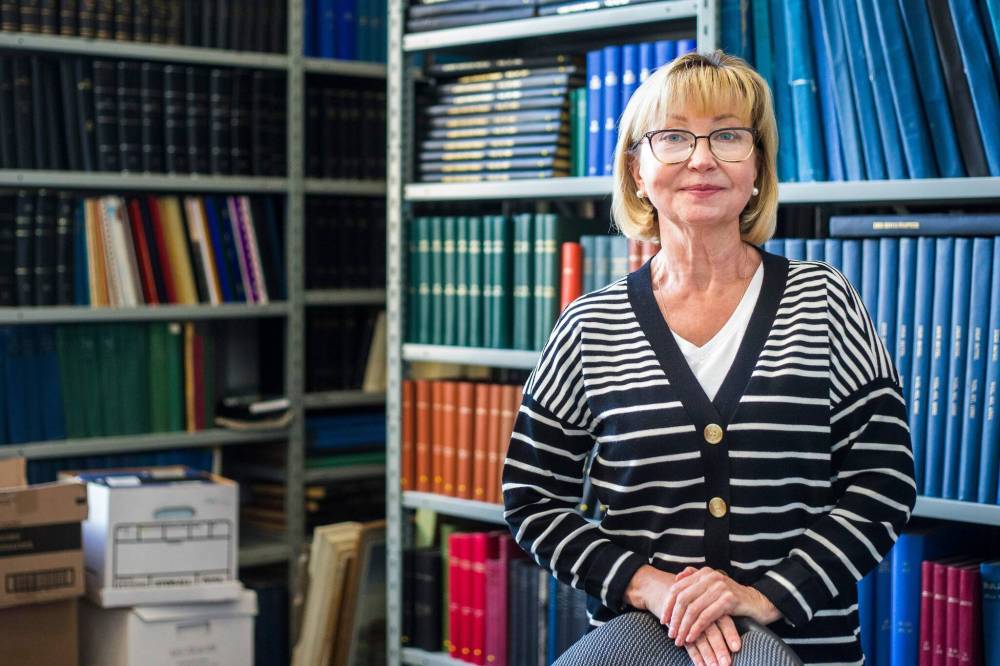
“I have friends, I have community, I have the archives, I have my life here.”
On sabbatical from teaching duties, Venger arrived in Winnipeg in June after leaving her city on a refugee train. She plans to spend nine more months researching 19th century Mennonite entrepreneurs in southern Russia, now part of Ukraine.
Although much of that material would be available in Russian archives, currently it is inaccessible to Ukrainian scholars like Venger because of the ongoing war between Russia and Ukraine. Thanks to North American Mennonites who microfilmed materials in Russian archives after the fall of the Soviet Union, some of that archival material is available in Winnipeg, says Aileen Friesen, history professor at the University of Winnipeg.
“All of these archives are in danger and these microfilms (in Winnipeg) are the only access to this material,” explains Friesen, executive director of the Plett Foundation, which funds Mennonite historical research.
“These microfilm archives are being revived because of the war in Ukraine.”
Ancestors of many Manitoba Mennonites lived in what is now Ukraine during the 18th and 19th centuries and many thousands left for North America in waves of immigration that began in the 1870s. After the fall of the Soviet Union, descendants of those immigrants returned to Ukraine as tourists, curious about the geography and history of former Mennonite settlements, says Venger, head of her university’s Centre on German-Ukrainian Studies.
“Mennonites quickly showed they came to Ukraine not to take, but to give,” she says of several charities and organizations set up by North American Mennonites for the well-being of Ukrainians.
Those collaborative relationships extend to the academic world, says Friesen, who is sponsoring Venger’s year in Winnipeg with funding from the Plett Foundation, based at the University of Winnipeg, where Venger was also appointed visiting professor.
“We’re happy to help her and highly value her scholarship,” she says.
“We also wanted to give her a safe place to work.”
These days, Venger’s time poring over microfilmed documents at the Mennonite archives on the campus of Canadian Mennonite University are punctuated by alerts on her cellphone of shelling in Dnipro, which is eight hours ahead of Winnipeg. She’s also concerned about her husband, a lawyer, who stayed behind to volunteer with the Ukrainian army.
“Every night there are missiles,” says Venger about ongoing attacks, which pushed university courses online because there aren’t enough bomb-proof places on campus to hold them in person.
“I have two or three alerts at night.”
Ironically, her research focuses on how Mennonites, who were German settlers on Russian territory, fared under increased Russian nationalism during the 19th century, a topic that might now resonate with her fellow Ukrainians. Although nationalism can unite a country’s citizens around common goals, she says extreme Russian nationalism is a factor in the invasion of Ukraine.

“Ukrainians got a strong sense of nationalism after independence,” says Venger of the positive influence of nationalism.
For now, Venger continues to pursue her research, supervise her Ukraine-based graduate students virtually, and cling onto hope that she can return to an independent Ukraine in 2023.
“A person in my situation needs faith,” says Venger, who relies on the rituals of her Ukrainian Orthodox tradition to fuel her hopes for her country’s future and well-being.
“Everyone needs faith. I need faith.”
brenda@suderman.com
The Free Press is committed to covering faith in Manitoba through our Religion in the News project. This reporting continues because readers like you step forward to fund it.
Donate now to support our reporting on religion.
Your donation is eligible for a charitable tax receipt.
BECOME A FAITH JOURNALISM SUPPORTER
Brenda Suderman has been a columnist in the Saturday paper since 2000, first writing about family entertainment, and about faith and religion since 2006.
Our newsroom depends on a growing audience of readers to power our journalism. If you are not a paid reader, please consider becoming a subscriber.
Our newsroom depends on its audience of readers to power our journalism. Thank you for your support.
The Free Press is committed to covering faith in Manitoba through our Religion in the News project. This reporting continues because readers like you step forward to fund it.
Donate now to support our reporting on religion.
Your donation is eligible for a charitable tax receipt.
BECOME A FAITH JOURNALISM SUPPORTER
Brenda Suderman has been a columnist in the Saturday paper since 2000, first writing about family entertainment, and about faith and religion since 2006.
Our newsroom depends on a growing audience of readers to power our journalism. If you are not a paid reader, please consider becoming a subscriber.
Our newsroom depends on its audience of readers to power our journalism. Thank you for your support.
Related Articles
Refugees settle in; pleas issued for more housing funds

Advertisement Advertise With Us
Advertisement Advertise With Us
The Free Press acknowledges the financial support it receives from members of the city’s faith community, which makes our coverage of religion possible.