Faith by the numbers
A StatCan study shows percentage of Canadians identifying as Christian continues to fall

Advertisement
Read this article for free:
or
Already have an account? Log in here »
To continue reading, please subscribe:

Digital Subscription
One year of digital access for only $205*
- Enjoy unlimited reading on winnipegfreepress.com
- Read the E-Edition, our digital replica newspaper
- Access News Break, our award-winning app
- Play interactive puzzles
*First annual payment billed as $205.00 + GST for one year. This annual subscription will automatically renew at $233.00 + GST every 52 weeks (10% off the regular annual price of $259.35). Offer available to new and qualified returning subscribers only. Cancel any time.
To continue reading, please subscribe:
Add Free Press access to your Brandon Sun subscription for only an additional
$1 for the first 4 weeks*
- Enjoy unlimited reading on winnipegfreepress.com
- Read the E-Edition, our digital replica newspaper
- Access News Break, our award-winning app
- Play interactive puzzles
*Your next Brandon Sun subscription payment will increase by $1.00 and you will be charged $17.95 plus GST for four weeks. After four weeks, your payment will increase to $24.95 plus GST every four weeks.
Read unlimited articles for free today:
or
Already have an account? Log in here »
Hey there, time traveller!
This article was published 11/11/2022 (1421 days ago), so information in it may no longer be current.
A faithful reader of this column often contacts me to ask why I keep writing about the decline of organized Christianity in Canada.
The answer is simple: Because that’s what’s happening — as the most recent Statistics Canada report about religion in Canada makes plain.
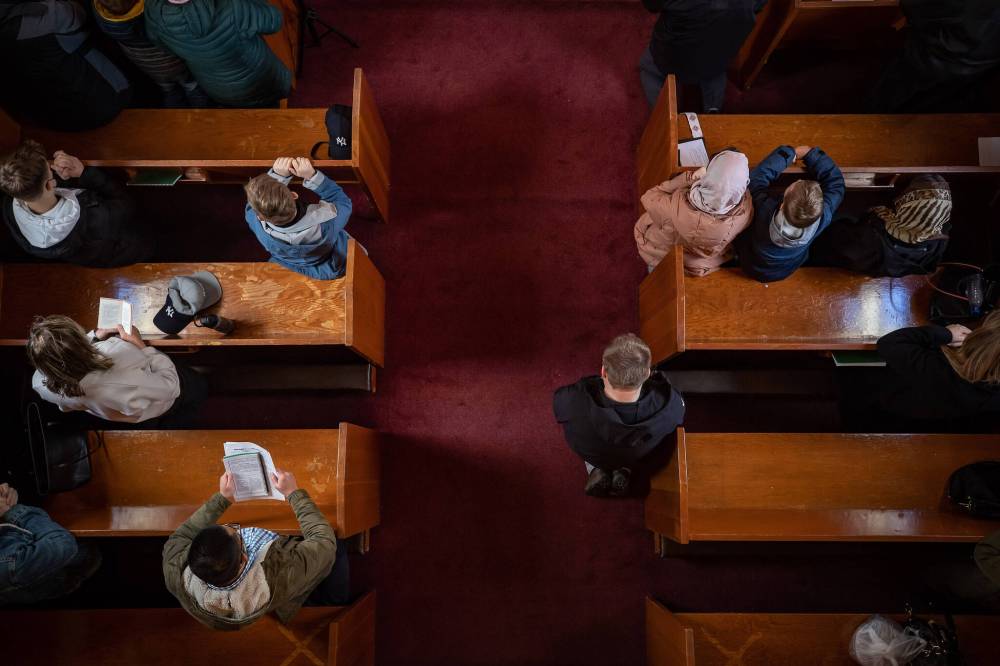
The report, based on the 2021 census, found that 53.3 per cent of Canadians identified as Christians. This is down from 67.3 per cent in 2011 and 77.1 per cent in 2001.
DARRYL DYCK / THE CANADIAN PRESS FILES
A recent Statistics Canada report about religion in Canada, based on the 2021 census, found that 53.3 per cent of Canadians identified as Christians. That is down from 67.3 per cent in 2011 and 77.1 per cent in 2001.
Of those who identify as Christians, about 30 per cent are Catholic (down from 39 per cent in 2011), 3.3 per cent are involved with the United Church (6.1 per cent), 3.1 per cent are Anglican (five per cent), 0.9 per cent are Lutherans (1.4 per cent), 0.8 per cent are Presbyterians (1.4 per cent), 1.2 per cent are Baptist (1.9 per cent) and 1.1 per cent are Pentecostal (1.5 per cent). The number of Canadians identifying as Christian Orthodox was the same in 2021 as in 2011 at 1.7 per cent.
“Other Christian” — the group into which Statistics Canada lumps all the other self-reported denominations — rose to 11.2 per cent from 9.2 per cent.
At the same time, 34.6 per cent of Canadians reported they have no religious affiliation — the so called “nones,” up from 16.5 per cent in 2001 and 23.9 per cent in 2011.
Meanwhile, the proportion of Canada’s population that reported being Muslim, Hindu or Sikh has more than doubled from 2001 to 2021. The Muslim community grew from two per cent to 4.9 per cent; Hindus grew from one per cent to 2.3 per cent; and Sikhs grew from 0.9 per cent to 2.1 per cent. Much of that growth is due to immigration.
Here in Manitoba, 54.2 per cent of residents identified as Christians, while 36.7 per cent reported having no religious affiliation — slightly higher than the national average.
Within the province, 21 per cent of Manitobans call themselves Catholic (down from 26.4 per cent in 2011), 5.8 per cent are United Church (11.1 per cent), 3.3 per cent are Anglican (5.7 per cent), 2.1 per cent are Lutheran (3.5 per cent), Presbyterians make up 0.4 per cent (0.8 per cent), Baptists make up 1.1 per cent (1.7 per cent) and Pentecostals 1.6 per cent (1.9 per cent). “Other Christian” is at 17.5 per cent (up from 16.1 per cent).
In Saskatchewan, 56.3 per cent of the population reported following a Christian religion and 36.6 per cent reported having no religious affiliation. Meanwhile, in Alberta — which we tend to think of as a conservative Bible belt — 48.1 per cent of people say they are Christian, while 40.1 per cent said they are “nones.”
While the decline in Christianity doesn’t surprise scholars who study religion in Canada, when I spoke to some of them recently they did express surprise at the quick and large increase in the number of “nones.”
Why so quickly? That’s a good question; the scholars are looking forward to digging into the data to find out more.
There are theories. Maybe some of the “nones” are people who were culturally religious but never attended worship services anyway. In this census they just decided to make it official.
Others may have decided to turn away from organized religion because of the church’s participation in the residential school system, involvement in sex scandals, or views and treatment of the LGBTQ2+ community.

Jeff McIntosh / THE CANADIAN PRESS FILES
The proportion of Canada’s population that identifies as Muslim grew from two per cent in 2001 to 4.9 per cent in 2021.
It could also be due to the earlier drop-off in religious interest by the baby boom generation. If they didn’t take their kids to church, it’s a fair bet those kids won’t go to church as adults, either — and neither will their children.
A few observations about the report:

First, since the census was conducted last year when the pandemic was at its height and in-person attendance at religious services was curtailed, it’s uncertain how that plays into the findings. Did the break cause some people to re-evaluate their religious commitments and decide they really weren’t all that interested in religion, after all? Perhaps.
Second, it’s important to once again note that people who call themselves “nones” are not necessarily atheist or agnostic, although those people are included in the category. Some consider themselves to be very spiritual; they just aren’t interested in identifying with a religious group.
Third, the findings don’t measure attendance, just identification. Despite the statistics, some churches may in fact be growing in numbers.
At the end of the day, one thing is clear: Organized Christianity is in decline in Canada. I hope even my faithful reader friend can acknowledge that.
faith@freepress.mb.ca
The Free Press is committed to covering faith in Manitoba through our Religion in the News project. This reporting continues because readers like you step forward to fund it.
Donate now to support our reporting on religion.
Your donation is eligible for a charitable tax receipt.
BECOME A FAITH JOURNALISM SUPPORTER
Our newsroom depends on a growing audience of readers to power our journalism. If you are not a paid reader, please consider becoming a subscriber.
Our newsroom depends on its audience of readers to power our journalism. Thank you for your support.
The Free Press is committed to covering faith in Manitoba through our Religion in the News project. This reporting continues because readers like you step forward to fund it.
Donate now to support our reporting on religion.
Your donation is eligible for a charitable tax receipt.
BECOME A FAITH JOURNALISM SUPPORTER
Our newsroom depends on a growing audience of readers to power our journalism. If you are not a paid reader, please consider becoming a subscriber.
Our newsroom depends on its audience of readers to power our journalism. Thank you for your support.
Advertisement Advertise With Us
Advertisement Advertise With Us
The Free Press acknowledges the financial support it receives from members of the city’s faith community, which makes our coverage of religion possible.