Anti-abortion group sues over Minneapolis clinic ordinance

Advertisement

Advertise with us

MINNEAPOLIS (AP) — An anti-abortion group sued the city of Minneapolis on Wednesday to overturn an ordinance that prohibits the obstruction of entrances and driveways to abortion clinics, saying it's an unconstitutional violation of free speech and freedom of religion.

Read this article for free:


or

Already have an account? Log in here »

To continue reading, please subscribe:

Subscribe and receive a limited-edition Free Press branded hat or tote.

Digital Subscription

One year of digital access for only $205*

  • Enjoy unlimited reading on winnipegfreepress.com
  • Read the E-Edition, our digital replica newspaper
  • Access News Break, our award-winning app
  • Play interactive puzzles

*First annual payment billed as $205.00 + GST for one year. This annual subscription will automatically renew at $233.00 + GST every 52 weeks (10% off the regular annual price of $259.35). Offer available to new and qualified returning subscribers only. Cancel any time.

To continue reading, please subscribe:

Add Free Press access to your Brandon Sun subscription for only an additional

$1 for the first 4 weeks*

  • Enjoy unlimited reading on winnipegfreepress.com
  • Read the E-Edition, our digital replica newspaper
  • Access News Break, our award-winning app
  • Play interactive puzzles
Start now

*Your next Brandon Sun subscription payment will increase by $1.00 and you will be charged $17.95 plus GST for four weeks. After four weeks, your payment will increase to $24.95 plus GST every four weeks.

Hey there, time traveller!
This article was published 05/04/2023 (1280 days ago), so information in it may no longer be current.

MINNEAPOLIS (AP) — An anti-abortion group sued the city of Minneapolis on Wednesday to overturn an ordinance that prohibits the obstruction of entrances and driveways to abortion clinics, saying it’s an unconstitutional violation of free speech and freedom of religion.

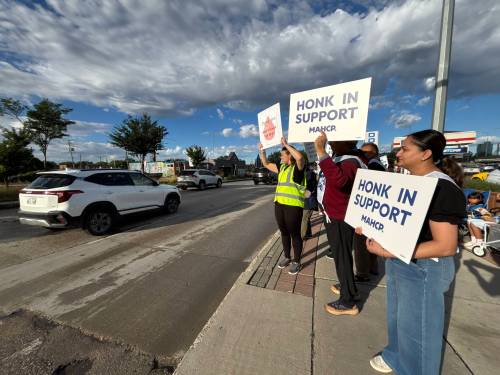
The ordinance, which was enacted in November, was designed to protect patients of the Planned Parenthood clinic in the Uptown neighborhood from “sidewalk counselors” who try to dissuade them from getting abortions. Pro-Life Action Ministries and several of its staff members filed the challenge in federal court, arguing that the ordinance was a deliberate effort to stifle them.

“The ministry of pro-life sidewalk counseling is a peaceful interaction with pregnant woman to convey life-affirming alternatives to abortion,” Erick Kaardal, an attorney for the group, said in a statement. “Yet the City of Minneapolis has specifically enacted an ordinance designed to prevent any success at conducting this peaceful interaction by Pro-Life Action Ministries, its staff members or volunteers, and any others involved in similar activities.”

Planned Parenthood officials told the City Council in November that protesters outside the Minneapolis clinic had become more numerous and aggressive since the U.S. Supreme Court last summer overturned the Roe v. Wade decision. Security video showed protesters approaching cars with pamphlets and two people with umbrellas getting into an altercation.

“There is no such thing as abortion rights without access,” Council Member Lisa Goodman, the ordinance author, told the council the day the ordinance passed. She said she was confident it would survive a legal challenge.

Planned Parenthood said the ordinance was needed to protect safety in the busy neighborhood.

“We stand by the necessity and constitutionality of the ordinance,” Tim Stanley, executive director of Planned Parenthood Minnesota, North Dakota, South Dakota Action Fund, said in a statement. “The ordinance balances the rights of patients, staff, community and protestors. Everyone should be able to get health care, go to the grocery store, drive in their neighborhood and exercise their First Amendment rights.”

Mayor Jacob Frey agreed. “This is not about limiting free speech, it’s about protecting community members from being physically disrupted while seeking the reproductive care they need and deserve,” he said in a statement.

The complaint said PLAM’s counselors walk up to women entering the clinic via the sidewalk or flag down cars entering the parking lot, then attempt to offer help, prayers and information on alternatives to abortion, believing it is their religious duty.

The complaint acknowledged that these actions delay women from entering the clinic, but denied blocking them. It said their actions have led thousands of women to change their minds about getting abortions and that they planned to violate the ordinance. Violations are misdemeanors, so they face a credible threat of prosecution.

A 1994 federal law prohibits using “physical obstruction” to “intimidate or interfere with” people entering health care facilities. Since the late 1990s, the U.S. Supreme Court has heard several cases involving buffer zones outside abortion clinics. In 2014, the high court struck down a law that created a 35-foot protest-free zone outside Massachusetts clinics. Other cases have led to mixed results

In 2020, the justices rejected pleas from activists in Chicago and Harrisburg, Pennsylvania, to make it easier to protest outside clinics. In 2011, the high court declined to hear a Pittsburgh case, letting stand a lower court decision that said the city’s 15-foot buffer zone for protests did not apply to “calm and peaceful” one-on-one “sidewalk counseling.” A federal appeals court in December temporarily barred the enforcement of a Louisville, Kentucky, buffer zone ordinance.

According to the Guttmacher Institute, 12 states, including Minnesota, plus the District of Columbia, prohibit blocking entrances and exits at abortion clinic facilities.

Report Error Submit a Tip

The Free Press acknowledges the financial support it receives from members of the city’s faith community, which makes our coverage of religion possible.

More Stories

The election of our discontent: City at a crumbling crossroads, grumbling residents say in poll

Matthew Frank 7 minute read Preview

The election of our discontent: City at a crumbling crossroads, grumbling residents say in poll

Matthew Frank 7 minute read Updated: Yesterday at 3:16 PM CDT

There’s an undercurrent of unhappiness running through the Winnipeg electorate as the municipal election day approaches.

One-half of Winnipeggers believe the city is heading in the wrong direction, according to a new Abacus Data poll, with nearly one-third unsure if Winnipeg is regressing or progressing.

Only 21 per cent of residents believe the city is on the right track, the Free Press-commissioned poll found.

That discontentment extends to how the city spends its tax dollars, with four in 10 Winnipeggers believing they receive poor value for what they pay in property taxes.

Read
Updated: Yesterday at 3:16 PM CDT

Essential workers ruling raises questions

Editorial 4 minute read Preview

Essential workers ruling raises questions

Editorial 4 minute read 2:00 AM CDT

Ever been to a Dynacare clinic? Most of us have been. It’s an amazing demographic and ethnic slice of the city we’ve become. Old patients. Young patients. New arrivals. Long-time Canadians. People who know the ropes — others who are startled by the crowds and the noise and the lockstep forward motion of professionals doing what they have been trained to do. It seems, all at the same time, both chaotic and diagnostic, as names of patients are steadily called out and thousands of tests are performed.

But Dynacare is at the centre of a new kind of test and this time, we’re all in the test tube together.

It’s the first real test for new labour law put in place by the government of Premier Wab Kinew in 2024 — a law that redefined what essential services are for provincially-regulated workplaces. Under this law, companies and their employee and unions must have an agreement of which employees are essential — which ones must stay on the job during a legal strike for the protection of the health and safety of the public.

Dynacare had that kind of essential employee agreement with its staff and union — the company and the union had agreed the employees were not essential.

Read
2:00 AM CDT

Scare up some social reconnection this fall

Maureen Scurfield 4 minute read 2:00 AM CDT

DEAR MISS LONELYHEARTS: I’m an emotional mess. My lesbian girlfriend and I broke up in August, and now I hold the lease on the apartment we shared. It’s a great big old place with two spacious balconies.

I just got new roommates — two younger friends who really love it here — but secretly I’m still feeling lonely. Every minute of living here reminds me of my girlfriend because we decorated the place together and hung out on the balconies to sunbathe in the summer.

Would it help to move out of my beloved old block with its memory triggers? Maybe, but what if I died of loneliness in a new place? I need people around me, and no one but my ex-girlfriend has really been the right person. Please help. I feel sick about this.

— Love-Nest Sadness, Winnipeg

Clocks stay in daylight saving, but analysis backs permanent standard time

Ashley Joannou, The Canadian Press 5 minute read Preview

Clocks stay in daylight saving, but analysis backs permanent standard time

Ashley Joannou, The Canadian Press 5 minute read Updated: Yesterday at 6:15 AM CDT

VANCOUVER - Ralph Mistlberger's light is adjustable, allowing him to have the full spectrum of options depending on what his internal clock needs.

"You want cool in the morning. You want warm in the evening or warm in the afternoon," he said.

"And so, it goes from being more bluish in the morning to more reddish in the evenings. Both of those are important because artificial light affects your clock."

Mistlberger knows real sunlight is better than a lamp, but after more than 40 years as a neuroscientist studying sleep and the body's circadian rhythms, he's preparing for what's to come Nov. 1.

Read
Updated: Yesterday at 6:15 AM CDT

Mayoral candidates Klein, Vogiatzakis continue to snipe over inducement allegations

Chris Kitching and Joyanne Pursaga 6 minute read Preview

Mayoral candidates Klein, Vogiatzakis continue to snipe over inducement allegations

Chris Kitching and Joyanne Pursaga 6 minute read Updated: Yesterday at 5:50 PM CDT

Winnipeg mayoral candidate Mike Vogiatzakis told reporters Monday he will contact the city clerk to report his allegation that rival Kevin Klein offered him a job to drop out of the race.

Vogiatzakis and Klein both doubled down a day after accusing each other of offering the other a position at city hall, if they were victorious in the Oct. 28 election, in exchange for a withdrawal.

“Do I want to get him charged? Not really. I don’t want to destroy anybody’s life,” Vogiatzakis told reporters.

“Kevin’s a good guy. I thought he was a friend of mine, but he’s not. Kevin uses leverage to get ahead, and he tried to use me as leverage.”

Read
Updated: Yesterday at 5:50 PM CDT

Two hospitalized in Osborne Village assault

1 minute read Updated: Yesterday at 10:12 AM CDT

Two people are in hospital and another two are in police custody after a serious assault in Osborne Village early Monday morning.

Winnipeg Police Service spokesman Const. Pat Saydak said officers were called to the assault scene on Osborne Street near River Avenue just after midnight.

Two people were rushed to hospital, one in critical condition and the other in stable condition.

Two individuals, both adults, were arrested by police. There's no word yet on charges.