Black Protestant church still vital despite attendance drop
Advertisement
Read this article for free:
or
Already have an account? Log in here »
To continue reading, please subscribe:

Digital Subscription
One year of digital access for only $205*
- Enjoy unlimited reading on winnipegfreepress.com
- Read the E-Edition, our digital replica newspaper
- Access News Break, our award-winning app
- Play interactive puzzles
*First annual payment billed as $205.00 + GST for one year. This annual subscription will automatically renew at $233.00 + GST every 52 weeks (10% off the regular annual price of $259.35). Offer available to new and qualified returning subscribers only. Cancel any time.
To continue reading, please subscribe:
Add Free Press access to your Brandon Sun subscription for only an additional
$1 for the first 4 weeks*
- Enjoy unlimited reading on winnipegfreepress.com
- Read the E-Edition, our digital replica newspaper
- Access News Break, our award-winning app
- Play interactive puzzles
*Your next Brandon Sun subscription payment will increase by $1.00 and you will be charged $17.95 plus GST for four weeks. After four weeks, your payment will increase to $24.95 plus GST every four weeks.
Read unlimited articles for free today:
or
Already have an account? Log in here »
Hey there, time traveller!
This article was published 01/05/2023 (1257 days ago), so information in it may no longer be current.
COLUMBIA, S.C. (AP) — The wide empty spaces in pews between parishioners at a Sunday service at Zion Baptist Church in South Carolina’s capital highlight a post-pandemic reality common among many Black Protestant churches nationwide.
At its heyday in the 1960s, more than 1,500 parishioners filled every seat at Zion. But membership at the historic church — a crucial meeting point for many during the Civil Rights Movement — dwindled over recent decades.
The trend has been accelerated by the COVID-19 pandemic, which infected and killed Black Americans at a disproportionate rate. Zion’s attendance dropped from 300 parishioners before the outbreak to 125 now.
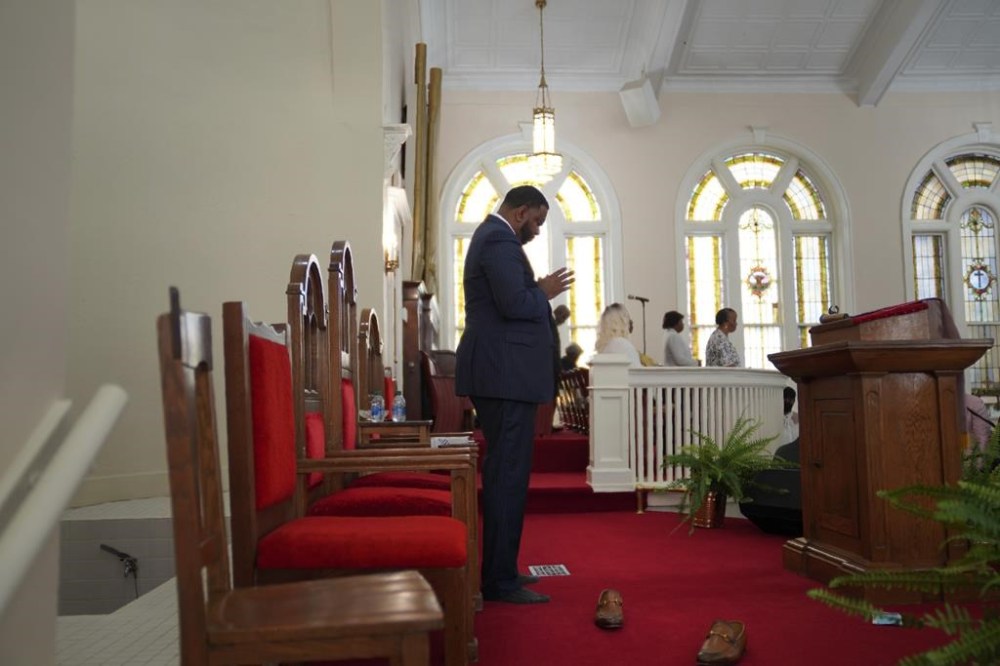
Founded in 1865 — the year Abraham Lincoln was assassinated — Zion still has a choir capable of beautiful singing, but it too has shrunk by more than half. The stomping of feet and the call-and-response of the leader and congregation have subsided from what they were before the pandemic.
“It saddens my heart,” said Calvernetta Williams, who has worshipped at Zion for 40 years. “What I really say to myself is, ‘Lord, the pastor has a lot of outreach to do, and so do we … because it’ll never be the same.”
Zion’s shrinking attendance is in line with a recent Pew Research Center survey; it found a significant attendance drop among Black Protestants that is unmatched by any other major religious group. The number of Black Protestants who say they attend services monthly has fallen from 61% in 2019 to 46% now, said Pew, and they are the only group in which more than half (54%) attend services virtually.
Zion broadcasts services online, produces digital content and is active on social media. But the Rev. M. Andrew Davis said his church’s virtual experience can’t match in-person interactions, including the smiles of children, and how sometimes older congregants share testimonials about how God healed them.
Davis’ sermon on a recent Sunday was titled: “Trust during times of trouble.” He recalled the pandemic as one the most challenging times in his church’s history – and offered words of hope.
“We may not ever go back to the way it was, but we can do better,” Davis told parishioners.
Black Americans — two-thirds of whom are Protestant — attend church more regularly than Americans overall, and pray more often, surveys show. But patterns of worship are shifting across generations: younger Black adults attend church less often than their elders, and those who attend are less likely to do so in a predominantly Black congregation.
“It’s imperative that we get our young people back,” said Donnie Mack, a deacon at Zion. “As we say in old churches — if you don’t see any young people, if you don’t hear any babies crying, then, you’re at a dying church.”
Several Black church leaders said it’s proved difficult to convince members to return for in-person worship. They note that many congregants are older, have inadequate access to health care, and hesitate to return to church for fear of catching a contagious illness.
A history of systemic racism and lack of economic opportunity made many Black Americans far more vulnerable to the virus. Black adults also suffer from higher rates of obesity, diabetes and asthma, making them more susceptible. They are also more likely to be uninsured.
Additionally, many Black working people had jobs deemed essential and were less able to work from home during the pandemic, raising concerns about exposing others in their often crowded households to the virus.
“The pandemic exasperated that,” said the Rev. Quardricos Driskell, pastor at Beulah Baptist Church in Alexandria, Virginia.
Attendance at his 160-year-old church dropped from a peak of more than 200 people who met in two Sunday services in the early 2000s, to less than half that at a single service.
“We’re lucky if we have 100 on any given Sunday,” Driskell said.
Driskell tries to reach young people by talking openly with them about issues including race, sexuality and gender identity.
“What does it mean to be gay, Christian and single?” he said. “How do we live out our lives authentically as human beings, but yet still maintaining levels of faith … those are messages that are resonating with younger people.”
Although his congregation has been welcoming to the LGBTQ community, Driskell said that historically that has not been the case for the Black church.
“The Black church is kind of grappling with and struggling with this idea of religious progressivism.”
Despite the attendance drop, academics, pastors and parishioners agree that churches remain fundamental to Black communities, providing refuge and hope, especially during times of challenge.
“No pillar of the African American community has been more central to its history, identity, and social justice vision than the ‘Black Church,’” Harvard scholar Henry Louis Gates Jr. wrote in ‘The Black Church,’ his companion volume to the PBS series.
“For a people systematically brutalized and debased by the inhumane system of slavery, followed by a century of Jim Crow racism, the church provided a refuge: a place of racial and individual self-affirmation, of teaching and learning, of psychological and spiritual sustenance, of prophetic faith,” he wrote.
Although there’s broad respect for the historical role of Black churches, including their crucial role fighting for racial equality, polls show that there’s also a perception among Black Americans that they have lost influence in recent decades.
“It still functions in the same way: It’s a source of hope for people who cannot hold on to political promises, they can’t necessarily go to the law and get the things that we need and give them the safety that we need,” said Tamura Lomax, professor of religious studies at Michigan State University who specializes in the Black church.
But attendance had been dwindling — even before the pandemic and the 2020 protests over racial justice — because the way people connected to the church had changed, Lomax said.
A pivotal moment came when the Black Lives Matter movement was founded. Its members, she said, embraced some of the African spirituality and religious practices that were taken from their ancestors during enslavement and rejected the Christ-centered movement that had been pivotal to the civil rights struggle.
“They didn’t want to carry the patriarchal kind of Black masculinity leadership model,” Lomax said.
During the pandemic, Black pastors used their influence to encourage vaccinations from the pulpit, while hosting testing clinics and vaccination events in church buildings.
“It has impacted our community pretty substantially,” said the Rev. Hewitt Clifton Sawyers at West Harpeth Primitive Baptist Church in Franklin, Tennessee. Attendance at the church dropped from about 150 people before COVID to about 80 now. “The people are just really, really afraid to come back.”
Sawyers said his church benefited from a rise in virtual attendance and online donations, which have financed a building renovation. Still, he lamented that many congregants have not returned in person.
“They’ve really gotten to the place that they can turn over in bed and flip on the television or their phone and watch the services, press a button, send their offerings and go back to sleep,” he said. “It’s hard to get them to want to come back to church.”
Although in-person numbers dropped, some Black Protestant churches have grown if one counts a rise in virtual attendance. That’s the case of Enon Baptist Tabernacle Church, which at 5,000 seats is one of Philadelphia’s largest Black churches.
“I believe it has shifted for the better,” said its pastor, the Rev. Alyn Waller. “Many of us have come up with the concept of virtual membership. I have people who belong to my church that don’t even live in Pennsylvania.”

The Rev. Eldren D. Morrison of Shaw Temple African Methodist Episcopal Zion Church in Georgia’s Cobb County, said in-person attendance plunged by half — from 400 to about 200 — since the virus outbreak. But the pandemic helped pastors like him rethink how to connect with their congregation.
“It’s teaching us that we’re not necessarily looking for numbers, but we’re looking for engagement,” Morrison said. “Whether that’s virtual, or whether that’s people in pews or whether it’s through some type of ministry involvement throughout the community, people are involved with the church and are growing their faith. And that’s what the mission is in the end anyway.” ___
Associated Press visual journalist Jessie Wardarski contributed.
___
Associated Press religion coverage receives support through the AP’s collaboration with The Conversation US, with funding from Lilly Endowment Inc. The AP is solely responsible for this content.
The Free Press acknowledges the financial support it receives from members of the city’s faith community, which makes our coverage of religion possible.