
United Methodists lose one-fifth of US churches in schism driven by growing defiance of LGBTQ bans

Advertisement

Advertise with us

More than 6,000 United Methodist congregations — a fifth of the U.S. total — have now received permission to leave the denomination amid a schism over theology and the role of LGBTQ people in the nation's second-largest Protestant denomination.

Read this article for free:


or

Already have an account? Log in here »

To continue reading, please subscribe:

Subscribe and receive a limited-edition Free Press branded hat or tote.

Digital Subscription

One year of digital access for only $205*

  • Enjoy unlimited reading on winnipegfreepress.com
  • Read the E-Edition, our digital replica newspaper
  • Access News Break, our award-winning app
  • Play interactive puzzles

*First annual payment billed as $205.00 + GST for one year. This annual subscription will automatically renew at $233.00 + GST every 52 weeks (10% off the regular annual price of $259.35). Offer available to new and qualified returning subscribers only. Cancel any time.

To continue reading, please subscribe:

Add Free Press access to your Brandon Sun subscription for only an additional

$1 for the first 4 weeks*

  • Enjoy unlimited reading on winnipegfreepress.com
  • Read the E-Edition, our digital replica newspaper
  • Access News Break, our award-winning app
  • Play interactive puzzles
Start now

*Your next Brandon Sun subscription payment will increase by $1.00 and you will be charged $17.95 plus GST for four weeks. After four weeks, your payment will increase to $24.95 plus GST every four weeks.

Hey there, time traveller!
This article was published 06/07/2023 (1196 days ago), so information in it may no longer be current.

More than 6,000 United Methodist congregations — a fifth of the U.S. total — have now received permission to leave the denomination amid a schism over theology and the role of LGBTQ people in the nation’s second-largest Protestant denomination.

Those figures emerge following the close of regular meetings in June for the denomination’s regional bodies, known as annual conferences. The departures began with a trickle in 2019 — when the church created a four-year window of opportunity for U.S. congregations to depart over LGBTQ-related issues — and cascaded to its highest level this year.

Church law forbids the marriage or ordination of “self-avowed, practicing homosexuals,” but many conservatives have chosen to leave amid a growing defiance of those bans in many U.S. churches and conferences.
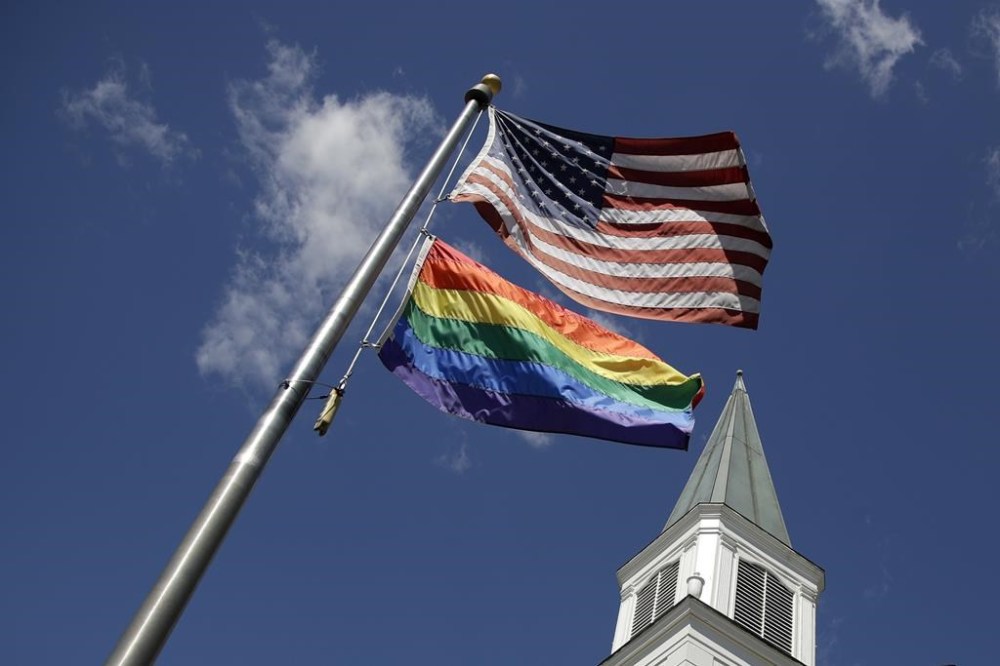
FILE - A gay Pride rainbow flag flies with the U.S. flag in front of the Asbury United Methodist Church in Prairie Village, Kan., on Friday, April 19, 2019. As of June 2023, more than 6,000 United Methodist congregations — a fifth of the U.S. total — have now received permission to leave the denomination amid a schism over theology and the role of LGBTQ people in the nation's second-largest Protestant denomination. (AP Photo/Charlie Riedel, File)

Many of the departing congregations are joining the Global Methodist Church, a denomination created last year by conservatives breaking from the UMC, while others are going independent or joining different denominations.

Some 6,182 congregations have received approval to disaffiliate since 2019, according to an unofficial tally by United Methodist News Service, which has been tracking votes by annual conferences. That figure is 4,172 for this year alone, it reported.

Some annual conferences may approve more departures at special sessions later this year, according to the Rev. Jay Therrell, president of the Wesleyan Covenant Association, a conservative caucus that has advocated for the exiting churches. While most UMC congregations are remaining, many of the departing congregations are large, and denominational officials are bracing for significant budget cuts in 2024.

The numbers of exiting churches are higher than conservatives originally estimated, Therrell said.

Legal wrangles have largely been resolved over how much compensation the departing congregations must pay for their property and other financial obligations.

“For the most part, bishops and other annual conference leaders have been very gracious, and I deeply appreciate that,” Therrell said. “There have been some small exceptions to that, and those are unfortunate, but we’re grateful that cooler and calmer heads have prevailed.”

Bishop Thomas Bickerton, president of the UMC’s Council of Bishops, said the departures were disappointing.

“I don’t think any of us want to see any of our churches leave,” he said. “We’re called to be the body of Christ, we’re called to be unified. There’s never been a time when the church has not been without conflict, but there’s been a way we’ve worked through that.”

But for those who want “to go and live out their Christian faith in a new expression, we wish God’s blessings on them,” he said.

The split has been long in the making, mirroring controversies that have led to splits in other mainline Protestant denominations. United Methodist legislative bodies, known as general conferences, have repeatedly reinforced bans on LGBTQ marriage and ordination, on the strength of coalitions of conservatives in U.S. and overseas churches.

But amid increased defiance of those bans in many U.S. churches, many conservatives decided to launch the separate Global Methodist Church, saying they believed the sexuality issues reflected deeper theological differences.

The departures have been particularly large in the South and Midwest, with states such as Texas, Alabama, Kentucky and Ohio each losing hundreds of congregations.

In some areas, United Methodists have designated “lighthouse” or similarly named congregations, with a mission for receiving members who wanted to stay United Methodists but whose churches were leaving. The GMC has begun planting new churches, including in areas where United Methodist congregations have remained in that denomination.

With these departures, progressives are expected to propose changing church law at the next General Conference in 2024 to allow for same-sex marriage and the ordination of LGBTQ people.

The United Methodist Church has about 6.5 million members in the United States and at least that many abroad, according to its website. The U.S. membership has been in steady decline, while the overseas membership has grown, particularly in Africa.

Therrell said there will be efforts at the 2024 General Conference to provide overseas churches a legal way to disaffiliate, similar to what U.S. congregations have had.

The GMC says about 3,000 churches so far have affiliated with the new denomination, with more expected.

Bickerton said it’s time for United Methodists remaining in the denomination to refocus their work.

“Quite often, when you’re pressed, you begin to exhibit creativity,” he said. “We’re pivoting away from what we were into what our next expression is going to be.” Budgets will be smaller, but “this is our opportunity to refashion the church for relevance in the 21st century and really focus on evangelism.”

___

Associated Press religion coverage receives support through the AP’s collaboration with The Conversation US, with funding from Lilly Endowment Inc. The AP is solely responsible for this content.

Report Error Submit a Tip

The Free Press acknowledges the financial support it receives from members of the city’s faith community, which makes our coverage of religion possible.


More Stories

Manitoba e-scooter legislation changes set to impose speed limit, age restrictions, sidewalk ban

Matthew Frank 5 minute read Preview

Manitoba e-scooter legislation changes set to impose speed limit, age restrictions, sidewalk ban

Matthew Frank 5 minute read Updated: Yesterday at 11:26 AM CDT

People riding e-scooters and other personal electric vehicles in Manitoba will have to strap on a helmet, stay off sidewalks and follow new age limits once new provincial rules for the devices take effect next year.

The vehicles, which also include electric skateboards, hoverboards and unicycles, will fall under The Highway Traffic Act starting in 2027, according to the province’s website. E-bikes are excluded from the new rules, according to the province’s frequently-asked-questions page.

All riders must be at least 16 years old and wear properly fitting helmets — that goes for passengers, too, the province said.

The proposed new legislation sets a speed limit of 25 km/h and would prohibit personal electric vehicles from sidewalks unless signs specifically allow sidewalk use. Riders would be using shared paths or roads with speed limits of 50 km/hr or less. They won’t be allowed to operate the vehicles under the influence of alcohol or drugs and they must use hand signals and obey traffic signs.

Read
Updated: Yesterday at 11:26 AM CDT

MPI not sleeping on ride-share fraud

Editorial 4 minute read Preview

MPI not sleeping on ride-share fraud

Editorial 4 minute read 2:00 AM CDT

Rust never sleeps.

You may remember those words as the title of a Neil Young and Crazy Horse album from 1979. You might even recognize an even older use of the words as an advertising slogan for anti-rust paint Rust-Oleum.

Or you might be more familiar with the overall concept behind the saying.

That is, that corrosion is a continuous thing that requires constant attention and action, rather than one simple fix. You might even look at it specifically from the point of view of society, as defined by Quora: “neglect, decadence, or entropy accumulate quietly; vigilance and maintenance of institutions or values are necessary.”

Read
2:00 AM CDT

Former Oilers teammates square off for first time

Ken Wiebe 7 minute read Preview

Former Oilers teammates square off for first time

Ken Wiebe 7 minute read Monday, Oct. 12, 2026

Calvin Pickard has been many things to Stuart Skinner.

An ally, sounding board, confidante and most importantly, a close friend.

They were a goalie tandem for parts of three seasons with the Edmonton Oilers, making two trips to the Stanley Cup final, combining for 29 playoff wins, but falling just short of achieving the ultimate goal on both of those occasions.

They were opponents just once last season when the Oilers and Pittsburgh Penguins met for the first time since the trade that shipped Skinner to Pennsylvania, but it was Tristan Jarry – the guy he was traded for – standing at the opposite side of the rink.

Read
Monday, Oct. 12, 2026

Comparing the Iran and Vietnam Wars

Peter McKenna 5 minute read Preview

Comparing the Iran and Vietnam Wars

Peter McKenna 5 minute read Yesterday at 2:00 AM CDT

The other day I asked my students in U.S. foreign policy to think about the relevance of the Vietnam War in relation to the ongoing war in Iran. More specifically, I wanted them to identify the similarities and differences between the two wars.

Read
Yesterday at 2:00 AM CDT

White-supremacist highway sign casts pall on Steinbach city council campaign

Matthew Frank 4 minute read Preview

White-supremacist highway sign casts pall on Steinbach city council campaign

Matthew Frank 4 minute read Yesterday at 7:41 PM CDT

The RCMP is investigating a white-nationalist sign near Steinbach with racist messaging and alleged links to a known Canadian far-right group.

A sign hanging on a overpass at the intersection of Highways 1 and 12 read: “STEINBACH VOTES WHITE NOT BROWN,” according to photos posted on social media.

Also written was the name Nationalist-13, a men’s-only neo-Nazi group, also known as NS-13, primarily based in Hamilton, Ont. The Free Press couldn’t independently verify if the group is associated or who hung the sign.

“On Oct. 13, the Steinbach RCMP were made aware of this sign and have opened an investigation,” a spokesperson said in an email statement. They also said the sign has been removed.

Read
Yesterday at 7:41 PM CDT

Storm costs not factored in to MPI request for 2.38% rate increase

Nicole Buffie 5 minute read Preview

Storm costs not factored in to MPI request for 2.38% rate increase

Nicole Buffie 5 minute read Yesterday at 6:43 PM CDT

Manitoba Public Insurance told the Public Utilities Board Tuesday it didn’t factor in reinsurance costs related to devastating summer storms in its application for an increase to vehicle insurance rates.

Cara Low, the Crown corporation’s chief actuary, told the board that given MPI anticipates an increase to reinsurance premiums, the 2.38 per cent increase listed in its application won’t be adequate to cover its costs.

“There’s going to be a significant increase. We still have to decide how much we want to retain, what we want the coverage to look like, and what the upper end needs to be,” she said on the opening day of a three-week hearing.

Nearly 41,000 claims have been submitted in relation to summer storms that swept across southern Manitoba from June to August. Floods, tornadoes and hail pummelled several communities and forced MPI to open satellite claims centres to deal with the record number of calls.

Read
Yesterday at 6:43 PM CDT


